




Fiverr income risk for Nigerian freelancers starts with a personal question: how much of your cash depends on one channel? Fresh platform results make that question timely. However, a global buyer trend cannot tell you what your own earnings will do.
The useful response is a 90-day audit of receipts, clients and working time. This report supplies a blank project ledger, a transparent stress-test grid and five figures. Use them to separate a visibility problem from weak conversion or declining repeat work.
Research checked 31 October 2026. Platform observations end 30 September 2026. All planning scenarios below are hypothetical.
What Fiverr reported in October 2026
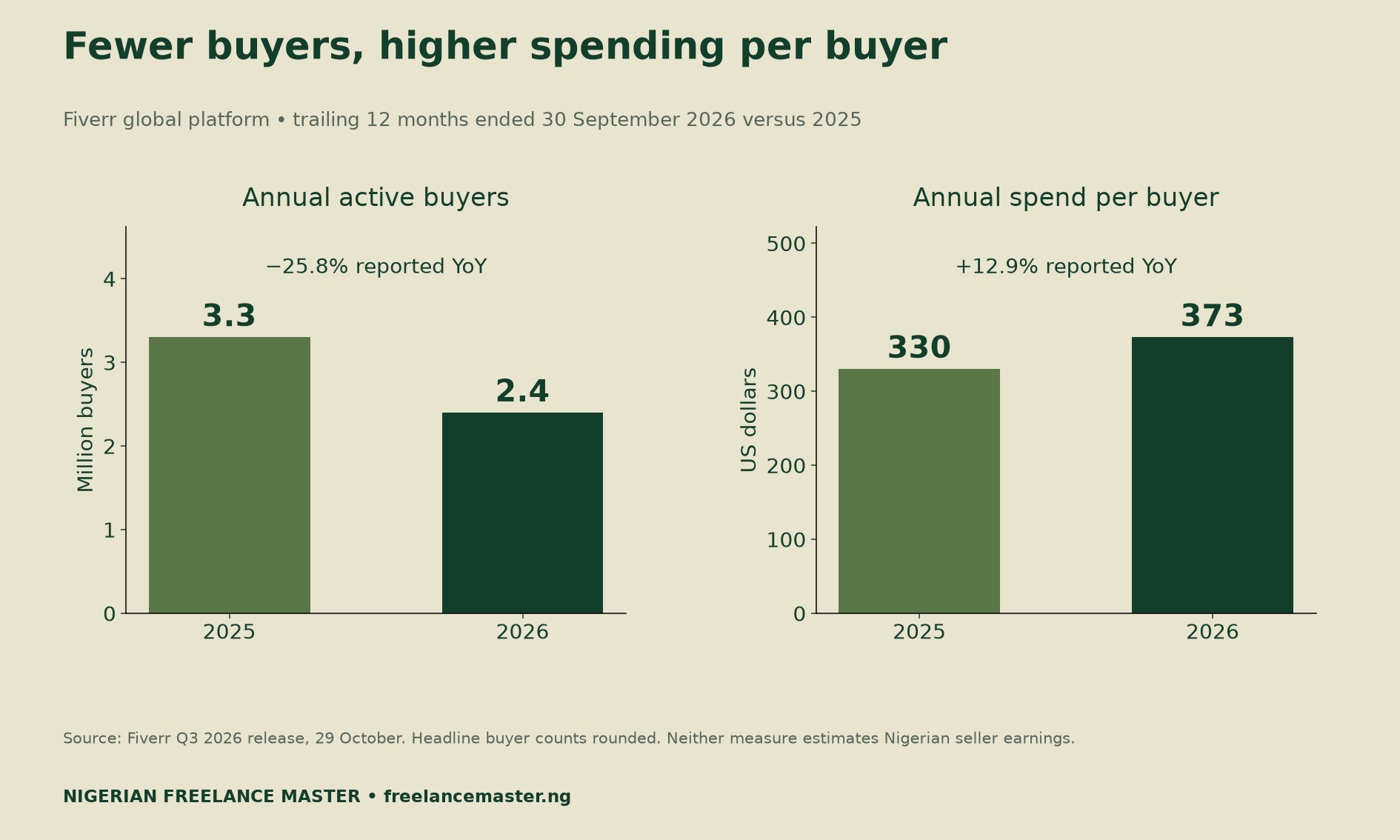
Fiverr’s 29 October earnings release reports 2.4 million annual active buyers, down 25.8% year on year. Annual spend per buyer rose 12.9% to US$373. These annual measures cover the trailing twelve months to 30 September.
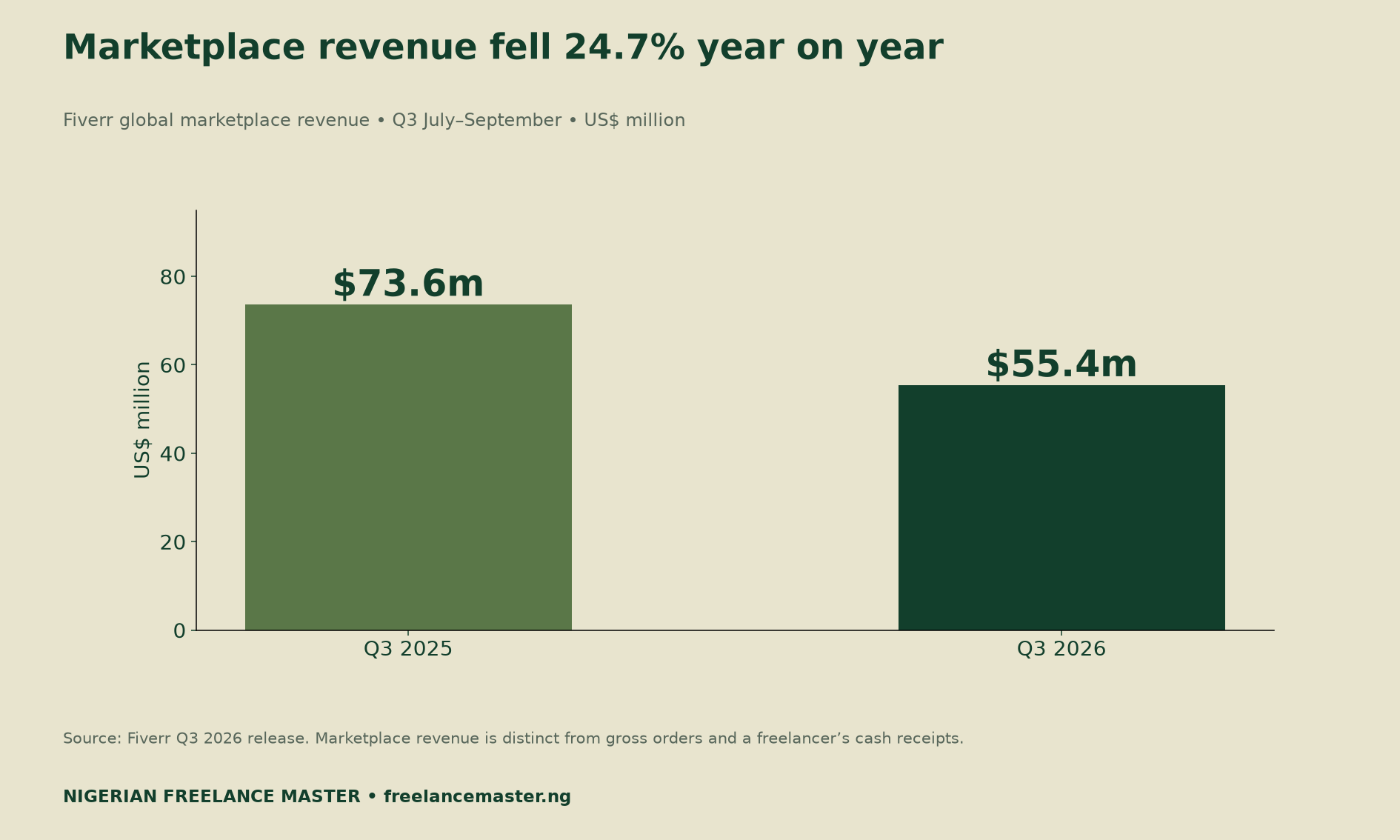
Marketplace revenue in Q3 was US$55.4 million, down 24.7% from a year earlier. That revenue belongs to the marketplace business. It is a different measure from money that a seller receives.
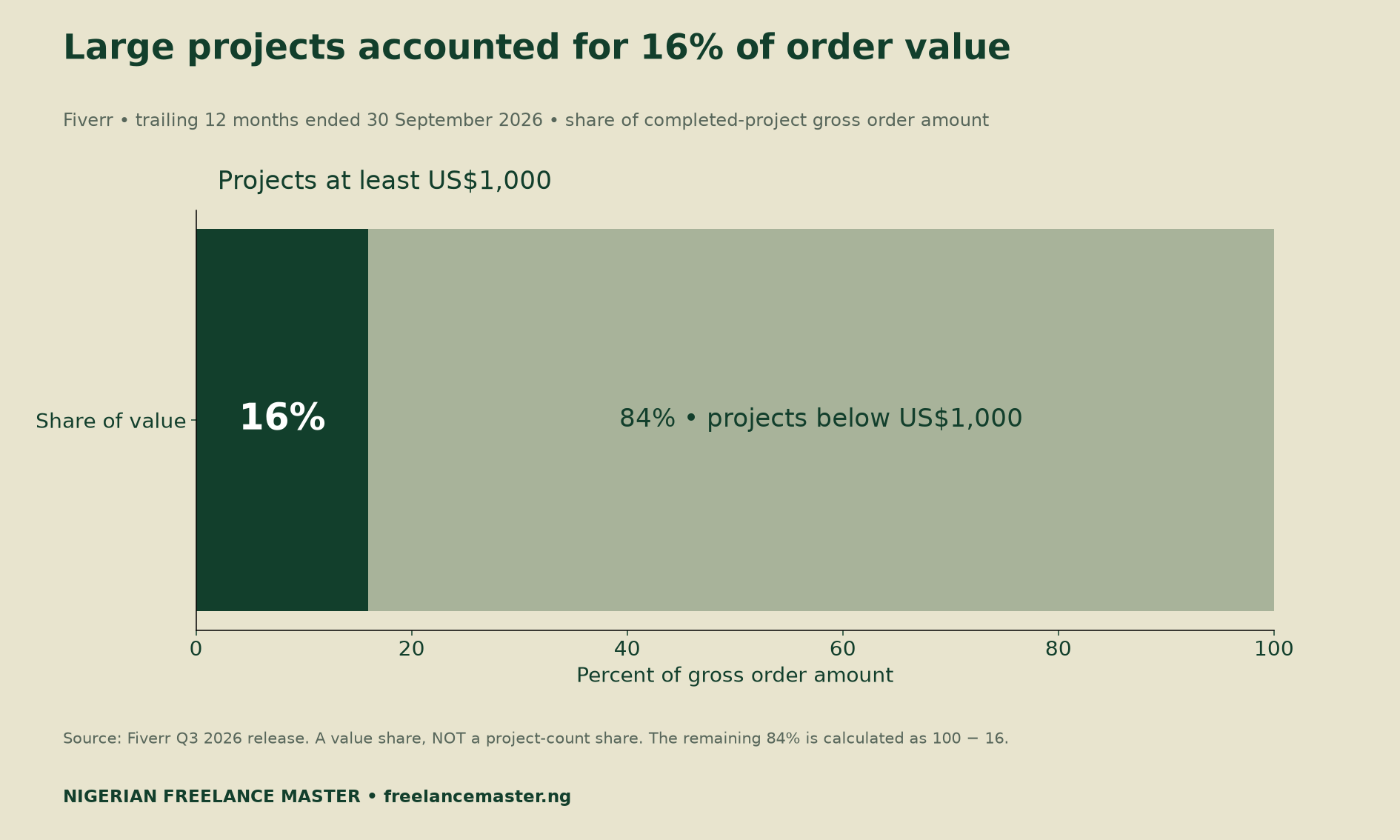
Projects worth at least US$1,000 accounted for 16% of completed-project gross order amount over the trailing year. This is a share of value, not a share of project count. None of these figures provides a Nigerian seller-income breakdown.
Why buyer spending cannot set your prices
A platform average cannot reveal whether your own buyer has a larger budget. A copy editor, animator and software specialist may face very different buyers and project scopes. Consequently, use your own completed work to test whether a service remains worthwhile.
Nor should you turn the marketplace take rate into a personal seller-fee assumption. Record the actual charges and payout for your transactions. If your receipts already exclude a fee, do not subtract that fee again.
For a Nigerian business, currency also matters. Keep each currency separate or document the actual conversion into your reporting currency. A change in exchange rates can alter naira receipts even when foreign-currency sales stay flat. We apply no assumed exchange rate in this audit.
Build a 90-day channel ledger
Choose a fixed start and end date. Then list every completed project and the source through which you first won that client. Use a private client identifier, rather than a name or email address. Do not upload the completed sheet publicly.
For each project, enter the billed amount, money actually received and direct delivery expenses. Also log acquisition hours and delivery hours. Researching leads, writing proposals and attending unpaid discovery calls use time even when they do not generate an invoice.
Keep the scope consistent. A completed-project ledger helps compare delivery economics. A separate cash calendar can track receipts from older projects and payments still outstanding. Mixing those two populations can produce a misleading channel share.

Next, group the ledger by acquisition channel. Calculate each channel’s share as its actual receipts divided by total actual receipts in the same currency and scope. Where total receipts are zero, leave the share undefined and explain why. Zero income is not a zero-percent dependence finding.
Finally, calculate your largest-client share using private client IDs. A channel can look diverse while one client supplies most of its work. Keep channel concentration and client concentration as separate checks.
Calculate contribution per hour carefully
Effective contribution per hour = (actual receipts − direct delivery expenses) ÷ (acquisition hours + delivery hours). This is a planning measure, not a full profit calculation. Rent, tax, equipment replacement and other overheads may remain outside it.
Use expenses that you have not already deducted from receipts. For example, a payout net of a transaction fee already reflects that charge. Also retain unsuccessful acquisition time in a separate channel log; otherwise, a completed-project view will understate the time needed to win work.
If recorded hours are zero or incomplete, leave the hourly result blank. Do not replace missing time with zero. You can still identify the channel’s cash exposure while marking the hourly comparison as unavailable.
Stress-test Fiverr income risk without predicting it
Suppose, purely for illustration, that one channel supplies 70% of your receipts. If receipts from that channel fall by 20%, total receipts fall by 14%, provided all other receipts stay unchanged. The calculation is 0.70 × 0.20 = 0.14.
That example does not apply Fiverr’s buyer decline to seller earnings. It tests a chosen scenario. Your orders, prices, buyer mix, delivery capacity and other channels could move differently.
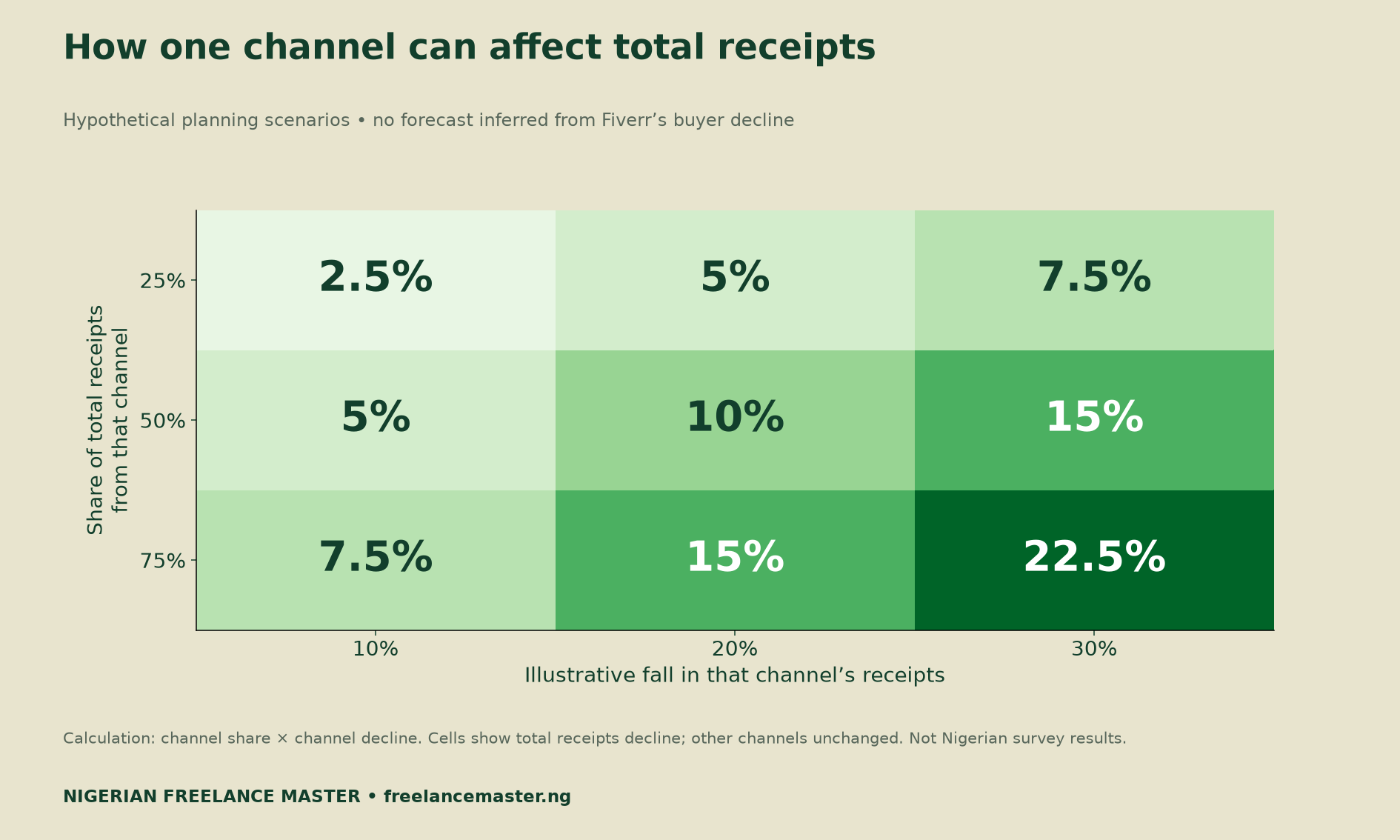
The grid shows why exposure matters alongside a market headline. With a 25% channel share, the illustrated declines produce total falls of 2.5%, 5% and 7.5%. At a 75% share, the same scenarios produce 7.5%, 15% and 22.5%. These are arithmetic outputs, not surveyed outcomes.
Find the weak point before changing channels
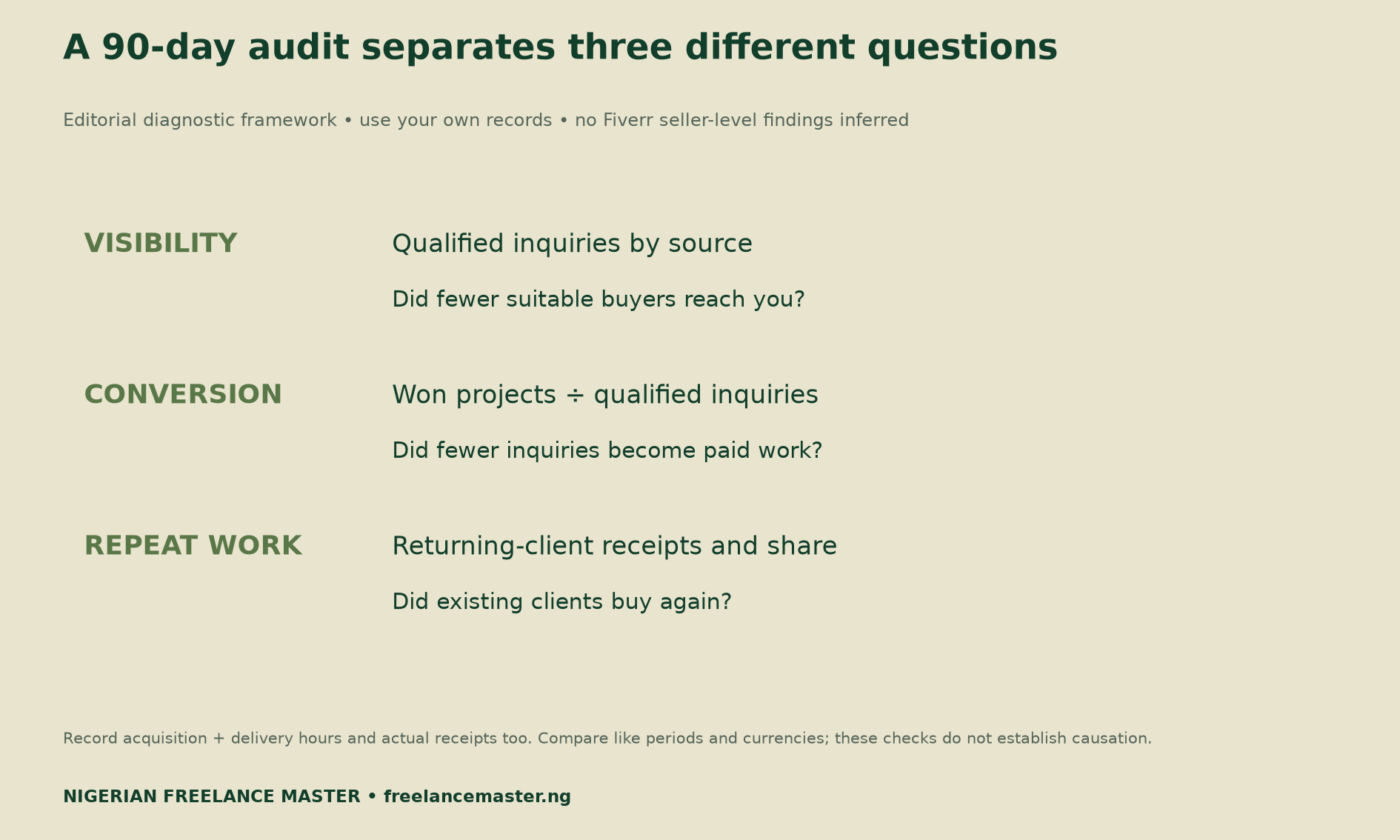
Begin with visibility. Count qualified inquiries by source across comparable periods. Define a qualified inquiry before counting, so a burst of irrelevant messages does not look like stronger demand.
Then examine conversion. Divide won projects by qualified inquiries for a clearly defined inquiry cohort. If projects take weeks to close, allow the cohort enough time to mature. Do not compare this week’s inquiries with unrelated projects completed this week.
Finally, check repeat work. Track returning-client receipts and the share of projects from returning buyers. A growing repeat share can reflect better retention, fewer new clients, or both. Read the counts alongside the share.
A delivery issue can also interrupt repeat purchases. Our guide to handling client delays helps you review the workflow. For the relationship side, see earning repeat work from Nigerian freelance clients. Use those checks alongside your ledger, not as substitutes for evidence.
Choose one measurable experiment
Select an experiment that addresses the weak point you observed. If suitable inquiries fell, test one new acquisition activity with a fixed time budget. If conversion weakened, review whether your offer states the scope and acceptance conditions clearly. For repeat work, test a useful follow-up after successful delivery.
Write down the start date, time budget and review date. Compare qualified inquiries, paid work and contribution after the review window. A small experiment may be inconclusive; record that outcome instead of forcing a success story.
Keep platform rules and client agreements in view. Diversification does not require moving existing platform clients elsewhere in breach of the applicable terms. Build permitted new sources of work and assess their costs honestly.
Download the data and audit tools
Reported Fiverr measures (CSV) contains the four observations, periods, units and caveats used here.
Blank 90-day channel audit (CSV) supplies project, receipt, expense and time fields. Blank rows are deliberate; the file contains no observed freelancer results.
Hypothetical channel stress scenarios (CSV) includes the nine grid cells and the separate 70% exposure example. Percentages are stored as percentage values, so 70 means 70%.
Methodology and limits
We checked the original release on 31 October 2026 and retained its reference periods. The figures use reported growth rates because rounded headline values may not reproduce the precise change. The remaining project-value share is 100% minus 16%.
Our original contribution is the audit structure, diagnostic framework and reproducible sensitivity calculation. We did not survey Nigerian sellers, measure platform-category demand or estimate anyone’s future income. No seller-level result, causal effect or recommended rate follows from this report.
Suggested citation: Nigerian Freelance Master, “Fiverr Income Risk: A 90-Day Audit for Nigerian Freelancers,” 31 October 2026. Credit Fiverr for the source measures and identify our scenarios as hypothetical when reusing them.