




AI orchestration freelance services can be easier to explain when you name the problem, deliverable and acceptance test. For Nigerian freelancers, that is a more useful starting point than promising broad “AI expertise.” A fresh US survey helps frame the opportunity, but it does not measure Nigerian demand.
This report translates selected findings into three bounded service packages: workflow mapping, output-quality evaluation and performance reporting. It includes five figures, a service matrix and a blank 30-case evaluation register. The register is a proposed demonstration, not a completed benchmark.
Research checked 31 October 2026. Survey fieldwork: August–September 2026. No freelance rates, Nigerian hiring totals or personal earnings are estimated.
What the new Upwork survey actually measures
Upwork’s 27 October study surveyed 750 US-based business leaders at director level or above. McGuire Research conducted the fieldwork in August and September. Among foundational organisations, 72% said AI increased their need for freelance or contingent talent; the share was 90% among advanced organisations.
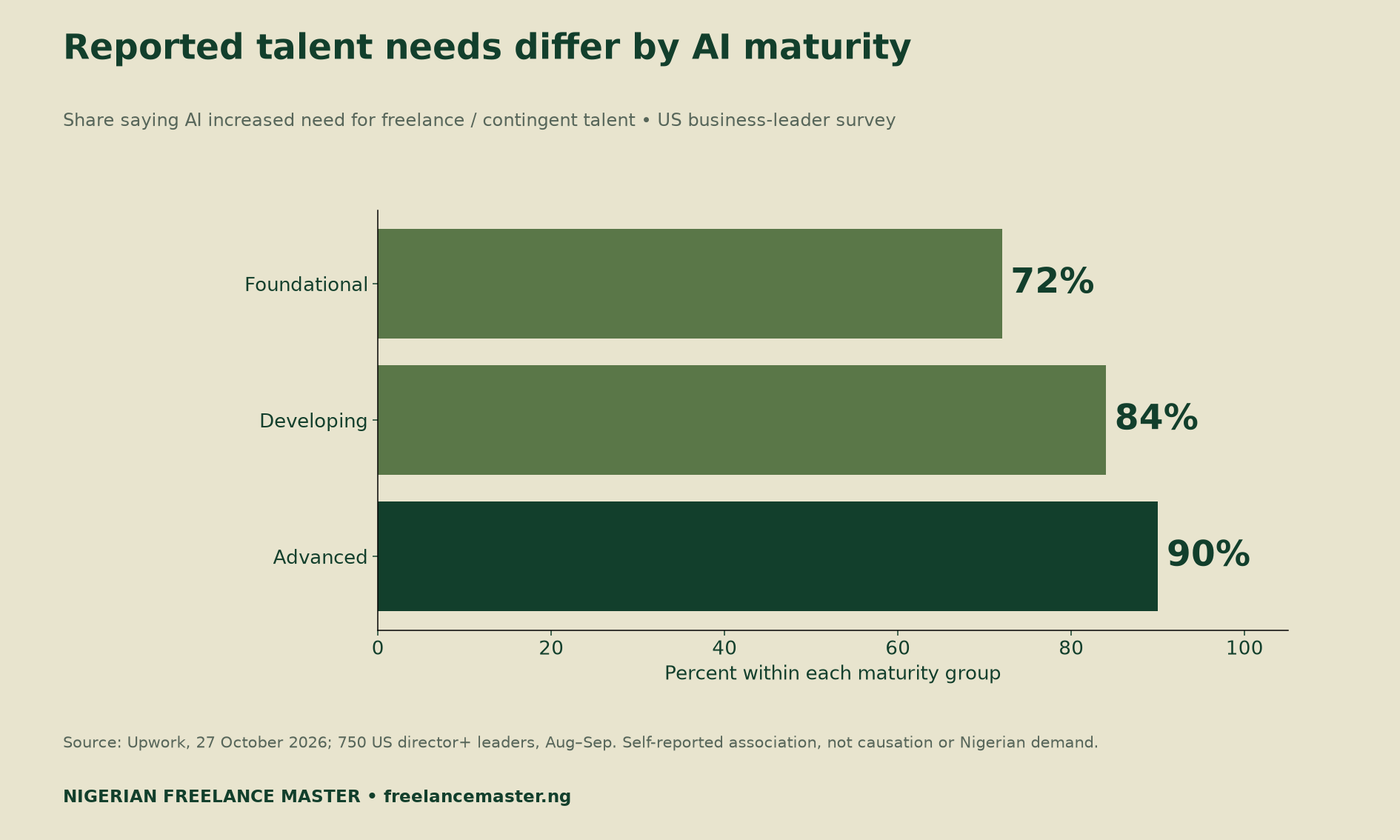
Overall, 70% favoured combining employees with flexible talent for major AI initiatives. Selected orchestration responsibilities included identifying suitable workflows (57%), validating outputs (48%) and measuring impact (45%). These responses describe reported needs, not completed freelance contracts.
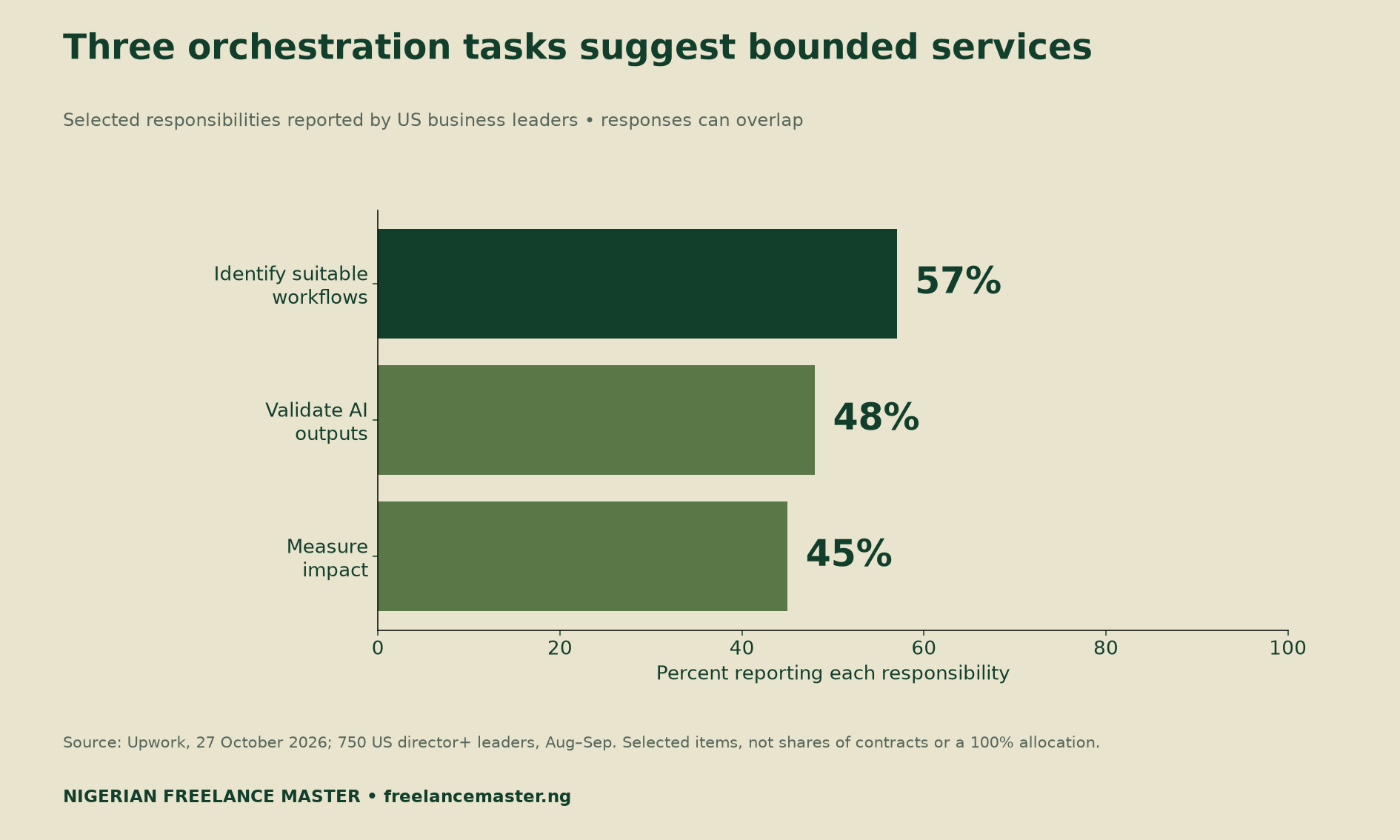
The study is commercially sponsored and self-reported. Its groups were not randomly assigned. Consequently, it cannot establish that greater AI maturity causes more freelance hiring, or that a Nigerian freelancer can charge a particular rate.
Define AI orchestration freelance services in plain language
Think of orchestration as coordinating the work around an AI tool. Someone must decide which inputs are suitable, where a human checks the output and what happens when a task fails. A client also needs a way to judge whether the revised process helps.
Those activities require different skills. An operations specialist may be able to document a process without being qualified to connect production systems. An evaluator may test an agreed rubric without being competent to make legal or clinical decisions. Set the boundary before describing the service.
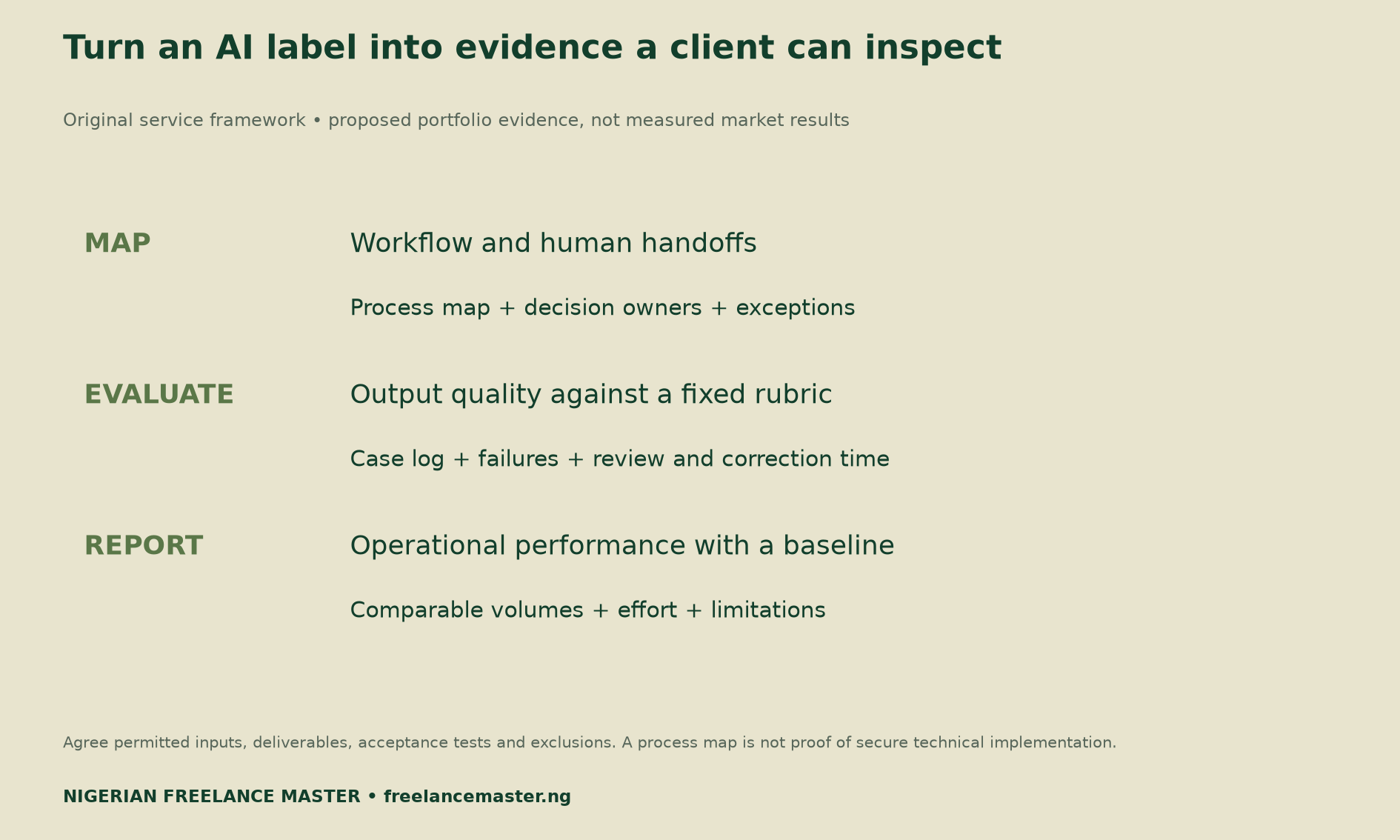
Service one: map a workflow and its review points
Start with a narrow process, such as sorting fictional incoming requests into a few operational categories. Map the existing inputs, decisions, handoffs and outputs. Then identify which steps might benefit from assistance and which require a named human owner.
A useful deliverable contains the process map, input requirements, exception routes and an approval checklist. For each step, state who supplies the information and who accepts the result. The client should be able to follow one request from arrival to completion.
An acceptance test could require every mapped step to have an input, output, owner and exception route. Ask the client to walk through a routine case and a missing-information case. Record unresolved questions instead of silently filling gaps with assumptions.
Exclude production integration, access-control design and security certification unless you have the required competence and explicit scope. A clear map can inform a technical partner’s work. It does not prove that the resulting system will be secure or compliant.
Service two: evaluate outputs against an agreed rubric
The client’s problem may be inconsistent output quality rather than an absence of AI tools. In that case, define what an acceptable output must contain. Include facts that must remain unchanged, information that cannot be invented and situations requiring a human decision.
Build a small synthetic case set before using client material. Our proposed register contains ten routine requests, ten missing-information requests and ten difficult exceptions. These are chosen test-design counts, not observed output results.
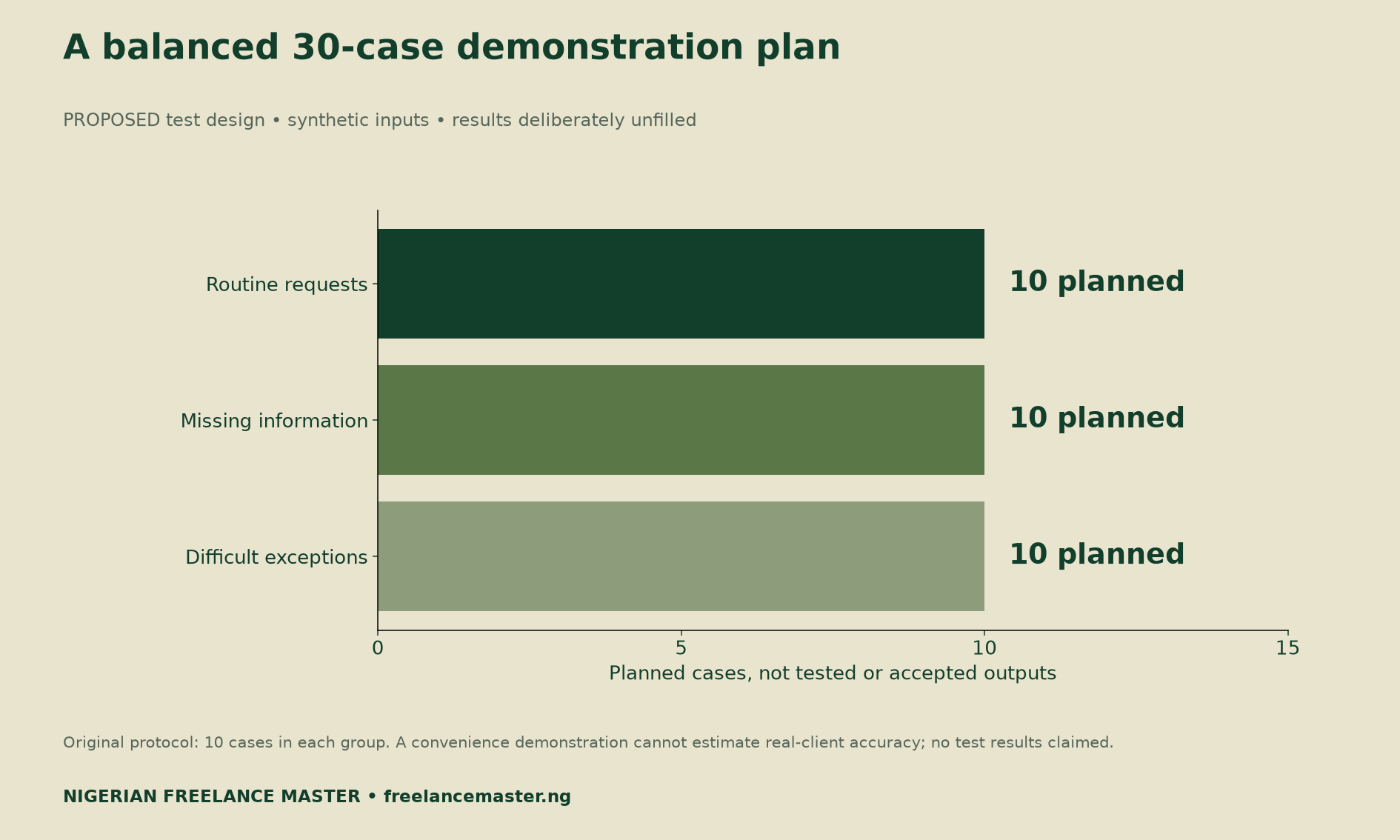
Write the expected outcome before running each case. For missing information, an acceptable response might ask for clarification instead of guessing. For an exception, the correct action might be to stop and route the request to a person.
Next, record the observed output, acceptance decision and reason for any failure. Capture human review and correction time separately. Retain failed attempts and retries, since excluding them would make the workflow appear more efficient than it was.
The downloadable register deliberately leaves outcome and timing fields blank. “Not tested” is a status, not a failure or a pass. Populate those fields only after you actually run the test and retain enough evidence to reproduce the decision.

Service three: report performance without hiding effort
A client may need help understanding whether an operational change works. Offer a reporting method with a baseline, consistent definitions and a clear observation window. Establish the volume of work and quality requirement before comparing methods.
Acceptance rate = accepted outputs ÷ evaluated outputs. State both counts alongside the percentage. Leave the result undefined when no cases have been evaluated. Do not turn a planned 30-case register into a claim of 30 successful cases.
Also report total review minutes and correction minutes. A high acceptance rate can still require substantial human effort. Include preparation, retries and necessary administration when comparing the whole workflow with an existing process.
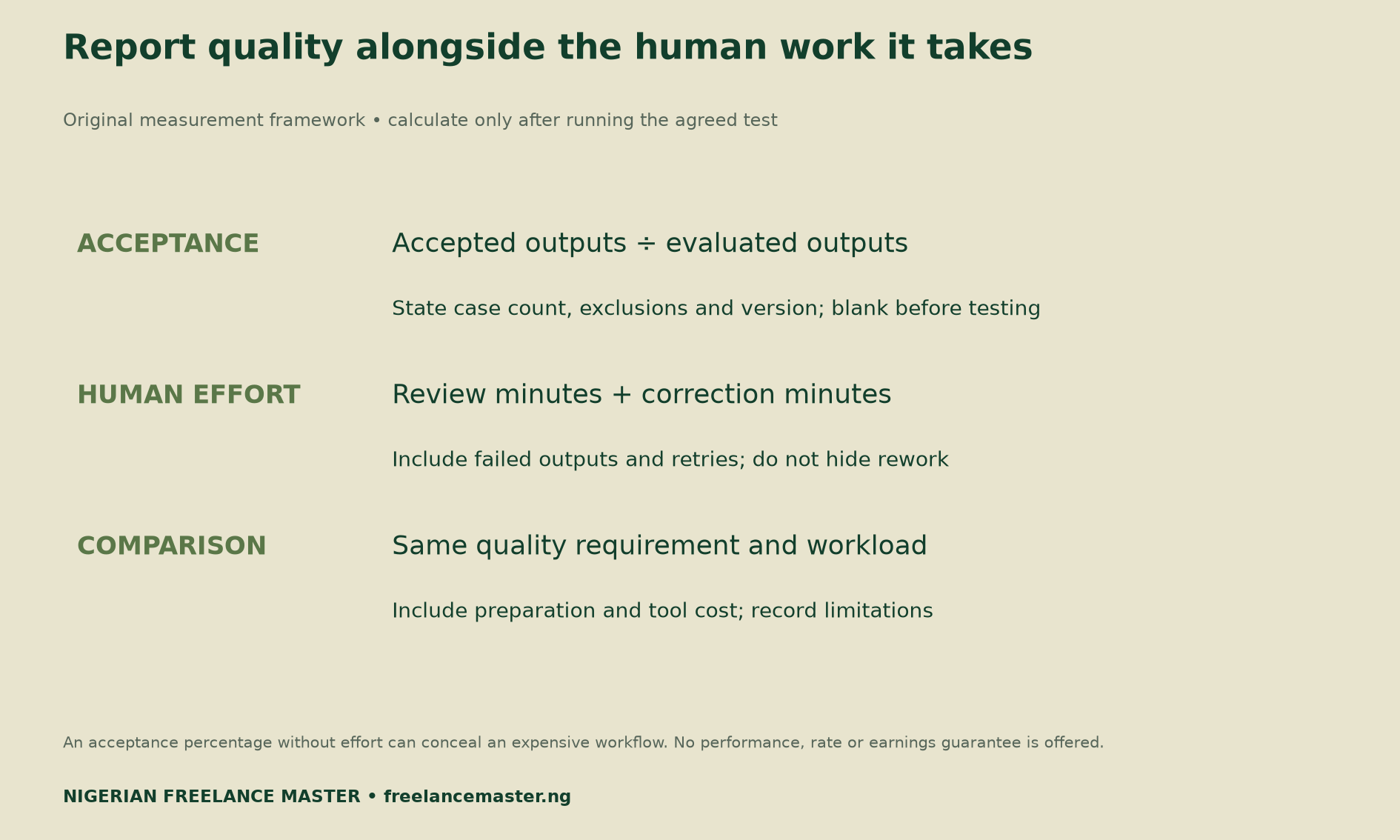
If the client changes tools, case types or acceptance requirements during the pilot, document the change. A simple before-and-after comparison cannot isolate every cause. Describe it as an operational observation rather than proof that the tool caused a business outcome.
Build a demonstration you can show safely
Choose one service that matches skills you can already demonstrate. A former administrator might begin with a process map. Someone with strong subject knowledge may focus on checking outputs within that competence. A reporting specialist might document definitions and reconcile a small synthetic dataset.
Use fictional names, invented requests and non-sensitive material. Keep the demonstration small enough to inspect from beginning to end. Do not copy private client files into a portfolio or an AI tool without appropriate permission and safeguards.
Our guide to creating case studies without breaking an NDA offers a separate confidentiality check. For positioning, read turning industry knowledge into freelance opportunities. Neither removes the need to check the actual client agreement.
Show the artefact, the acceptance conditions and the limitations together. A polished screenshot alone provides little evidence of judgement. A short explanation of a failed case and its correction can make the work easier for a client to assess.
Write a bounded offer before choosing a price
Describe the client problem in one sentence. Then state permitted inputs, the deliverable, the review process and what is outside scope. Agree who supplies domain knowledge and who can approve changes. Avoid promising a business result that your service cannot independently control.
For example: “I will map this one request-handling workflow and document its human review points using synthetic examples.” That offer is easier to verify than a claim to automate an entire business. Add a defined revision limit and a completion condition suited to the actual project.
Only then estimate preparation, delivery and review time. This report supplies no recommended Nigerian rate or earnings premium. The related 90-day channel audit can help you record actual receipts and time once you deliver work.
Download the research and demonstration tools
Selected Upwork survey measures (CSV) retains the reported percentages, fieldwork, overall sample and scope caveats.
Service-to-evidence matrix (CSV) lists each proposed package’s problem, demonstration, acceptance test and exclusions. Adapt it to your competence and the client’s actual needs.
Blank 30-case evaluation register (CSV) supplies routine, missing-information and exception rows. Add synthetic inputs and expected outcomes first; outcome and timing fields remain empty until testing.
Methodology and limits
We checked the original research and methodology on 31 October 2026. Survey percentages are reported values. We did not multiply subgroup percentages by the full sample to invent subgroup counts. Selected responsibilities overlap and must not be summed into a market share.
Our original contribution is the service framework, acceptance conditions and proposed evaluation protocol. No demonstration was run for this report. A future 30-case convenience test would still be a personal workflow assessment, not a representative accuracy benchmark.
Suggested citation: Nigerian Freelance Master, “AI Orchestration Freelance Services: A Nigerian Guide,” 31 October 2026. Attribute the survey measures to Upwork and describe the matrix and test register as our original proposed tools.