




Skilling Africa with Google gives Nigerian freelancers a new starting point for training research. The useful question is which learning route supports a task you need to perform—and what access, time, assessment and charges actually apply to that route.
Google announced the hub on 2 November 2026. We checked its public pages and three official programme listings on 6 November. This guide adds a course-selection scorecard, a proposed before-and-after practical task and transparent fictional time-value calculations.
We did not complete a course, enrol in a programme, reserve a webinar or test offline learning. The public hub describes its offering, but its full learning catalogue sits behind sign-in. The comparison below uses identified official programme pages rather than pretending we audited every course inside the new hub.
Separate launch targets from measured outcomes
Google’s launch announcement says the hub brings together more than fifteen initiatives. It sets a goal of equipping three million people by 2030 and separately describes earlier foundational training reaching more than seven million young Africans.
Those are different kinds of claims. One is a future goal; the other is a provider’s historical reach statement. Adding them would not establish ten million distinct people trained, because the periods, definitions and possible overlap differ. Neither number measures Nigerian freelance earnings.
The public hub homepage also advertises more than 175 courses and free learning. We verified that wording on the page. We did not count the signed-in catalogue, verify every credential or inspect every linked programme’s transaction terms.
Our claim register preserves these distinctions. A launch date, a learning target, a catalogue claim and a paid-work outcome should not share one results column. If a provider later publishes completion or employment data, check its population and method before connecting it to this guide.
Skilling Africa with Google: begin with a real skill gap
Write down a deliverable before choosing a course. “Learn AI” is too broad to assess. “Explain where an AI drafting tool could introduce unsupported claims into a supplied product brief” is more specific and creates a practical check.
Likewise, a data task might involve cleaning a synthetic sales table, documenting assumptions and explaining an appropriate chart. A business-learning task might involve developing a bounded service description and a measurement plan. These are editorial examples, not official programme assignments.
Choose a gap within your competence and permissions. Training does not grant access to a client’s systems or authorise regulated work. A practice task can use invented or openly licensed material while you learn, without exposing confidential client information.
Our business-client research guide offers a related discipline: keep an observed fact separate from a hypothesis. A course title is a starting signal. You still need evidence that its content addresses your actual gap.
Compare three different learning routes
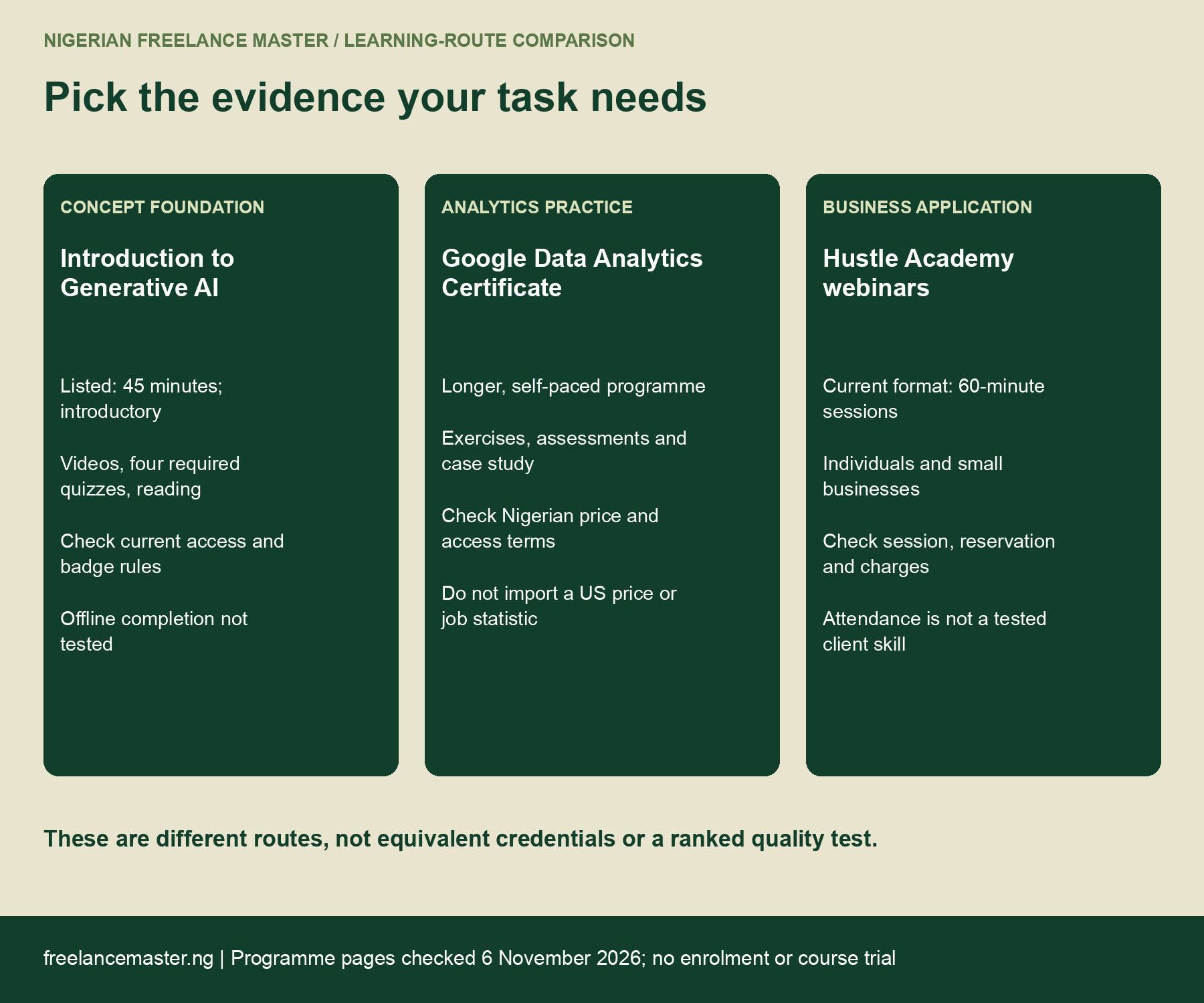
The routes below vary in purpose and commitment. They are not three equivalent credentials, and this is not a ranking based on completed course trials. Each comparison field records what the official pages support and what remains unverified.
A short conceptual route: Introduction to Generative AI
The Google Skills listing describes an introductory course with a listed duration of 45 minutes. Its visible contents include videos, four required quizzes and a reading. The page advertises a badge; that wording should not be expanded into a professional certification claim.
Google’s training announcement describes this particular introduction as no-cost. That older announcement is useful background, while current account and course terms still deserve checking. It also distinguishes introductory learning from deeper technical paths that can require credits.
This route may fit a conceptual gap, such as distinguishing generative AI from other machine-learning approaches. Completing an introduction would not by itself demonstrate production engineering ability. We have not tested the lesson, its offline behaviour or its badge-claim process.
A longer applied route: the Data Analytics Certificate
Google’s Sub-Saharan Africa certificate page says relevant experience is not required and describes self-paced online study in under six months. The linked Coursera programme page describes practical activities, assessments and a case study.
These are provider workload descriptions, not a promise about your completion speed. Tool access, practice, revision and your starting knowledge affect the real commitment. A multi-month certificate should not be compared with a 45-minute introduction as if both answered the same learning question.
The exact Nigerian certificate price was not verified in this review. Google’s cost explanation directs learners outside the US and Canada to local Coursera enrolment options. An overseas subscription amount should not be converted into a Nigerian quote without checking the actual offer.
An “enrol for free” button does not establish that every assessment, certificate or continuing subscription costs nothing. Check the charge scope, trial conditions, renewal and any scholarship terms before committing. No payment method or subscription was added during our research.
A live business route: Hustle Academy webinars
The current Hustle Academy agenda says its programme has evolved into shorter, practical 60-minute expert webinars. It is open to individuals and small businesses across Africa. The checked agenda includes a marketing-strategy-with-AI session on 10 November.
That listing gives the session as 13:00–14:00 SAST. Since SAST is one hour ahead of West Africa Time, that corresponds to 12:00–13:00 WAT. Recheck the agenda and the reservation confirmation before planning attendance; a listed session can change.
Google’s Africa overview calls Hustle Academy free but still describes an older week-long bootcamp format. We therefore retain the current agenda’s shorter format and mark session-specific charges, assessment and credential terms as unverified where they are not displayed. Do not merge different programme versions into one guaranteed offer.
A webinar may help you consider a business method. Attendance alone does not demonstrate that you can deliver a client-ready service. We did not reserve a place or independently test the teaching quality.
Check what free access actually covers
Use separate fields for the hub, the linked course, assessments, a completion badge, a professional certificate and any lab resources. A zero charge for one does not establish zero charges for all the others. Keep cash fees distinct from the value of your time.
Also record the currency, billing period and cancellation conditions when an actual offer is shown. A monthly amount is not necessarily a full completion cost. A scholarship may have eligibility limits, while a trial may become a paid subscription later.
For this review, the Nigerian analytics-certificate price remains unknown. That is a real evidence gap, not a zero. Our comparison worksheet leaves room for you to enter the dated offer you actually see, without treating your result as a universal price for all Nigerian learners.
The hub’s launch announcement describes downloadable short lessons and offline capability. We did not test that feature. Nor did we establish that the separate Coursera programme or a live webinar can be completed offline merely because the hub advertises offline lessons.
Count study time without calling it a fee
Imagine a freelancer assigning twelve study hours a chosen value of ₦3,000 per hour. The product is ₦36,000. Both inputs are fictional teaching assumptions, not measured Nigerian freelancer data or a recommended hourly rate.
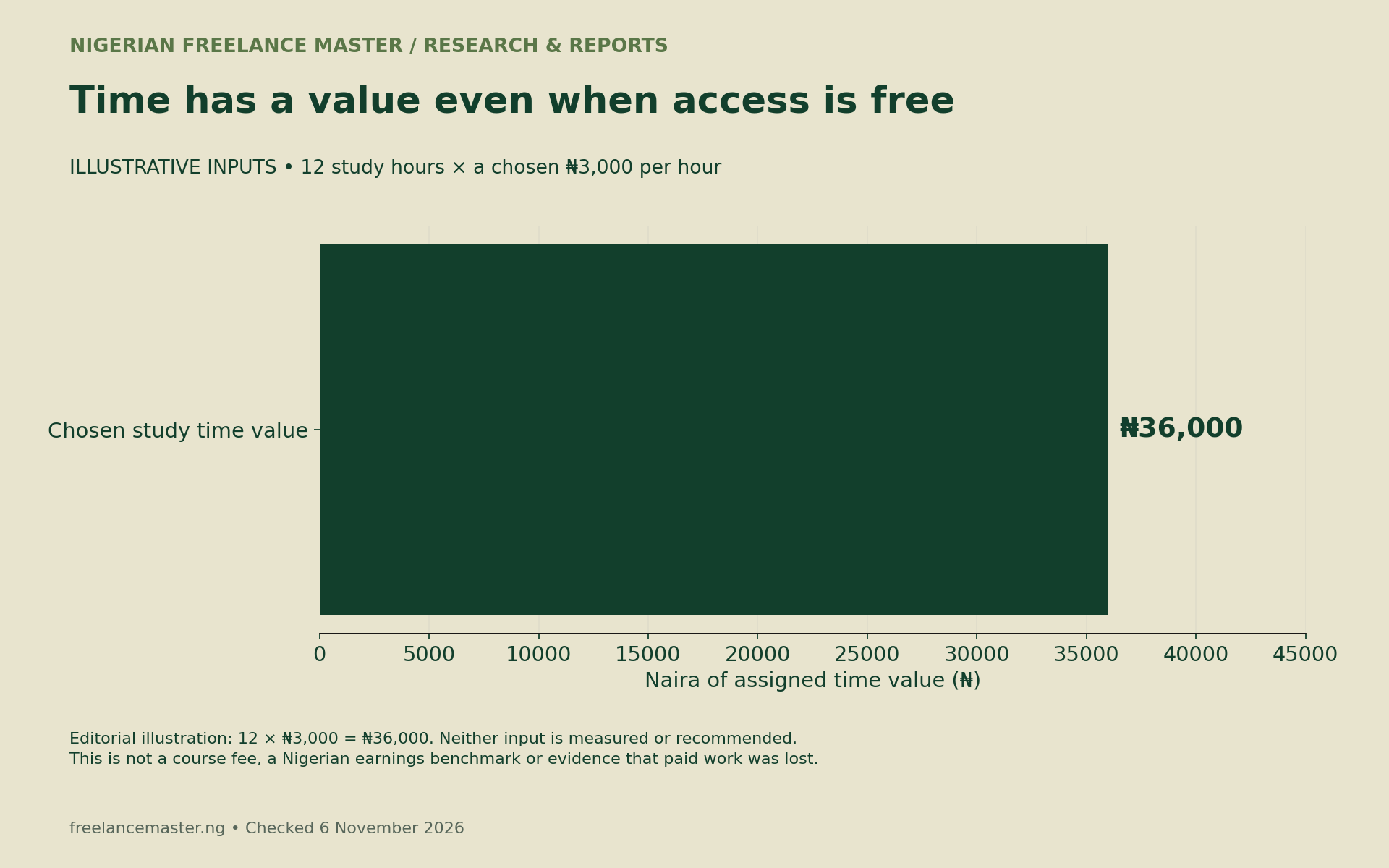
The calculation can help you notice a commitment. However, it does not prove that twelve hours of paid work were available and lost. Actual opportunity cost depends on what you would otherwise have done, and that alternative may be uncertain.
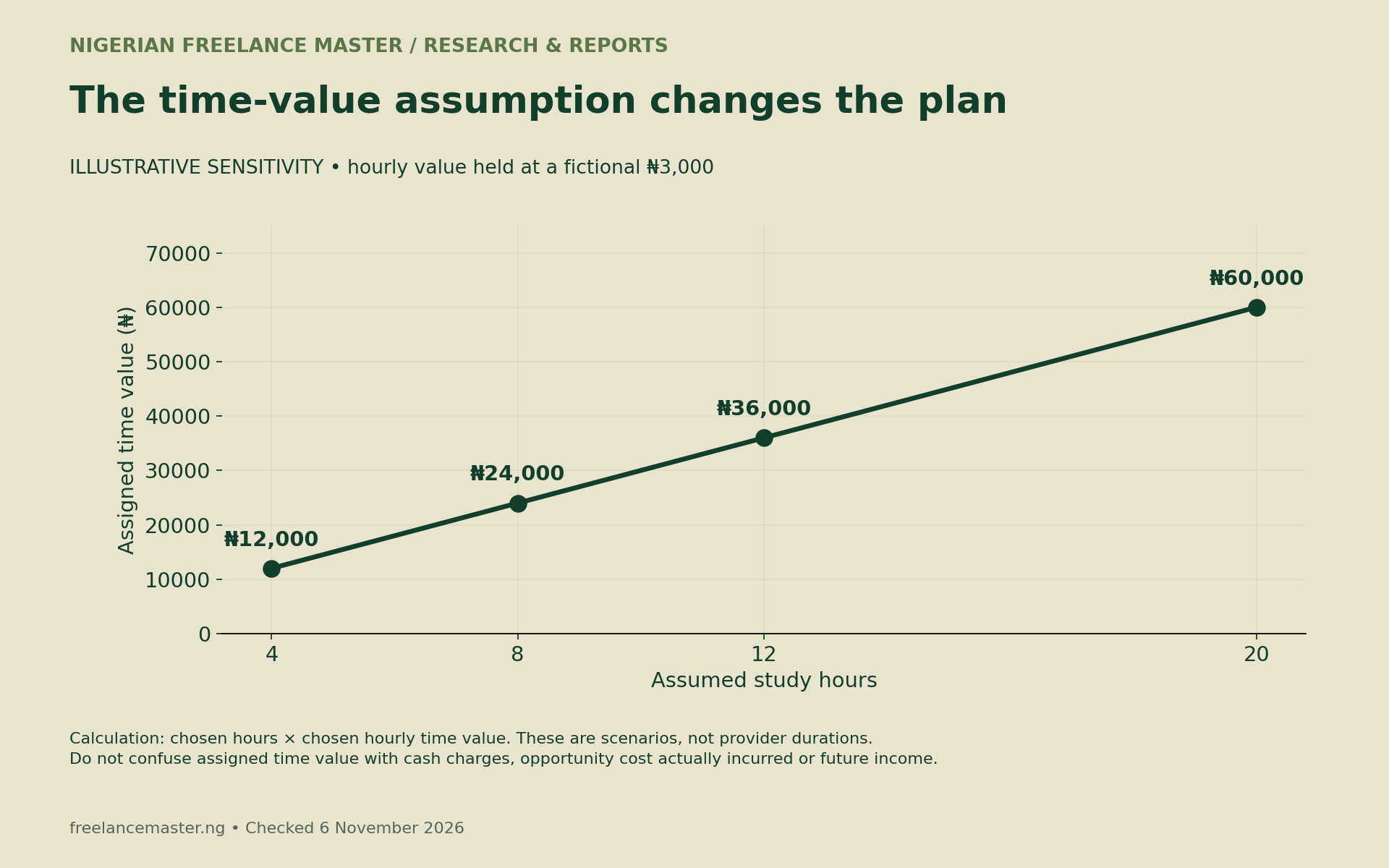
If the chosen hourly value stays fixed, four hours gives ₦12,000, eight gives ₦24,000 and twenty gives ₦60,000. These are sensitivity scenarios, not official course durations or forecasts of future income.
Our internet-data budget guide helps structure actual connectivity records. Measure your own downloads and calls rather than presenting an invented data allowance as a course requirement.
Reserve time for application and review
A fictional twelve-hour plan could allocate four hours to study, five to a practical task and three to review and revision. That split is an editorial proposal. It is not the official workload of any route compared here.
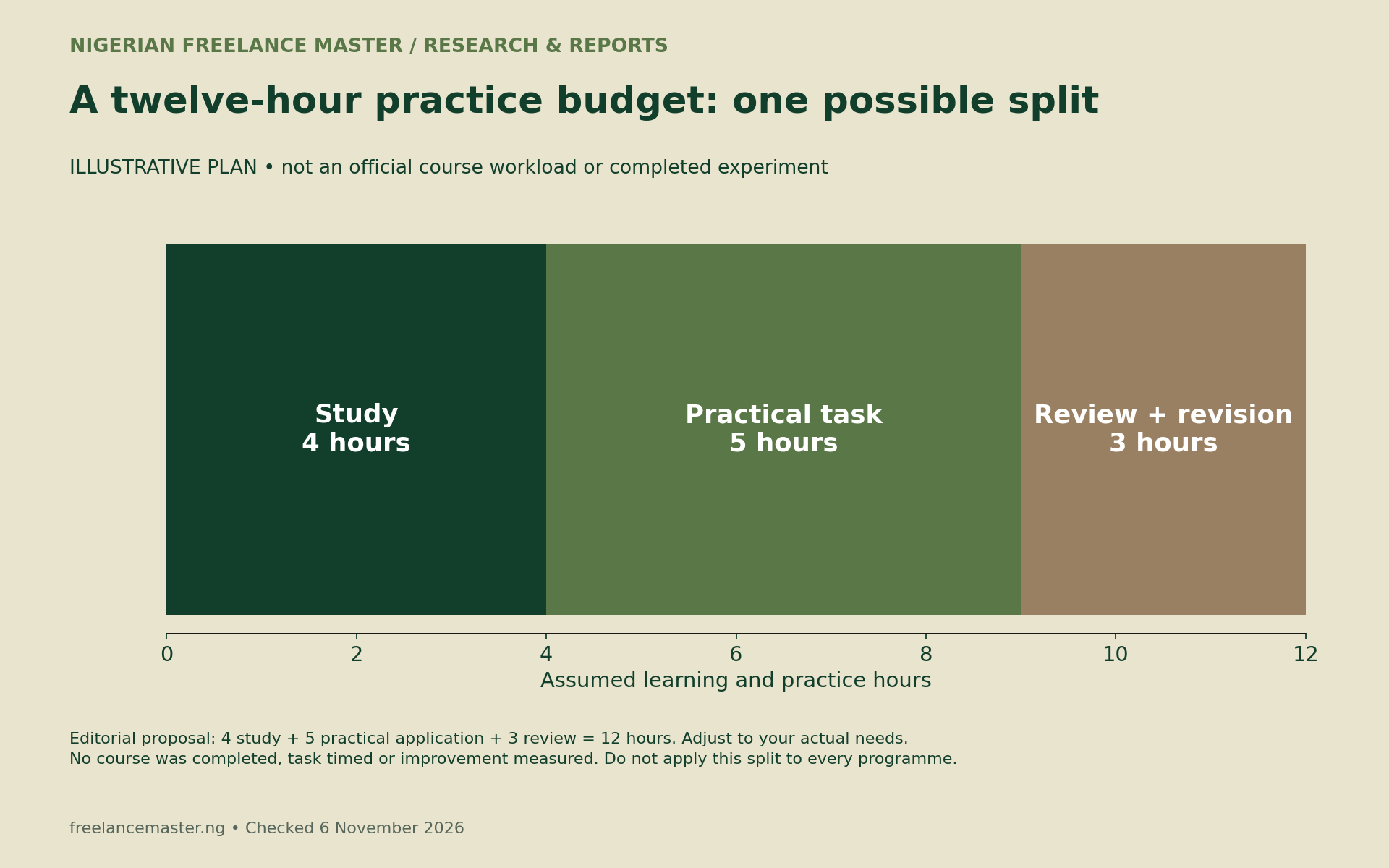
The purpose is to avoid treating video completion as the entire learning process. A task may reveal a gap that requires another lesson. Review may also show that you cannot yet explain an output or reproduce it without assistance.
Record actual time separately when you begin. If your plan changes, preserve the original assumption and explain why. Do not rewrite an untested plan as if it were measured evidence of training efficiency.
Predefine a before-and-after practical task
Choose permitted inputs and the same acceptance checks before looking at results. For a synthetic-data task, you might check factual accuracy, completeness, reproducibility and whether the explanation distinguishes observation from assumption. For a business task, adapt the checks to the deliverable.
Our downloadable task sheet has six proposed checks and leaves both result columns marked NOT_RUN. No improvement score has been invented. A learner can replace those markers only after performing the task and retaining the supporting work.
Use comparable conditions for a repeat attempt. Record any help, tools, time limits or material changes. If the second task is easier or uses different inputs, do not attribute every improvement to the training.
Even a stronger second attempt is a small personal learning observation. It does not establish causation, client demand or an earnings increase. A credential and a permitted work sample can serve different purposes; describe each accurately.
Download the comparison and planning tools
- Launch-claim register (CSV) separates future targets, historical reach and untested access claims.
- Three-route evidence comparison (CSV) records official URLs, entry expectations, time, charge limits, assessment and offline status.
- Blank training-selection scorecard (CSV) provides three named routes with empty fields for your dated checks.
- Before-and-after practical-task checks (CSV) contains six proposed rules with results explicitly not run.
- Fictional time-value scenarios (CSV) preserves the assumed hours and chosen hourly value behind the charts.
Use the scorecard to select what you need to verify next. An unresolved price or device requirement may justify holding a decision. Do not force every route into a numeric total when the underlying evidence is missing or the learning goals differ.
Sources, method and limitations
We inspected the public hub, its sign-in gate, the Google Skills course contents, the regional certificate page, the linked Coursera description and the current Hustle Academy agenda. We also checked Google’s launch, fee and training explanations. The source register retains page snapshots and distinguishes current listings from older context.
No course was completed, lesson downloaded for an offline test, credential claimed or learning outcome benchmarked. We did not verify every course in the signed-in hub. The three numeric figures are explicitly fictional planning calculations; the separate comparison infographic explains observed programme differences and unverified fields.
The featured image is AI-assisted conceptual artwork of a freelancer comparing learning materials and practical evidence. It depicts no real learner, Google interface or awarded certificate. Cite Google and the named programme pages for their stated terms, and Nigerian Freelance Master for the scorecard and original planning tools. Our original visuals and worksheets may be reused with attribution and a link to this article; source material retains its own terms.