




Finding Nigerian business clients starts with evidence about a business, not a promise hidden inside a vacancy headline. NISER’s newly released hiring report offers a useful research starting point. However, a company advertising an employee role has not automatically invited freelancers to sell it a service.
The report was published on 1 November 2026 and covers April–June 2026. Its sample contains 660 advertisements from The Guardian, The Punch and The Nation. This guide explains the denominators, then provides a blank 20-company prospect register for your own investigation.
We have not contacted companies, tested a sales campaign or identified twenty qualified buyers. The register is an original planning tool. Its purpose is to separate an observed business signal from a service hypothesis and an actual buying route.
What NISER counted—and what it did not
The NISER publication page links to the full Q2 report. It examines advertisements in three newspapers, rather than all vacancies, hires or freelance contracts in Nigeria. Its own limitations note that online and other newspaper openings can be missed.
This distinction changes how you use the research. An advertisement records an employer’s published recruitment message. It does not confirm that someone was hired, that the employer has a procurement budget, or that the work can be purchased from an external specialist.
A single organisation can also advertise several roles. Therefore, 660 ads should not become 660 companies in a prospect list. Before recording a business, identify it from a legitimate public source and check whether several signals refer to the same organisation.
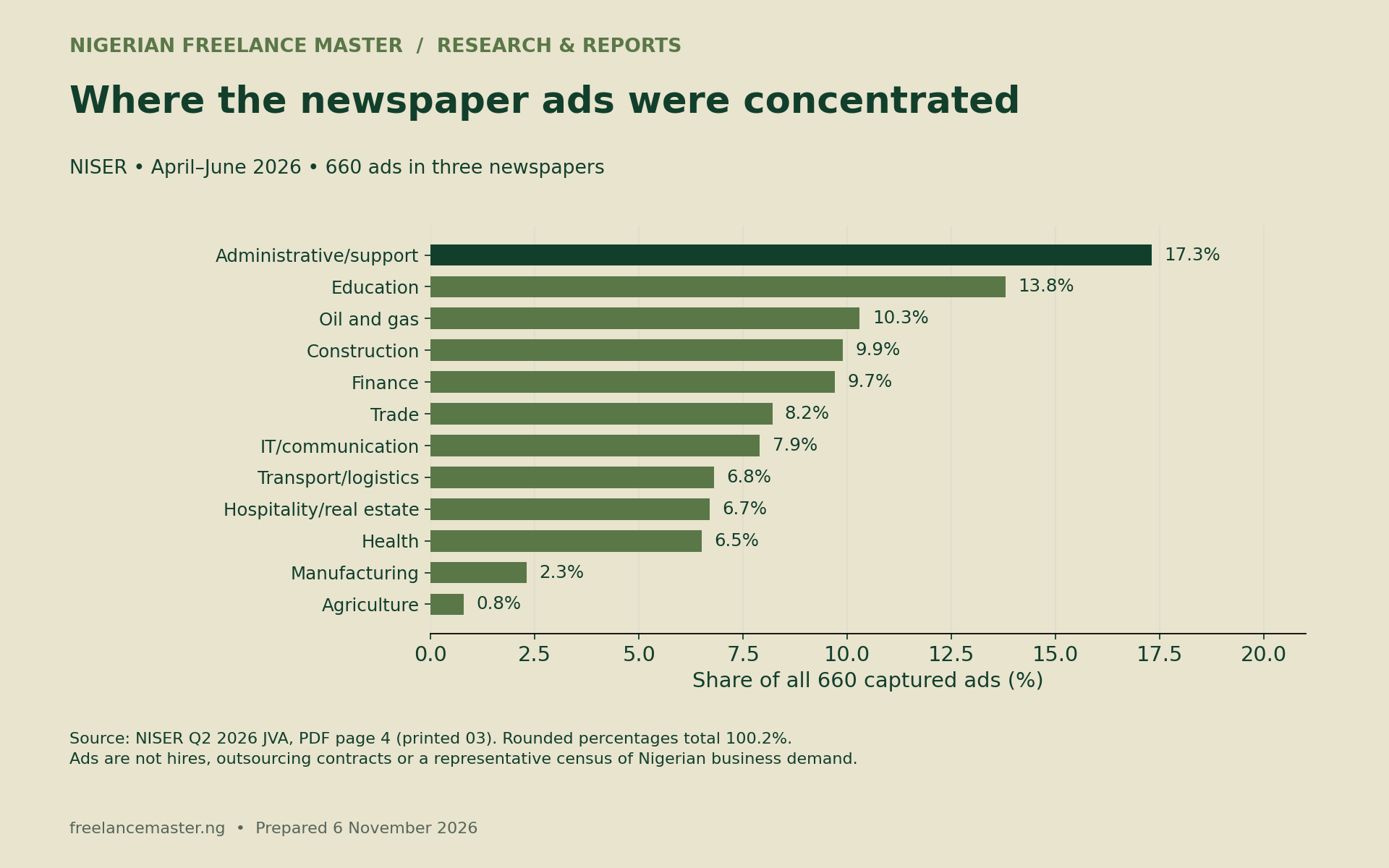
Administrative/support services account for 17.3% of captured ads, followed by education at 13.8%. Finance is 9.7%, trade 8.2% and IT/communication 7.9%. These percentages describe the report’s advertising sample. They do not rank the sectors by how much they spend on freelancers.
The sector shares sum to 100.2% because the published values are rounded. We retain the reported figures rather than forcing one category to absorb the difference. We also avoid multiplying rounded shares by 660 to invent exact sector counts.
Finding Nigerian business clients: choose a research hypothesis
Start with the intersection of a sector signal and a service you can already deliver. Someone with a credible editing portfolio might investigate publication workflows. A spreadsheet specialist might investigate a clearly bounded reporting task. These are possible questions, not established needs at a named employer.
Choose a deliverable small enough to explain and assess. “Improve the business” is too broad. “Clean a supplied, permitted product catalogue and return an exception log” states an output, an input boundary and a way to check the result.
Next, write the hypothesis in conditional language. For example: “If this business maintains a large catalogue and accepts external suppliers, it may need a defined data-cleaning service.” The conditions matter. Until verified, they should stay visible in your notes.
| Research starting point | Possible question | Evidence still required |
|---|---|---|
| Administrative/support recruitment | Is there a bounded documentation or reporting problem? | Current workflow, permitted scope and external buying route |
| Education recruitment | Does the institution buy editing or learning-material production? | Relevant supplier guidance and subject competence |
| Trade activity | Is a public catalogue incomplete or inconsistent? | Ownership, current need, data access and decision authority |
| IT/communication recruitment | Is there a limited testing or documentation task? | Technical scope, permissions and acceptance criteria |
These examples are editorial hypotheses. They are not services NISER found employers buying. A technically simple task can still involve confidential information, professional boundaries or permissions you do not possess.
The location figures need a different denominator
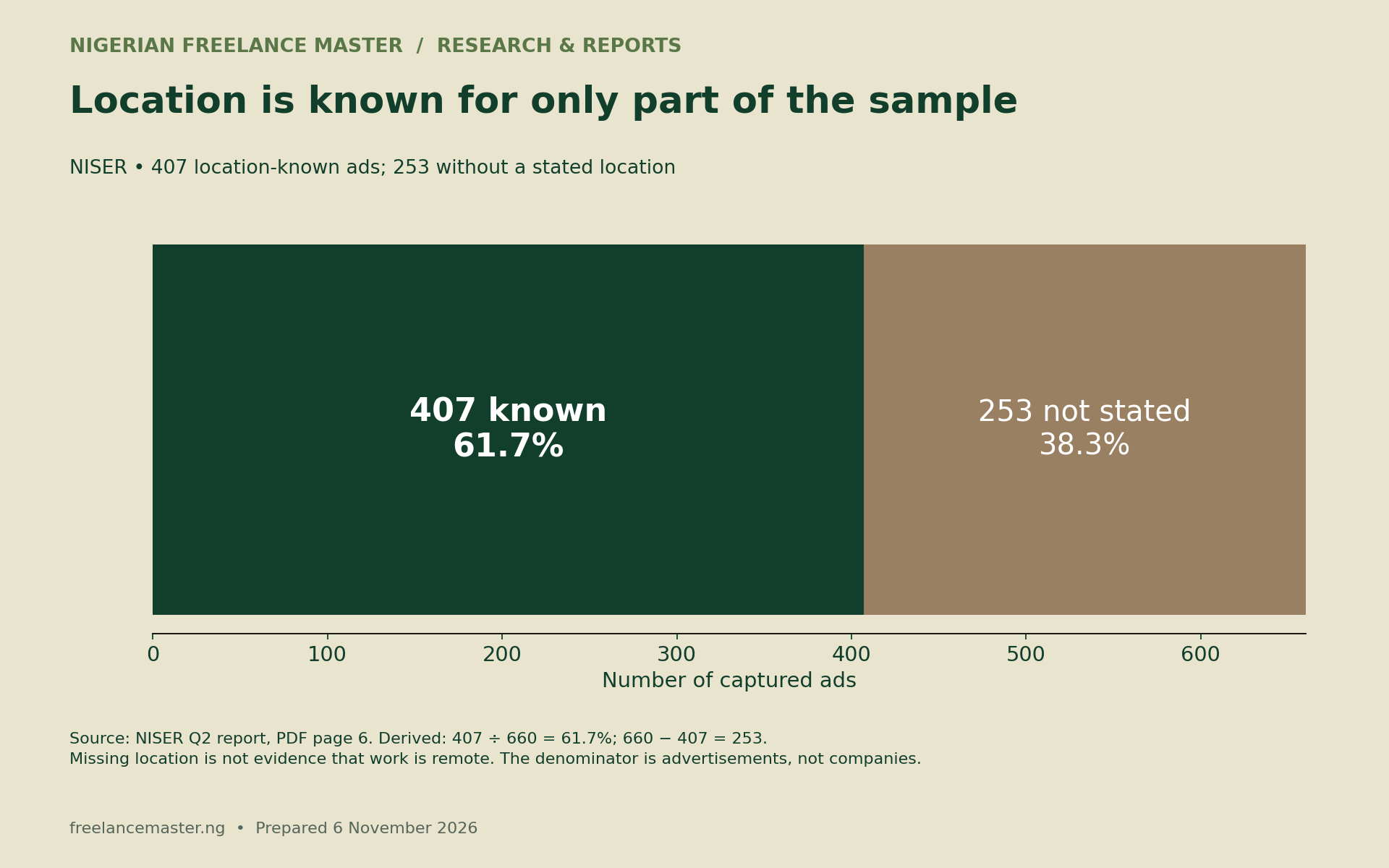
Only 407 of the 660 ads stated a location. That is 61.7%, calculated as 407 divided by 660 and rounded to one decimal place. The remaining 253 did not state one. An unstated location does not establish that a job is remote.
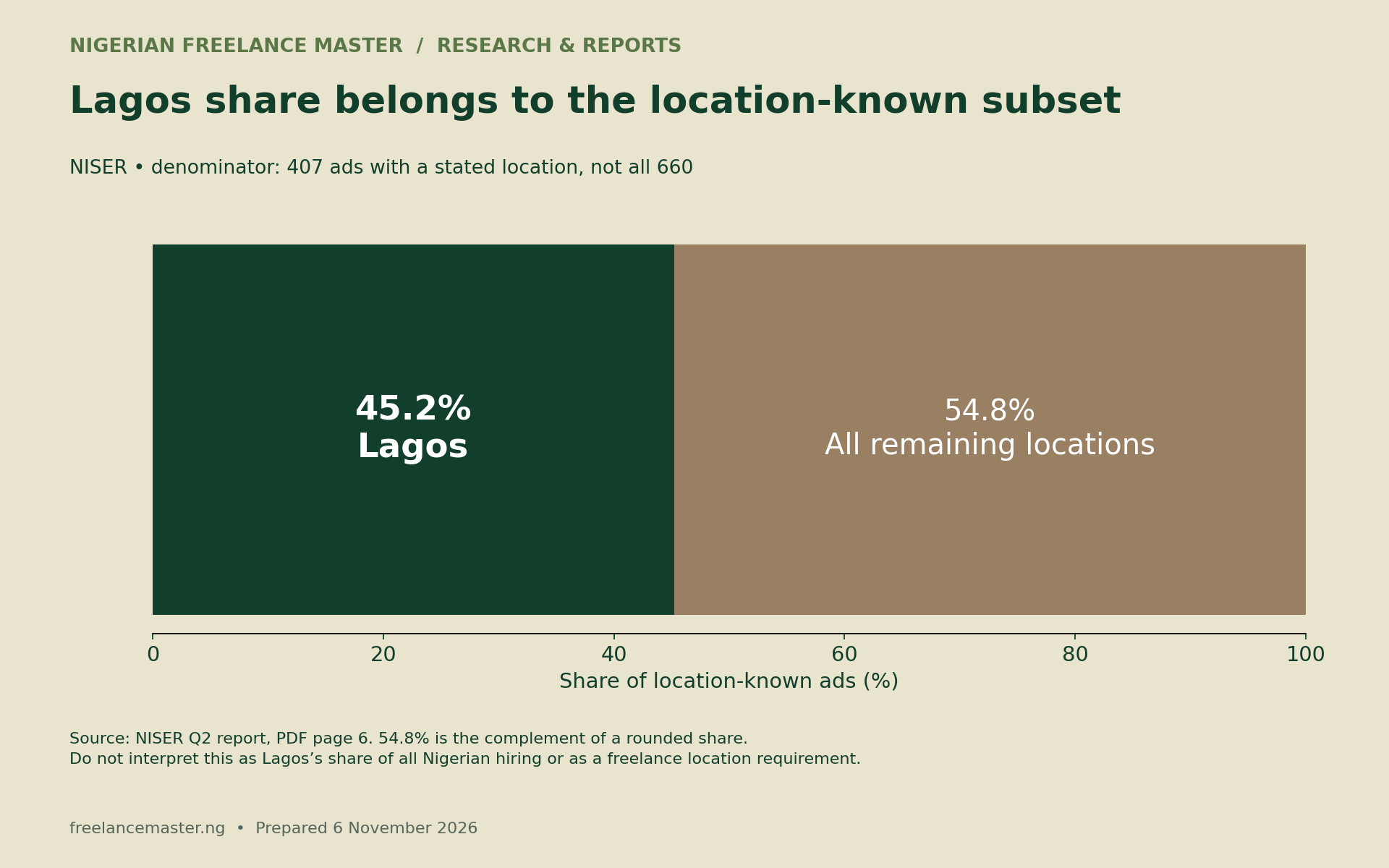
The report’s 45.2% Lagos share uses the 407 location-known ads. It does not use all 660. It also does not measure Lagos’s share of national employment, freelance budgets or remote client opportunities.
For a freelancer outside Lagos, location is one qualification field among several. Check whether a proposed deliverable requires visits, regulated on-site work, local knowledge or access to a particular system. Do not assume that a large Lagos share means every useful client must be in Lagos.
Equally, do not promise remote delivery because a task sounds digital. A client may have physical records, security restrictions or a procurement process that affects feasibility. Those details require current evidence or a properly scoped discussion.
A new publication can describe older activity
The release is recent; the observations are older. April–June activity should not be described as a list of November vacancies. An advertisement may have closed, a project may have finished or an employer’s requirements may have changed.
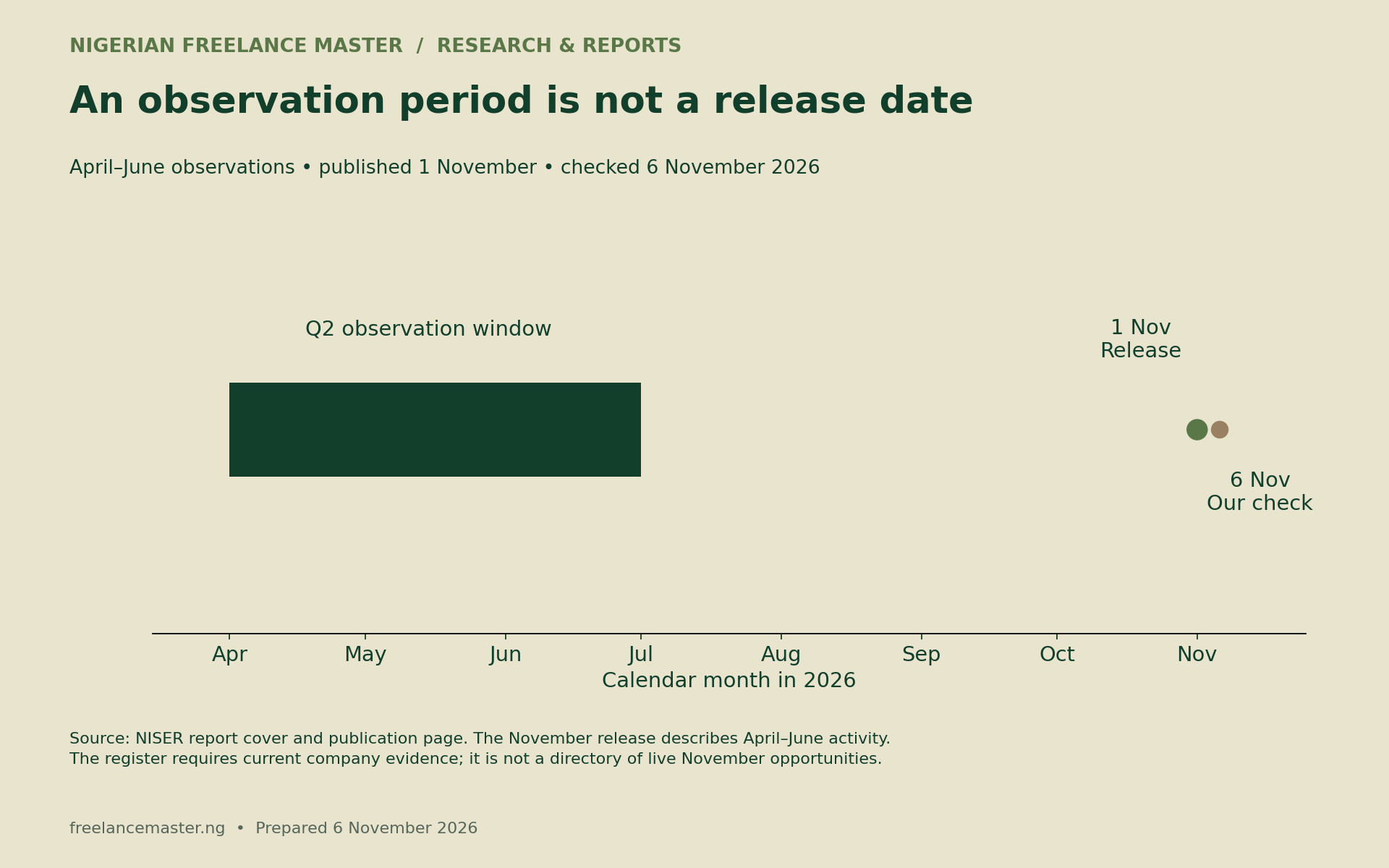
Use the report to select questions worth researching now. Then obtain a current company-level source, record its date and decide when it needs checking again. A page without a clear date deserves an explicit freshness limitation.
Our Fiverr income-risk research discusses channel dependence. Direct-business prospect research can sit alongside platform activity, but this report does not establish that one channel will outperform another for you.
Build the twenty-company register with four evidence layers
The downloadable register contains twenty blank company rows. Twenty is a manageable editorial worksheet size, not a scientifically validated sales sample or a target guaranteed to produce a client. You can use fewer rows if your evidence is thin.
First, record an observed signal with its public URL and date. Quote only what you need in private notes, and distinguish the source’s statement from your interpretation. If the business cannot be identified reliably, leave it unqualified.
Second, state a bounded service hypothesis. Identify the input, output and acceptance check. Add evidence that you can deliver the work responsibly, such as a relevant permitted portfolio example. Avoid claiming specialist competence from a vague similarity to a previous task.
Third, verify a legitimate external-supplier route. A supplier page, tender notice or clearly stated buying channel is stronger evidence than a recruitment inbox. A job application address is not automatically a place to send unrelated sales pitches.
Fourth, record the decision and unknowns. Budget, authority, security access, deadlines and outsourcing interest may remain unknown. Mark the next research step instead of filling those gaps with assumptions.
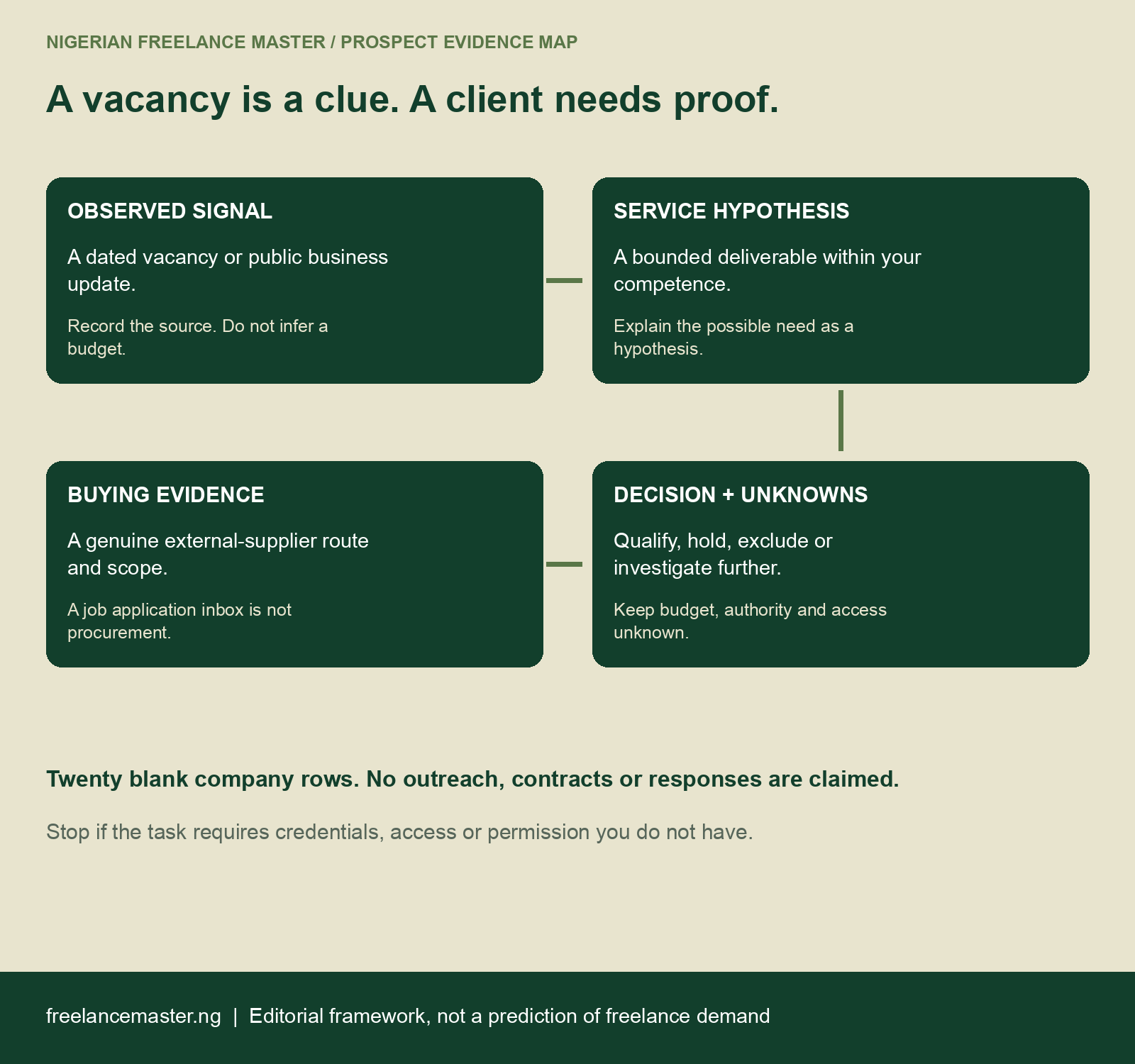
The infographic is an evidence map because the work is about connecting different kinds of support. It is not a sales funnel with invented conversion percentages. You may move a record back to investigation when new information contradicts an earlier assumption.
Use clear qualification states
“Investigate” means there is a useful question but insufficient evidence. “Hold” means a specific gap currently blocks progress. “Exclude” means the opportunity does not fit your capacity, permissions or service boundary. “Qualified for discussion” means a relevant discussion appears justified; it does not mean a contract exists.
Keep your reason beside the state. For example, “hold: no external procurement route found” is more useful than “cold lead.” Likewise, “exclude: requires licensed work outside my competence” prevents a tempting headline from overriding a real boundary.
Do not turn the number of completed rows into a revenue forecast. Twenty researched companies could yield no suitable conversation. Even a positive discussion can end without agreed scope, delivery or payment. Record each stage separately if you later run your own authorised campaign.
Our Upwork Now guide uses a similar principle for time: include unsuccessful and unresolved outcomes. Prospect research also needs honest denominators. Count how many companies you actually researched, not how many ads you skimmed.
Keep an illustrative prospect separate from real evidence
Imagine a fictional retailer whose public catalogue has inconsistent product units. You can describe a proposed sample-cleaning deliverable and list the checks you would apply. However, that exercise does not establish permission to scrape its systems or access its customer information.
A responsible research note might say: “Potential catalogue-quality issue; verify ownership, current need and supplier route.” It should not say: “The company needs my service and will pay a stated amount.” No budget has been observed in that example.
Use a small permitted sample to demonstrate competence when appropriate. Specify what a sample can establish, such as whether you can identify inconsistent units. It cannot establish the buyer’s willingness to pay or the full size of a private operational problem.
The register is not a contact database for bulk messaging. Keep personal contact details and confidential material outside any public version. This article provides a research framework; it does not perform outreach or authorise access to a business’s private data.
Download the source tables and blank tools
- NISER sector-share table (CSV) preserves all twelve rounded shares, their denominator and source.
- Location-denominator calculations (CSV) separates 660 total ads, 407 location-known ads and the Lagos percentage.
- Blank twenty-company prospect register (CSV) provides fields for current evidence, service scope, buying routes and unknowns.
- Prospect-register field guide (CSV) explains the qualification states and evidence boundaries.
The blank register has no prefilled companies, budgets or contacts. Keep it blank where evidence is missing. A transparent unknown is more useful than a confident-looking entry created merely to complete the sheet.
Sources, method and reuse
We checked NISER’s publication page and fourteen-page report on 6 November 2026. The source register and downloadable tables identify the report and relevant pages. Our calculations are 407 ÷ 660 × 100 for location coverage and 660 − 407 for unstated location; complements use the reported rounded share.
The sector chart retains published percentages, including their rounding excess. Four figures answer distinct questions about sector composition, missing location, the Lagos denominator and observation timing. The separate infographic explains the original research framework. No company-level source audit, outreach trial or freelance demand survey is claimed.
The featured image is AI-assisted conceptual artwork showing a researcher separating vacancy clues from contract evidence. It depicts no real person, employer or NISER interface. Cite NISER for its advertising data and Nigerian Freelance Master for the register and original calculations. Our original visuals and worksheet may be reused with attribution and a link to this article; underlying source material retains its own terms.