




A holiday retail discovery audit checks whether customers can find consistent, usable information. For a Nigerian freelancer serving a US small-retail client, that is a concrete remote deliverable. It is different from promising more traffic, a seasonal contract or extra sales.
Start with one approved customer path and document what a public visitor can verify. This guide combines a new US consumer finding with a fictional journey, one chart, an infographic and four CSV tools. We have not audited a real retailer or measured a sales effect.
Holiday retail discovery audit: read the US finding correctly
American Express’s 2026 Shop Small Impact Study release, published on 12 November, reports ways US consumers choose small businesses: friends/family recommendations (65%), customer reviews (45%) and social media posts (39%). These are non-exclusive stated responses, not conversion rates or marketing attribution.
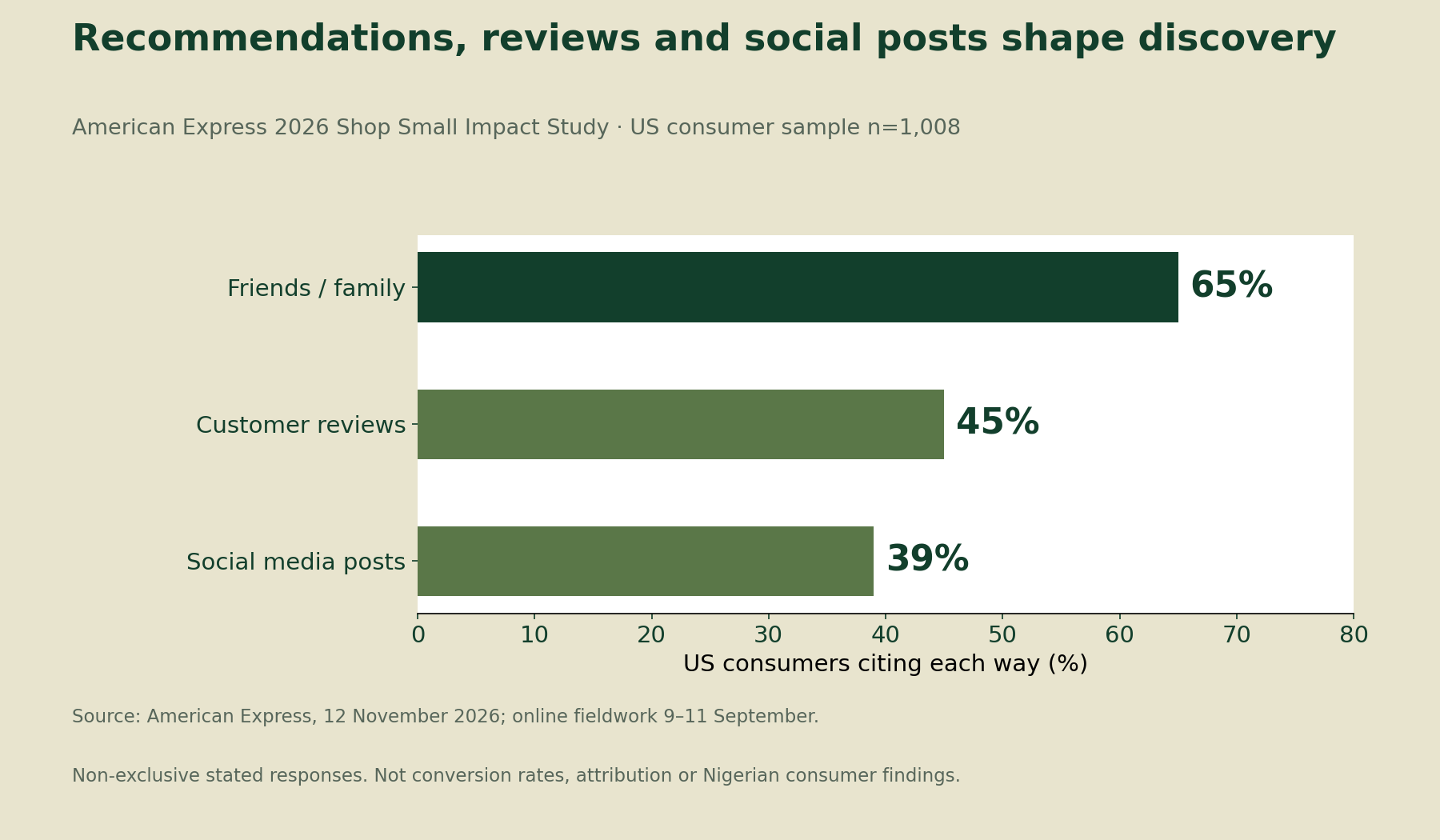
Teneo surveyed 1,008 US adults online on 9–11 September 2026 for American Express. Consumer weighting used age, sex, region, race and education. A separate owner survey involved 503 US physical-location, non-franchise businesses with 2–99 employees on 11–21 September. It is not the denominator for these consumer figures.
The release precedes US Small Business Saturday on 28 November 2026. Its findings do not describe Nigerian consumer behaviour or demand for freelance services. For a specific US client, investigate the actual public information rather than assuming the survey proves a need.
Define a fixed deliverable before offering content
Agree which business, public touchpoints and period the audit covers. A useful scope might inspect the merchant’s website, its approved social profile and its public visit information. Record the URLs and access dates so the handover is reproducible.
Keep the deliverable narrow: a prioritised list of contradictions, broken destinations and claims needing confirmation. State that the initial audit does not include logging into accounts, contacting customers or changing listings. Those actions require their own authorisation.
For a Nigerian freelancer, remote access and time zones matter. Write down which local time zone the merchant uses and when information was checked. A screenshot of opening hours needs that context, especially around holiday exceptions.
Trace one discovery-to-action path
Choose one public starting point, such as an approved seasonal post. Follow its link to the product or landing page, then inspect the information needed to contact or visit the merchant. Record the actual result at each stage.
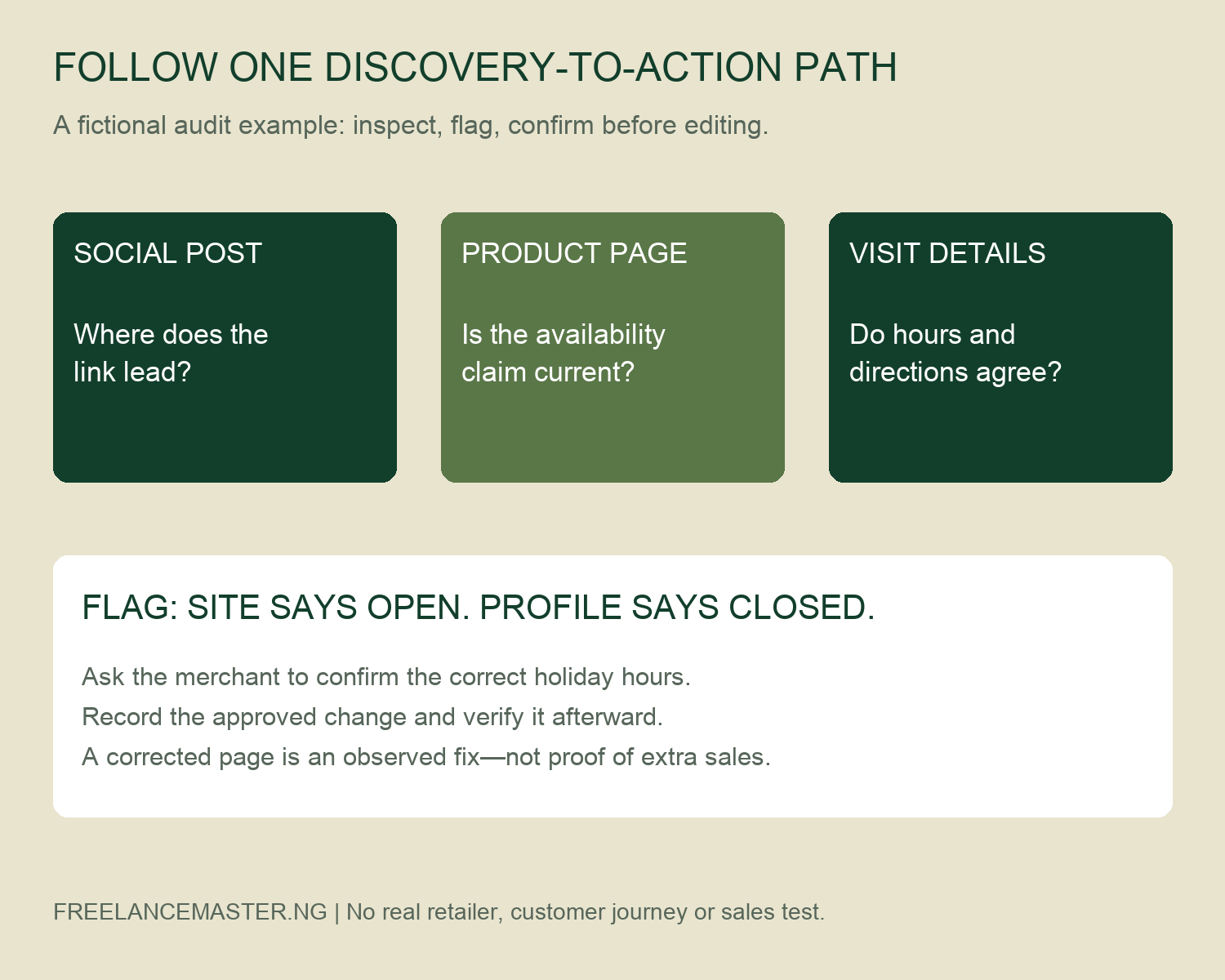
In our fictional example, one source says the business is open while another says it is closed. This does not prove either source is wrong. Ask the merchant which information is current and who owns the update.
Do not claim a customer abandoned a purchase unless you have appropriate evidence. A broken link is an observable problem; lost revenue is a separate claim. Keep the findings within what the public inspection actually establishes.
Check the details a visitor needs
Hours, contacts and directions
Compare normal and holiday opening hours across the selected touchpoints. Check whether telephone numbers, contact routes and addresses agree. Flag a destination that leads to an unrelated page or a contact option that no longer works.
When checking directions, describe the public information and any inconsistency. Do not claim to have verified a physical entrance or accessibility feature from a remote map alone. Ask the merchant to confirm details that require local knowledge.
Availability and promotional claims
Record the wording and checked time for availability statements. Public information may change quickly, so avoid treating a screenshot as a lasting inventory guarantee. Ask the merchant for approved current wording before making an edit.
For a discount or other promotional claim, identify the supporting evidence and conditions to confirm. Do not invent stock, deadlines, testimonials or eligibility. A clear unresolved question is better than attractive copy unsupported by the merchant.
Handle reviews and feedback honestly
Recommendations and reviews in the survey do not justify manufacturing either. Keep fictional examples out of public review systems. Never present an invented customer experience as genuine feedback.
If feedback requests are part of a later assignment, agree the authorised process and applicable platform requirements first. Do not initiate unapproved customer outreach or selectively suppress criticism. The initial public audit can simply document the existing route and questions for the owner.
Our client AI permission guide covers any proposed tool use separately. An audit brief does not automatically authorise supplying customer information to a third-party tool.
Prioritise fixes with evidence and an owner
For each issue, explain the affected path, evidence location and practical consequence that still needs confirmation. A broken contact destination may deserve earlier attention than a cosmetic inconsistency. Record why you chose the priority instead of inventing a numerical impact score.
Distinguish an editorial suggestion from a required correction. The merchant should confirm the underlying facts and approve the change. Also state who can implement it and how the saved result will be checked.
A concise handover should be understandable without your presence. Include unresolved questions, access limits and the audit’s date range. Avoid a large list of generic recommendations that does not correspond to inspected touchpoints.
Verify observable fixes separately from commercial outcomes
After an authorised edit, record before-and-after evidence, the approving owner and the verification time. Check the actual public destination. A saved editor field is not proof that the visitor sees the intended correction.
Describe the result precisely: the link now reaches the approved page, or the selected sources now show matching hours. Do not translate that into a percentage sales lift. Commercial evaluation would require a separate design, relevant data and appropriate permissions.
For downstream customer-support work, our holiday human-review guide addresses a different service boundary. This audit focuses on discovery information before a customer contacts the business.
Download the evidence and audit tools
- American Express consumer discovery values (CSV)
- Blank retail touchpoint audit (CSV)
- Fictional discovery-path example (CSV)
- Blank before-and-after evidence register (CSV)
The audit and evidence register are blank, while the journey example is fictional. They contain no real retailer’s findings, customer records or measured sales. Adapt them to an authorised scope and retain uncertainty.
Method and limitations
We checked the American Express release and its methodology on 15 November 2026. The chart transcribes three consumer percentages without calculating counts or combining them with owner responses. Our audit framework is editorial work, not a result of that survey.
Suggested citation: Nigerian Freelance Master, Holiday Retail Discovery: A Freelance Audit for US Clients, 15 November 2026. Retain the US population and September fieldwork dates. Refresh the calendar framing after the holiday period rather than presenting old responses as new evidence.