







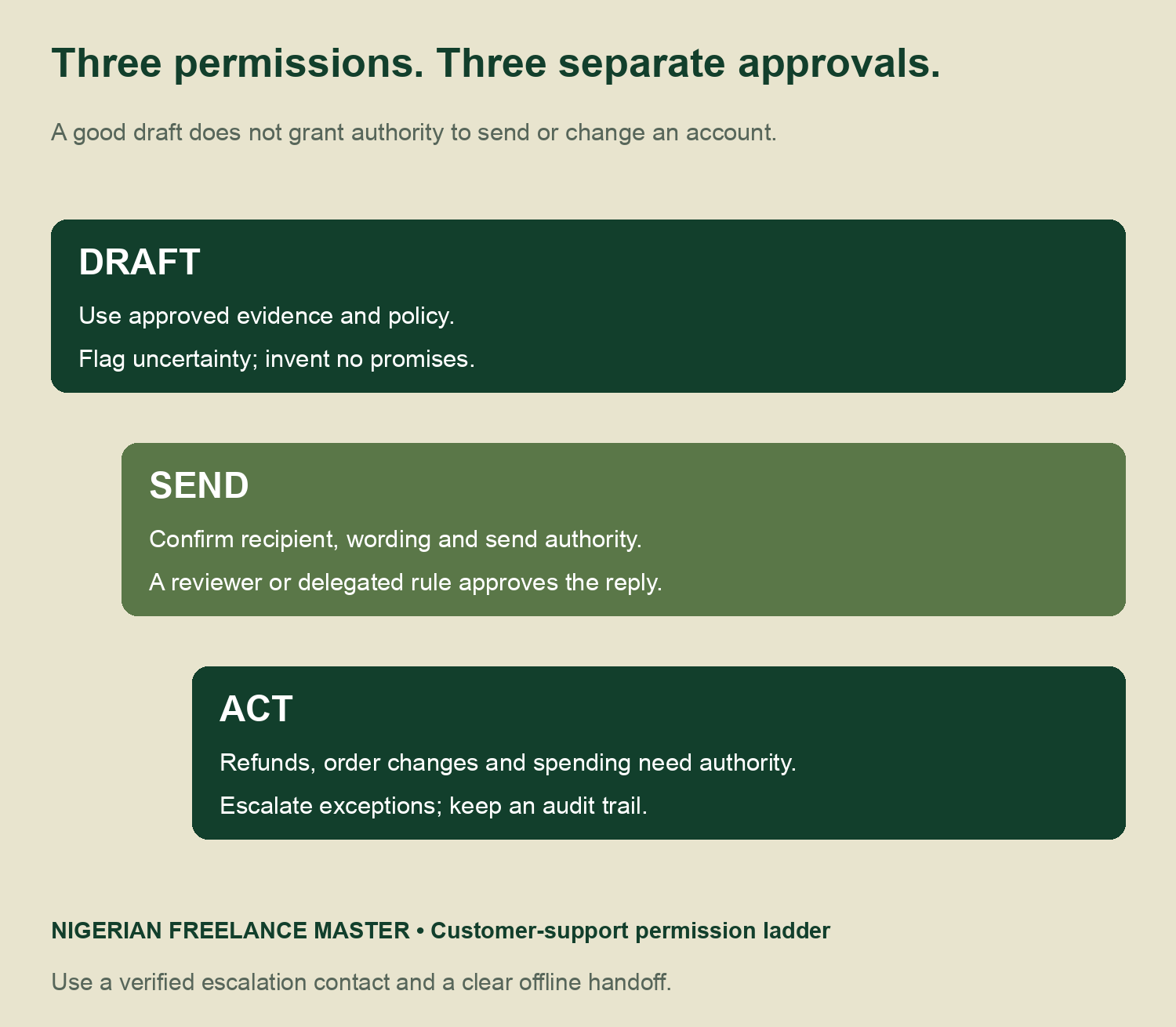
Holiday e-commerce freelance services can include useful human review, but the service needs a clear boundary. Drafting a response is different from sending it, and sending a response is different from changing an order or issuing a refund. Agree those permissions before you quote a busy-season support package.
A new US survey provides context for that distinction. Our guide pairs two branded charts with a permission ladder, twenty-four synthetic practice tickets and four CSV downloads. It does not claim to count Nigerian clients, prove freelance demand or report results from an unrun support experiment.
What the holiday shopping survey actually measures
Talkdesk’s 4 November 2026 release describes two Centiment samples: 1,048 US adult holiday shoppers and 312 US retail decision-makers at AI-using companies with at least fifty employees. The methodology and detailed tables give shopper fieldwork as 16–21 September and retailer fieldwork as 16 September–3 October.
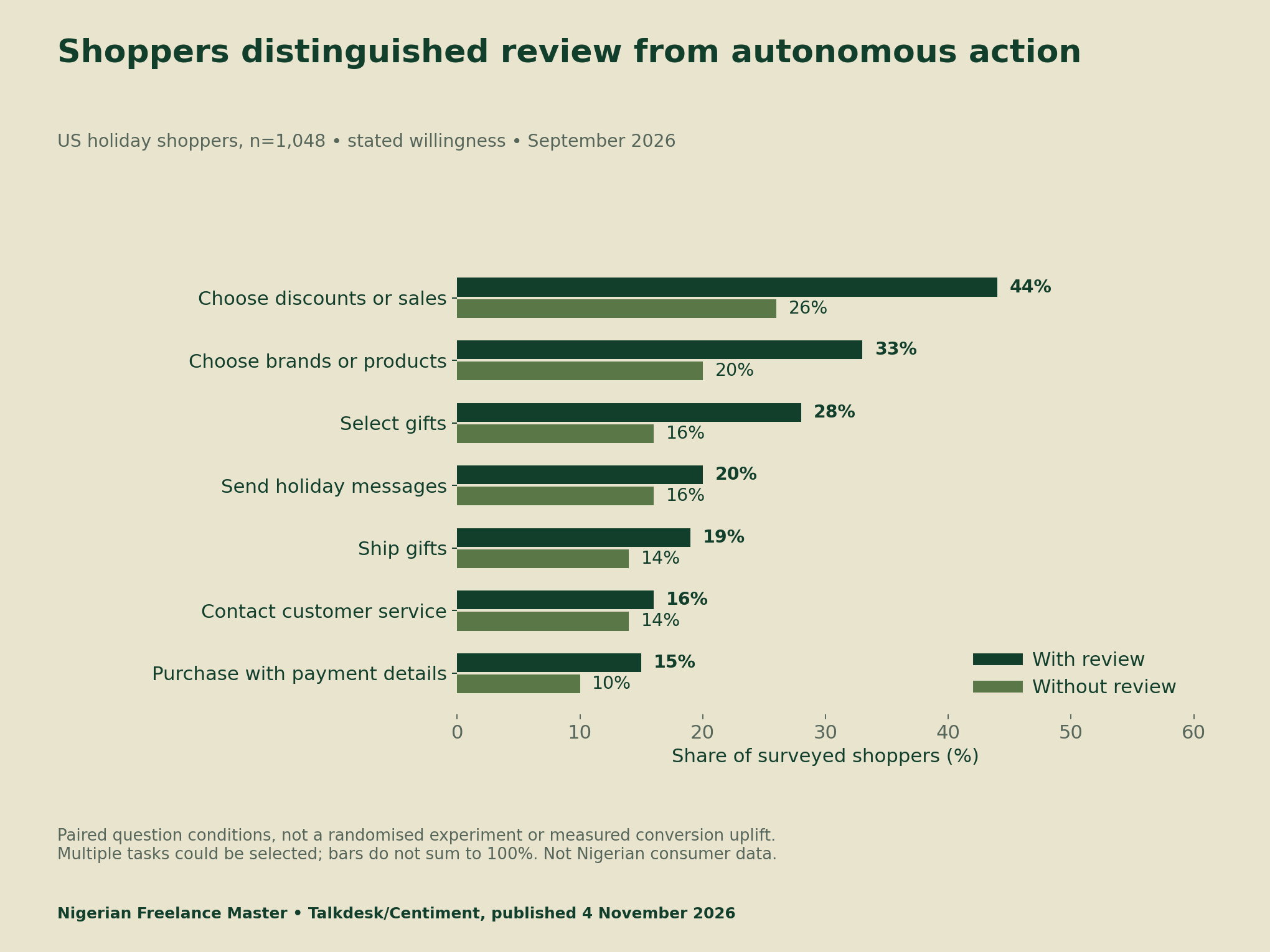
Among shoppers, 15% would let an agent purchase using payment details with review, versus 10% without review. For choosing discounts or sales, the figures are 44% and 26%. These are stated willingness under different question conditions. They are not measured conversion rates or proof that adding review causes a particular increase in sales.
Keep retailer plans separate from shopper permission
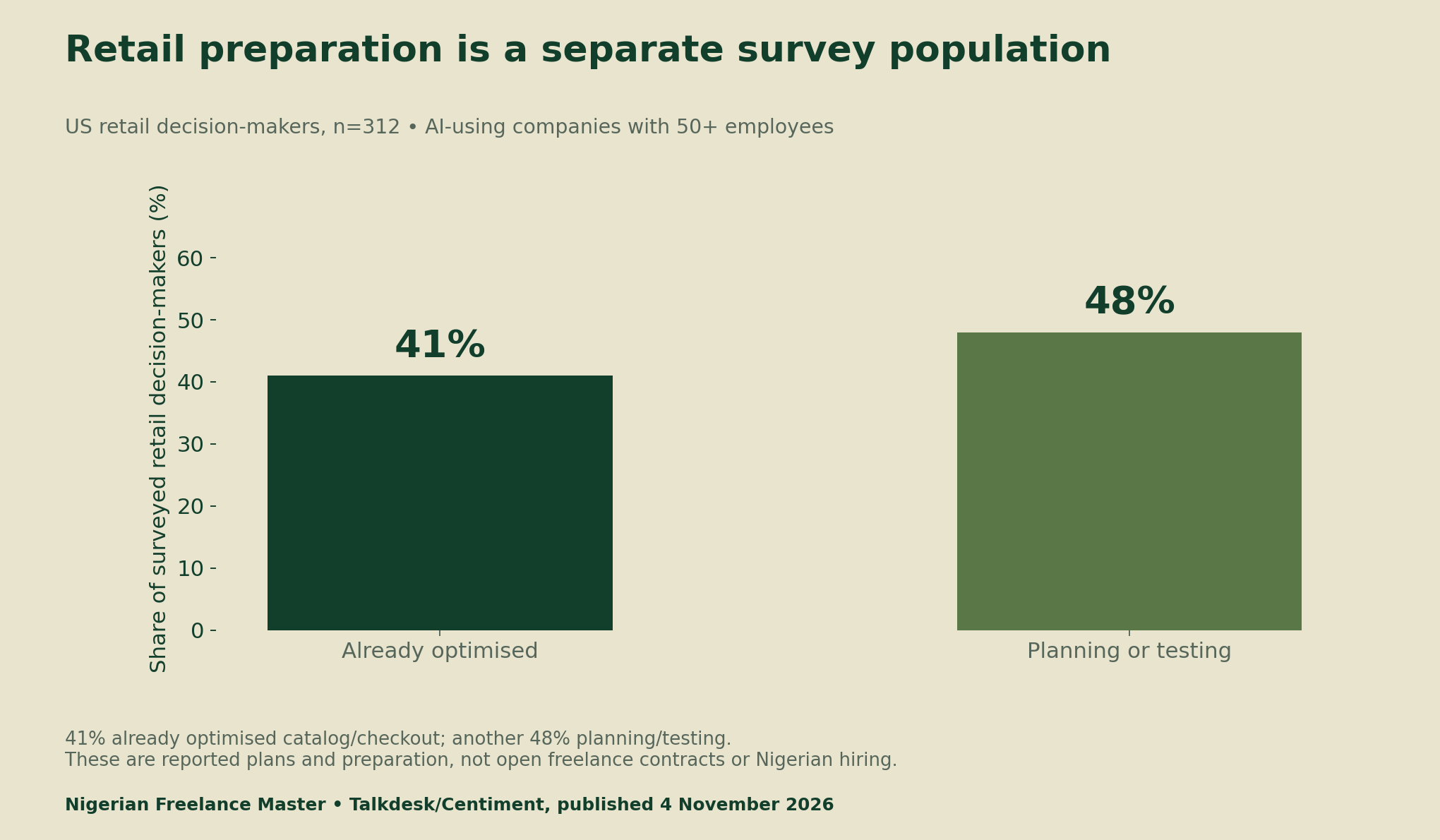
The retailer sample reports 41% already optimising catalogues and checkout for agents, with another 48% planning or testing. Those respondents differ from the shopper sample. Subtracting the shopper’s 15% from the retailers’ combined 89% would create a misleading single-population “trust gap.”
For a Nigerian freelancer, the useful next question is narrower: what verified problem does a prospective client need you to handle? Check its actual support queue, policies and service hours with permission. A survey headline is a reason to investigate a service idea, not evidence that a client has agreed to buy it.
Scope holiday e-commerce freelance services around authority
A draft-only package might organise approved policy answers, flag missing information and prepare suggested replies. Its deliverable can be reviewed before anything reaches a customer. Name the evidence sources and the policy version so a fluent answer does not silently replace the client’s current rules.
A sending package needs more. Agree which messages you may send, which recipient checks apply and what requires review. Permission to send a tracking explanation does not necessarily include permission to promise a new delivery date, offer compensation or disclose personal data.
An action-enabled service is a separate scope. Refunds, order changes, account updates and spending can have financial and privacy consequences. The client must define delegated authority, limits and an escalation route. Do not treat access to a button as permission to use it.
Use the practice tickets to test routing
Our twenty-four inert cases divide into eight routine information requests, eight exceptions and eight cases with insufficient information. They contain no real customer identifiers or live account actions. Their answer key specifies a next-step route, rather than inventing a refund amount or a customer outcome.
A routine ticket asks for the published returns policy. The safe exercise is to find the approved version and draft an accurate response within the agreed scope. An exception asks for a refund outside that policy. That belongs with the named authorised decision maker, even if a model can write a persuasive reply.
An incomplete case may lack an order reference, verified identity or current tracking evidence. Request the missing information through the agreed route before deciding. Do not fill the gap with a plausible order status or guarantee. Keep the customer-facing draft separate from any internal note about uncertainty.
The pack is a balanced teaching design, not a sample of a retailer’s queue. Equal category counts do not imply equal real-world frequencies. We have not run a model comparison, recruited support agents or measured customer satisfaction using these cases.
Measure the right things in a later pilot
If a client authorises a pilot, freeze the policy version, case wording and answer key before scoring. Save the exact tool version and settings if using a model. Count correct routes, missed escalations, false alarms, unsupported promises and permission breaches separately. A fast answer that exceeds authority should not be counted as a successful resolution.
Keep review time distinct from initial drafting time. Record the actual basis for each outcome, the authorised approver and any disagreement. The downloadable pilot register leaves results blank. It does not report zero errors, productivity gains or a before-and-after improvement.
Price staffed hours and a workable handoff
Write the timezone, staffed days, response target during those hours and ticket-volume cap into the scope. A solo freelancer should not casually promise continuous coverage. Explain how urgent issues reach the client when you are offline, and test that the named escalation contact is real and available.
Also agree what counts as a ticket, how revisions work and who updates the policy library. Separate ordinary clarification from an expanded scope that changes staffing needs. Use a private data-handling agreement rather than putting sensitive queue exports into an unapproved tool.
- Survey figures, populations and fieldwork register (CSV)
- Twenty-four synthetic support tickets and routing answer key (CSV)
- Blank support-routing pilot register (CSV)
- Blank staffed-hours and permission scope template (CSV)
Our AI job-screening guide helps check inputs and acceptance before bidding. Our remote-work eligibility guide adds location and engagement checks. An attractive service idea still needs a verified, eligible client opportunity.
Method and limitations
Research checked 10 November 2026. We retained Talkdesk’s primary survey source and kept the two respondent populations separate. We transcribed the paired willingness figures without inferring causality, and authored a synthetic routing pack and service-boundary template. This is commercial survey evidence, not a representative Nigerian labour-market study.
Suggested citation: Nigerian Freelance Master, “Holiday E-commerce Freelance Services: Set Human Review Boundaries,” 10 November 2026. Credit Talkdesk/Centiment for their survey and this report for the permission ladder and practice tools. Send corrections through our contact page.