







A freelance cash buffer is easier to assess when you can see which week the money runs short. An invoice total alone cannot show that. A thirteen-week naira forecast brings expected cleared receipts, essential outflows and a chosen stress case into the same timeline.
This report includes two charts, a cash-classification infographic, four CSV tools and an editable Excel workbook. The naira examples are entirely fictional. The workbook is a planning tool, not a recommendation for a universal savings target, a loan or a particular financial product.
What the latest cash-buffer survey can tell us
Bluevine’s company-issued 3 November 2026 announcement reports a Centiment survey of 760 US small-business owners, fielded 3–5 August. Its comparison survey had 774 respondents. The reported 7–14-day cash band rose from 14% to 20%, while the one–two-month band fell from 18% to 14%.
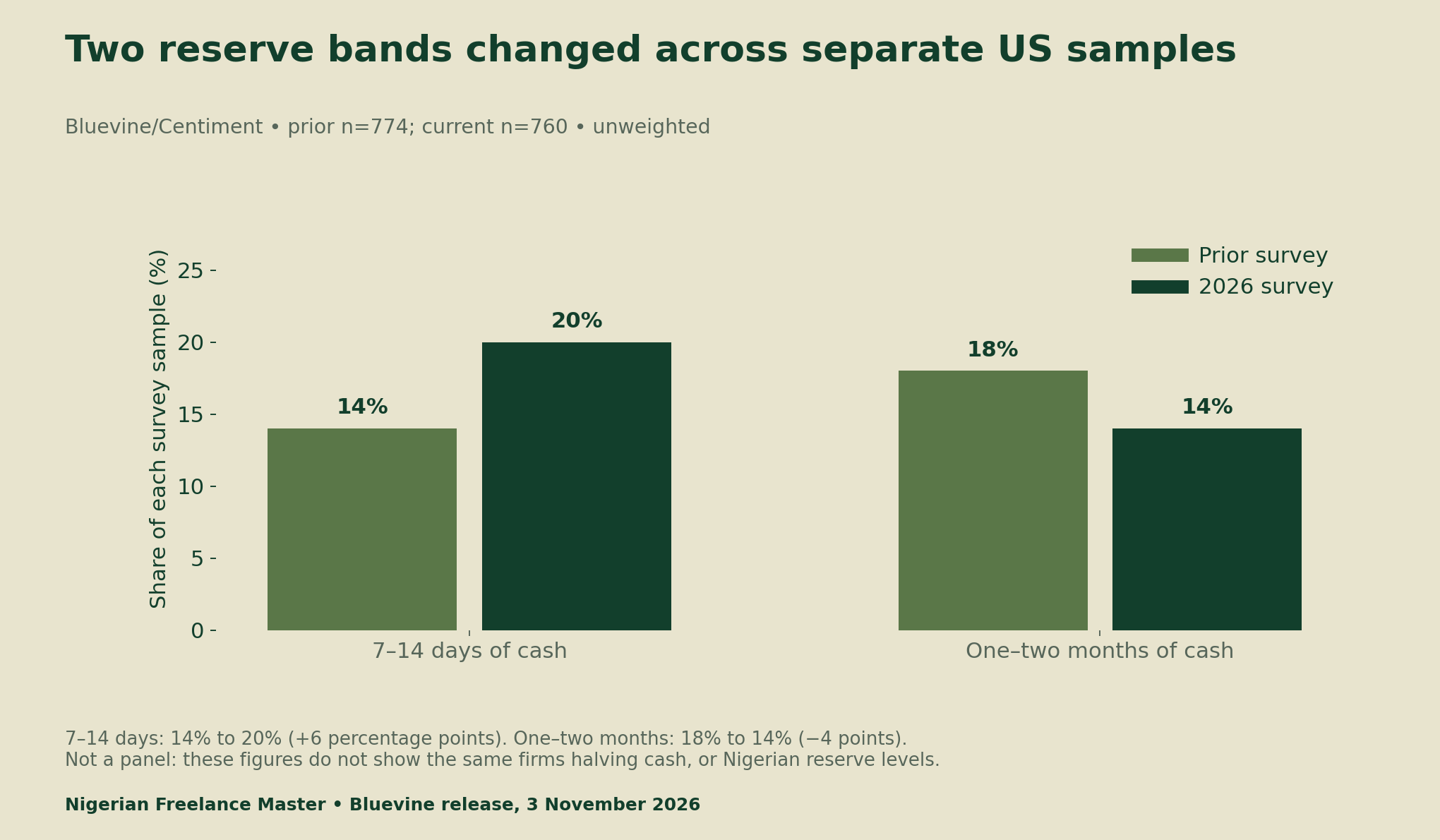
The release also reports 43% with less than one month of operating expenses in reserve and 42% delaying their own pay during the preceding year. These are self-reported US business figures. We do not apply them to Nigerian freelancers or turn the survey’s most common band into a recommended target.
There is a date discrepancy worth retaining: the linked Bluevine blog displays 29 October, while the company announcement is dated 3 November. We use the dated announcement as the news hook and leave the differing blog date visible. Commercial, unweighted survey evidence has limits beyond its publication date.
Build a freelance cash buffer forecast from usable cash
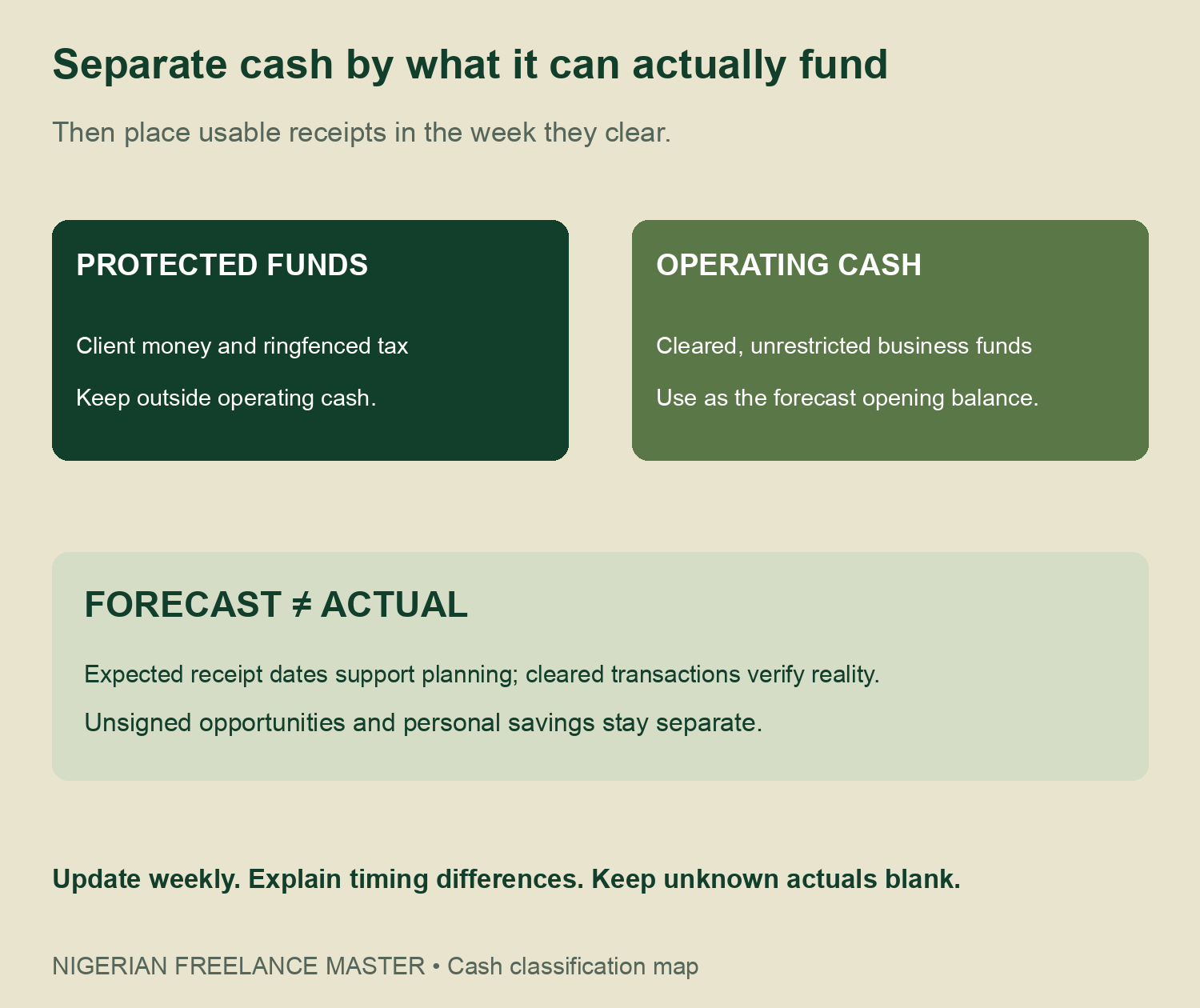
Start with cleared business cash. Remove client money, ringfenced tax funds and other amounts you cannot use for operations. Keep personal savings separate rather than silently treating them as business cash. If you decide to contribute personal funds later, show that as a specific, dated movement.
Our fictional workbook starts with ₦450,000 cleared business cash and ₦150,000 protected funds, leaving ₦300,000 unrestricted. That subtraction is an example, not an assumed Nigerian tax rate. Replace both inputs with your own evidence and preserve the reason an amount is protected.
Next, place expected receipts in the week you reasonably expect the funds to clear. The invoice issue date and contractual due date can inform that judgement, but neither proves receipt. Exclude unsigned opportunities from the base case. Do not count an uncertain proposal as if a client has already paid.
See how three fictional cases differ
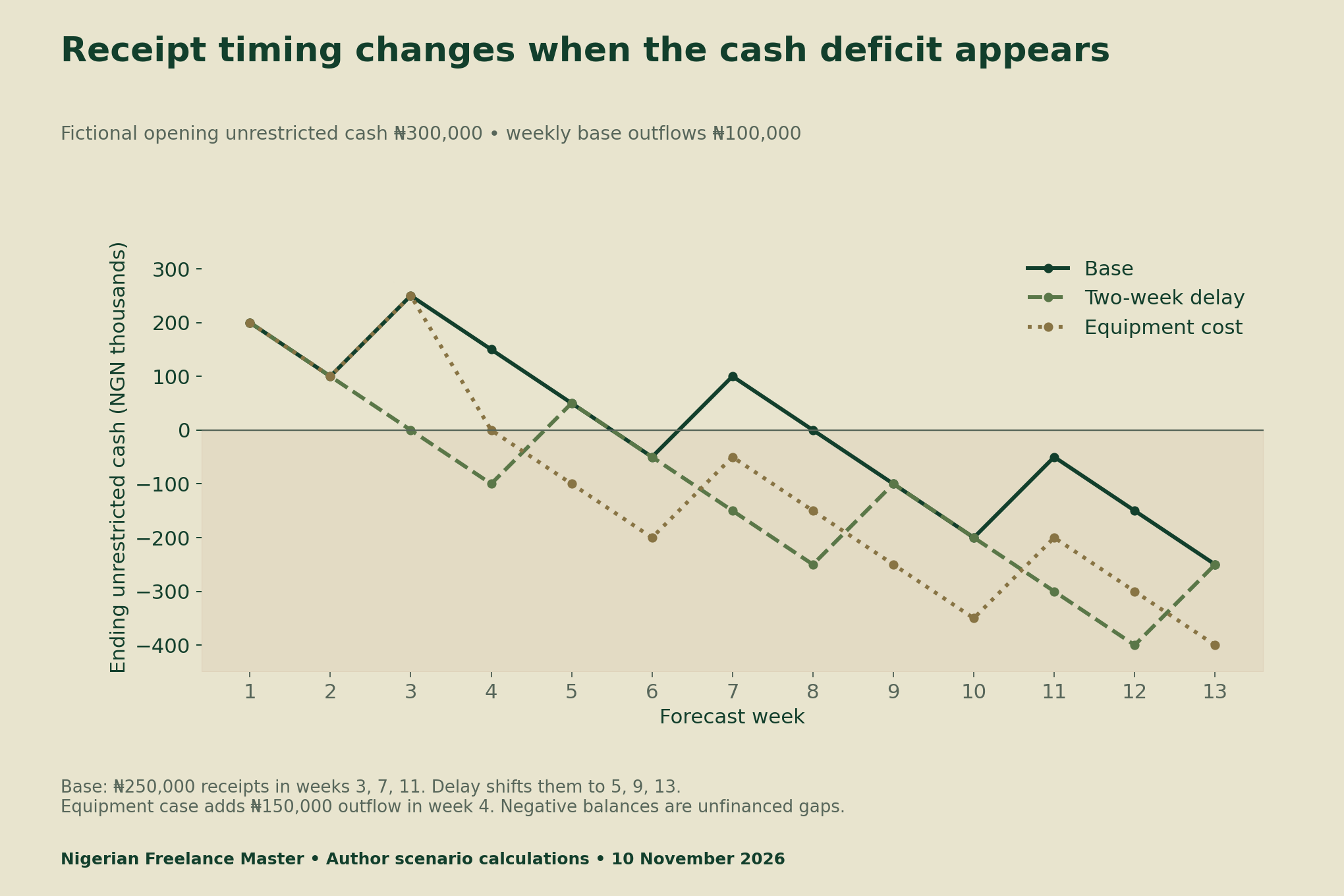
The base case assumes ₦250,000 clears in weeks 3, 7 and 11, with ₦100,000 paid out each week. The delay case moves every receipt two weekly buckets later, to weeks 5, 9 and 13. The equipment case keeps base receipt timing and adds ₦150,000 of cash outflow in week 4.
| Fictional case | First negative ending week | Lowest ending cash | Week 13 ending cash |
|---|---|---|---|
| Base | 6 | −₦250,000 | −₦250,000 |
| Two-week delay | 4 | −₦400,000 | −₦250,000 |
| Equipment cost | 5 | −₦400,000 | −₦400,000 |
All three cases expose a problem. The base case first turns negative in week 6 and ends at −₦250,000. Delaying receipts brings the first negative week forward to week 4 and lowers the minimum to −₦400,000, even though its week-13 ending balance returns to the base case’s level.
A negative result is an unfinanced gap. The workbook does not assume access to an overdraft or quietly borrow enough to balance. Use the date and amount to investigate verified options, revise a scope or cost plan, and seek appropriate advice where needed. No particular solution is assumed to be available.
Use the editable 13-week workbook
Choose case 1 for Base, 2 for Two-week delay or 3 for Equipment cost. One forecast build uses the active assumptions. Edit the blue-on-amber inputs for opening cash, protected funds, equipment cost and week, base receipts and base outflows. The example first week is Monday 16 November 2026; change it to your own horizon.
The summary shows opening unrestricted cash, the minimum ending balance, the first negative week and week-13 ending cash. Useful intermediate rows show opening cash, receipts, outflows, net flow and closing cash. The next week begins with the previous closing balance, so the timing remains visible.
Actual receipt and outflow rows remain blank until you enter observed values. Enter an explicit zero where you have verified zero activity, and complete earlier actual weeks first. Changing the case selector does not overwrite those actual observations. Missing actuals do not silently become zero.
We tested all three cases against independent arithmetic, changed a late-period input, checked missing-input handling and confirmed that case changes preserve actuals. Formula recalculation was checked in the authoring engine and the exported workbook was visually inspected. We have not tested every version of Excel or another spreadsheet app.
Refresh the forecast every week
Compare expected and actual clearing dates, explain the differences and update the remaining forecast with fresh evidence. Keep actual transactions intact. If a receipt moves beyond the thirteen-week horizon, show that absence rather than pulling it back inside the window to make the balance look healthier.
For foreign-currency receipts, enter a dated net-naira assumption supported by the relevant quote, fees and timing. Do not treat an old rate as current. Our net-payout calculator helps organise that arithmetic, while the payment-delay guide separates instructions from cleared funds.
Download the freelance cash buffer tools
- Editable 13-week naira cash forecast (Excel)
- US survey bands and scope register (CSV)
- Fictional three-case weekly cash calculations (CSV)
- Blank weekly forecast-versus-actual review (CSV)
- Cash forecast inputs and definitions (CSV)
Method, limits and citation
Research checked 10 November 2026. We retained Bluevine’s dated primary announcement and documented the survey population, timing and date discrepancy. The workbook and chart use the same author-created weekly inputs. We make no claim that the examples represent typical Nigerian income, spending, tax obligations or access to credit.
Suggested citation: Nigerian Freelance Master, “Freelance Cash Buffer: Build a 13-Week Naira Forecast,” 10 November 2026. Attribute the US survey to Bluevine/Centiment and the fictional calculation framework to this report. Send corrections through our contact page.