







Payoneer fees in Nigeria need an account-specific calculation, not a shortcut from a corporate earnings headline. Start with the gross invoice, trace each deduction and use the actual conversion quote. The amount that clears into your bank can differ from the headline amount you billed.
This guide provides a browser-only calculator, three charts, a two-ledger infographic and four CSV tools. Every payout example uses invented inputs. We have not accessed readers’ accounts, recruited a transaction sample or measured an average Nigerian Payoneer fee.
Why the latest company figures are not your fee schedule
Payoneer’s 5 November 2026 results cover the quarter ended 30 September. The company reports US$25.3 billion in volume, US$276.9 million revenue and a 109-basis-point take rate, versus 121 basis points a year earlier. Revenue includes US$54.7 million of interest income. B2B volume reached US$5.0 billion, up 59% year on year.
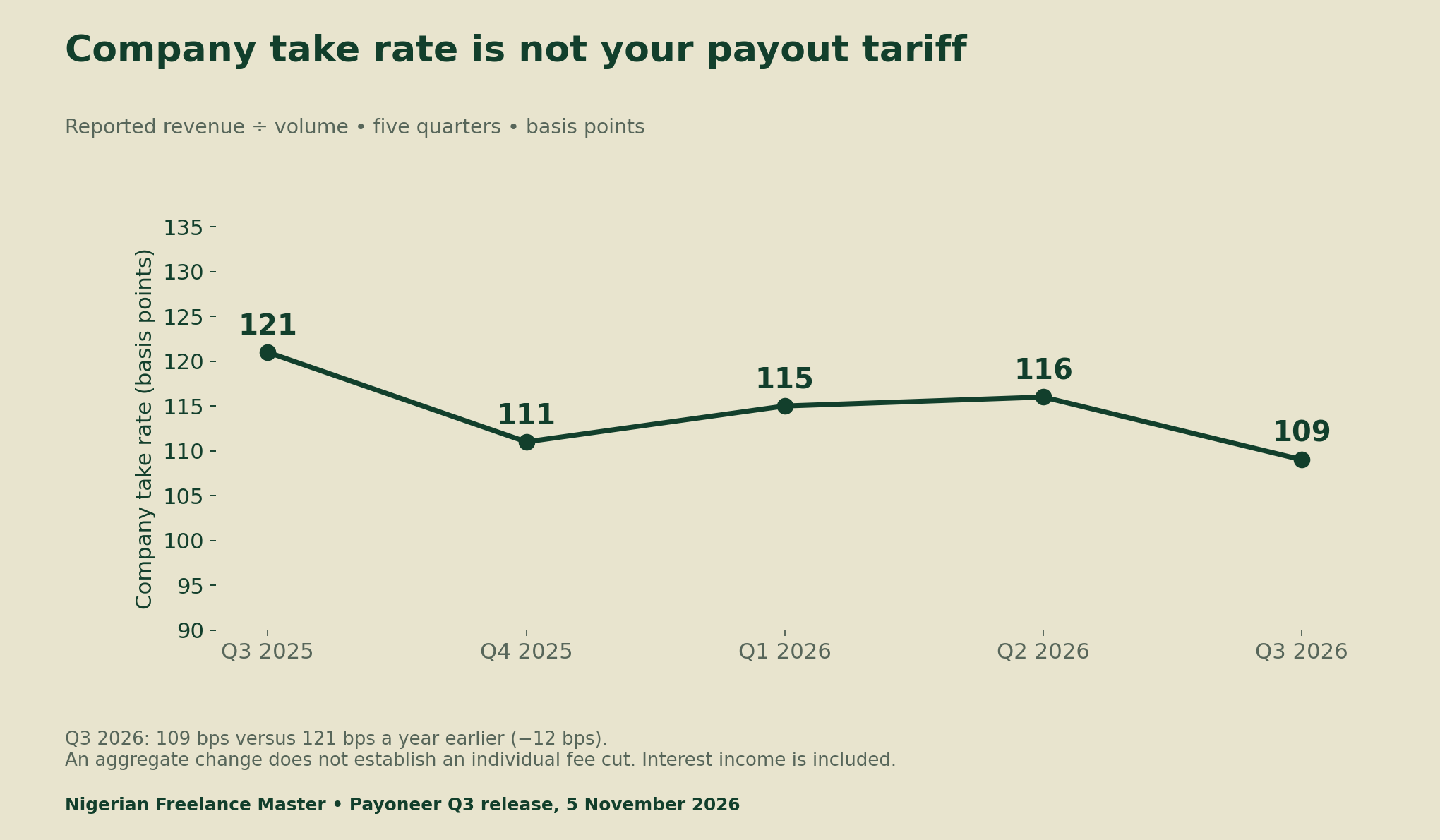
Those aggregates combine activities and customer groups. They do not identify your receiving method, corridor, conversion quote or bank charge. Avoid applying the company take rate directly to a freelance invoice, and do not infer a personal saving from its year-on-year change.
Check the actual route for Payoneer fees in Nigeria
The official pricing page, labelled last updated 1 January 2026 and checked 10 November, says charges vary by method, currencies, locations and corridor. Full account-specific details are available in the signed-in Fees section. A public pricing summary is not a quote for every Nigerian account.
One easily confused figure is US$3.15. On that page it belongs to certain card cash withdrawals, with additional percentage charges possible. It is not a universal Nigerian bank-withdrawal charge. Keep a card cash withdrawal separate from a transfer to a bank account.
For your own comparison, record the route, currencies, fee components, rate direction, quoted net amount and time. You do not need to share account identifiers or private statements publicly. The blank ledger accepts a private evidence reference instead of sensitive details.
Calculate a fictional $500 invoice step by step
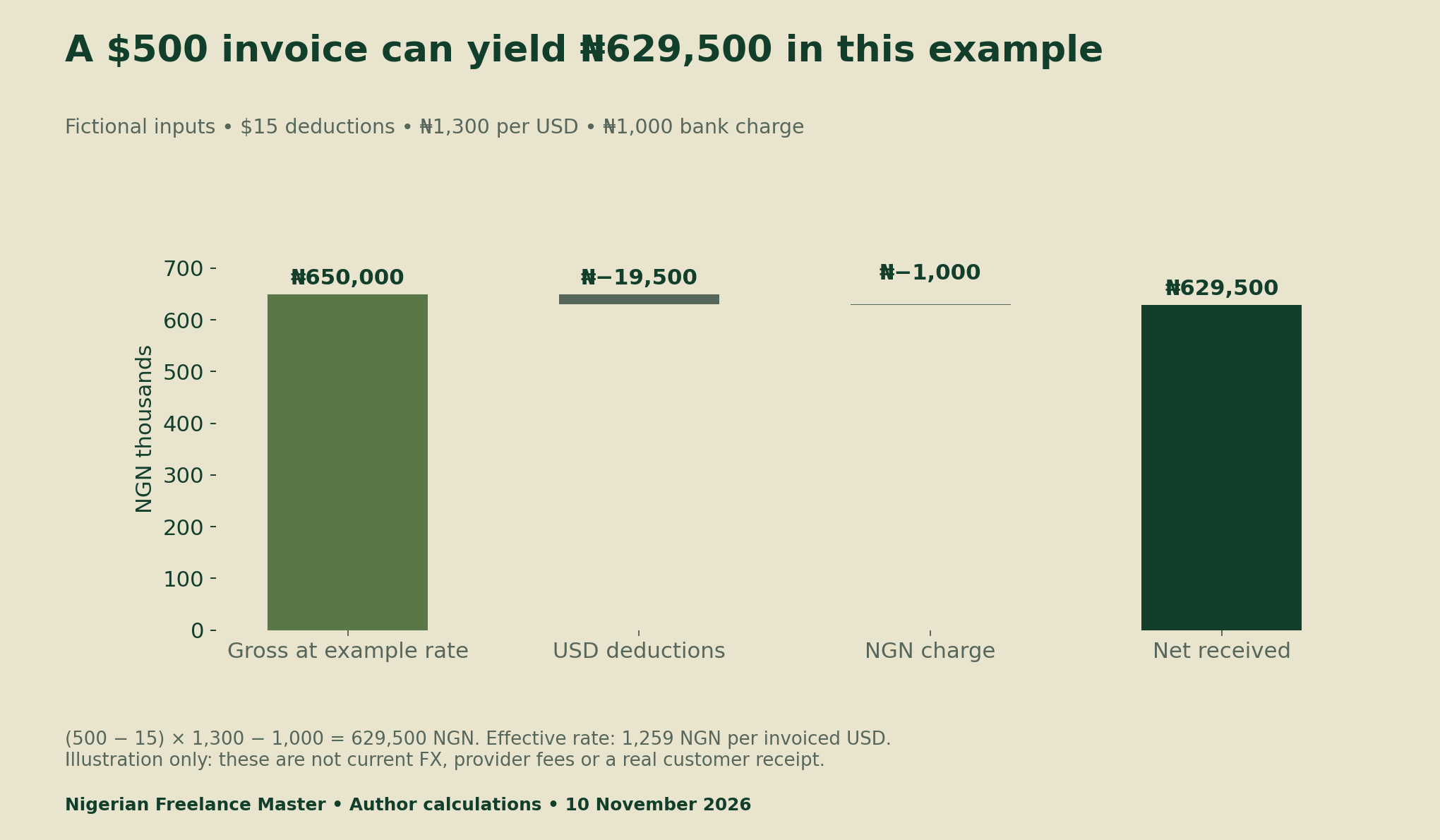
Let G be the gross invoice in dollars, D the included dollar deductions before conversion, R the quoted naira per dollar and B the charges after conversion in naira. Then net NGN = (G − D) × R − B. The units matter: subtract like currencies before converting, then subtract charges expressed in the destination currency.
Our fictional example uses G = US$500, D = US$15, R = ₦1,300 per US$1 and B = ₦1,000. It leaves US$485 to convert, producing ₦630,500 before the bank charge and ₦629,500 after it. Dividing by the original US$500 gives ₦1,259 per invoiced dollar.
Net payout calculator
Fictional defaults. Enter your own dated quote. This tool runs in your browser and does not move money.
Do not enter a charge twice. A spread already embedded in the quoted rate is not an additional deduction. Annual allocation is a planning cost, not a new bank debit. A negative result is a cost warning.
Do not count the same cost twice
Choose one starting point and stay consistent. If you start with the gross invoice, include all relevant deductions between that invoice and the final receipt. If your evidence starts with an already reduced wallet balance, do not subtract the earlier receiving fee again while calling that balance the gross invoice.
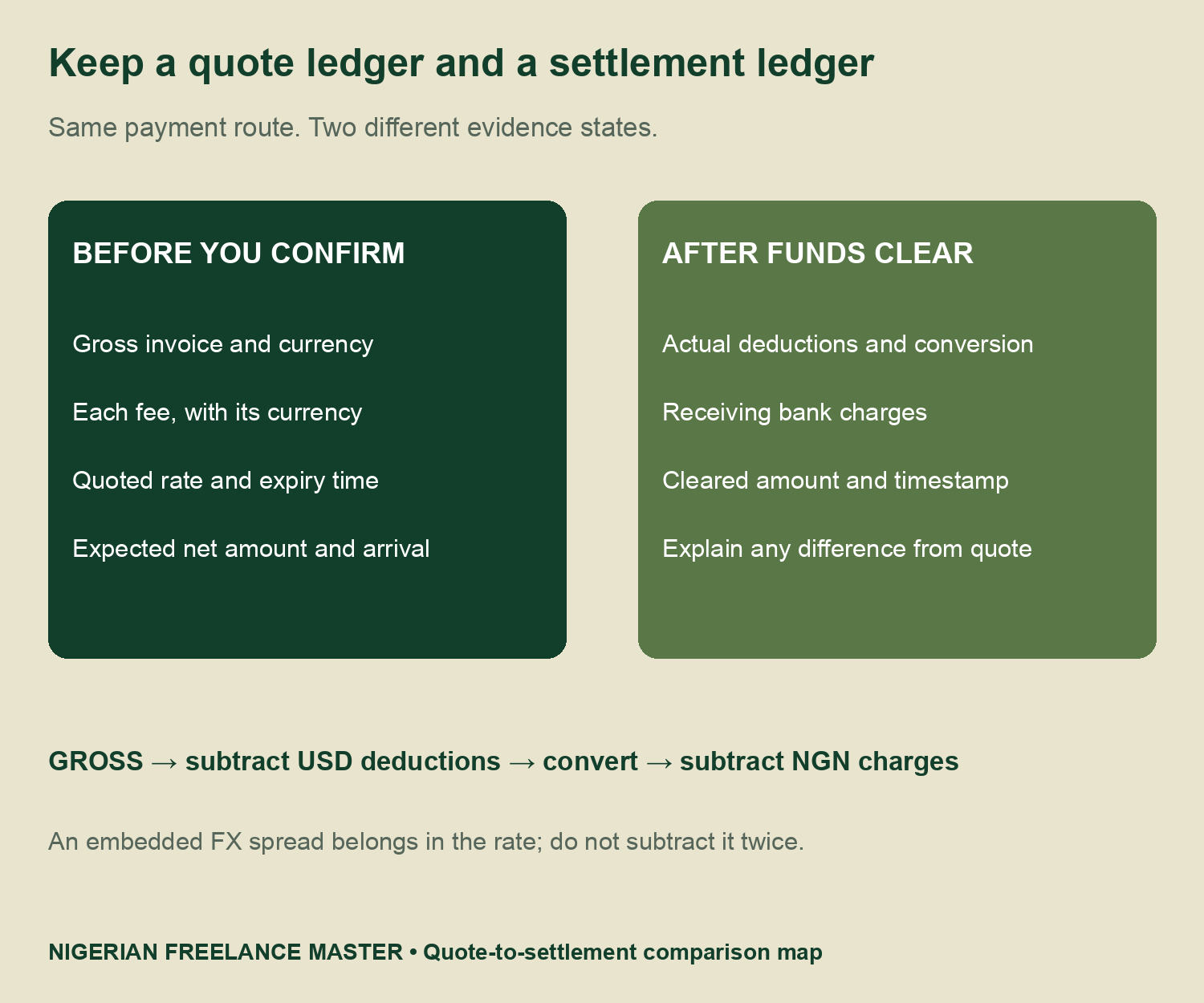
The same rule applies to exchange-rate spreads. A quoted rate may already incorporate a conversion margin. Enter that quoted rate as R; do not subtract an estimated spread again unless you have evidence of a separate charge outside it. Likewise, a net quote may already include the receiving-bank cost.
The optional annual-cost allocator is separate from transaction net. Enter an annual cost in naira and the number of transactions sharing it; the tool shows A ÷ N and a planning net after that allocation. It does not claim the provider debits that amount on each payout. Do not allocate an expense again if you already counted it in D or B.
Compare both the rate and the fee
A low visible fee can coexist with a less favourable conversion rate. Our sensitivity chart holds the invented invoice and deductions constant while changing only R. At ₦1,200, ₦1,300 and ₦1,400 per dollar, the fictional net receipts are ₦581,000, ₦629,500 and ₦678,000.
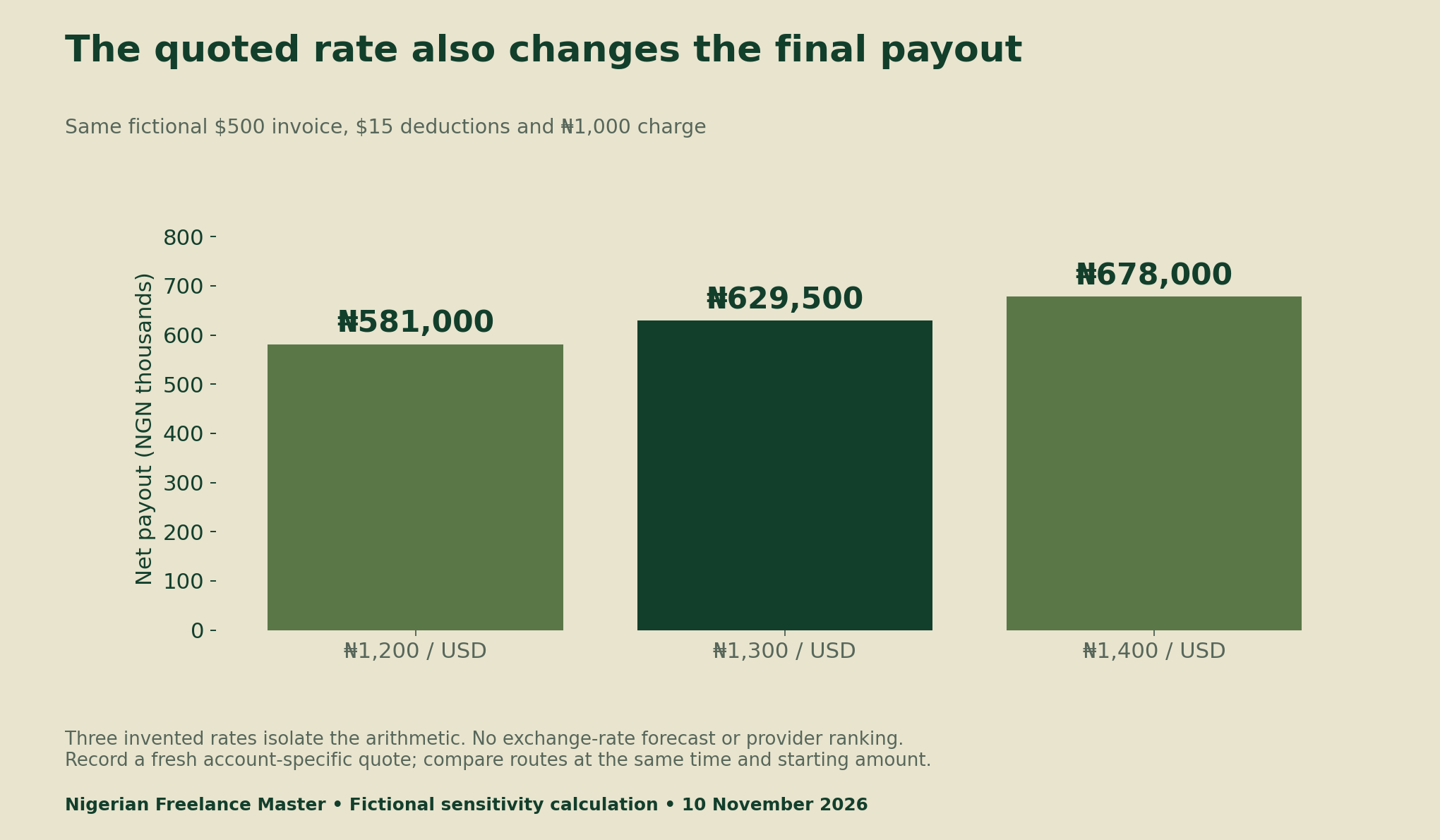
Compare quotes for the same starting amount, destination and approximate time. Record expected arrival as well as net value. A slower route may create a separate cash-timing problem even when its quoted net is larger. Do not assume a quoted amount is already cleared cash.
Keep a small, private payout audit
Use the ledger for your own recent transactions and retain the evidence privately. Record a fee as unknown when you cannot verify it. Do not silently fill missing charges with zero. Mark entries as quotes or settlements so an unfinished transfer cannot be mistaken for a completed receipt.
If you later collect contributions from other freelancers, obtain consent, minimise personal data and document which routes and dates are covered. A few volunteer receipts would still be a convenience sample. This report contains no such participant study and makes no representative claim about Nigerian users.
- Quarterly company context and source register (CSV)
- Fictional net-payout calculations (CSV)
- Blank private quote and settlement ledger (CSV)
- Payout units and double-counting dictionary (CSV)
Our payment-delay continuity guide helps distinguish a payment instruction from cleared cash. Our data-budget calculator covers another operating-cost line. Neither establishes the fees on your payment account.
Method and limitations
Research checked 10 November 2026. Corporate figures come from Payoneer’s quarterly release; pricing scope comes from its official public page. We verified the fictional arithmetic and calculator boundaries. The rate assumptions are deliberately invented, and the calculator contains no live FX feed, account connection or payment function.
This is a calculation and evidence-recording guide, not a recommendation to choose a particular provider, evade requirements or make an investment. Recheck the account-specific quote before acting. Suggested citation: Nigerian Freelance Master, “Payoneer Fees in Nigeria: Calculate Your Net Payout,” 10 November 2026. Send source-backed corrections through our contact page.