







AI freelance job screening should begin with a practical question: can you deliver this particular job with the files, permissions, tools and time you actually have? A confident model response cannot answer that question on its own. For a Nigerian freelancer paying for data, software or proposal credits, checking the brief first can protect a limited bidding budget.
This report separates a new research result from our own reusable screening method. It includes two charts, a decision-tree infographic and four CSV downloads. The twenty paired practice cases are synthetic teaching material. The experiment register is blank because we have not run a controlled model or participant study on those cases.
What the AI freelance job screening study tested
The PayWorthy preprint, submitted 3 November 2026 by Upwork-affiliated researchers, uses 1,494 selected freelance postings across twelve categories. An agent attempts a deliverable from the posting alone, in one response without tools. An LLM judge supplies the headline acceptance label. This is not a survey of Nigerian freelancers or evidence of their earnings.
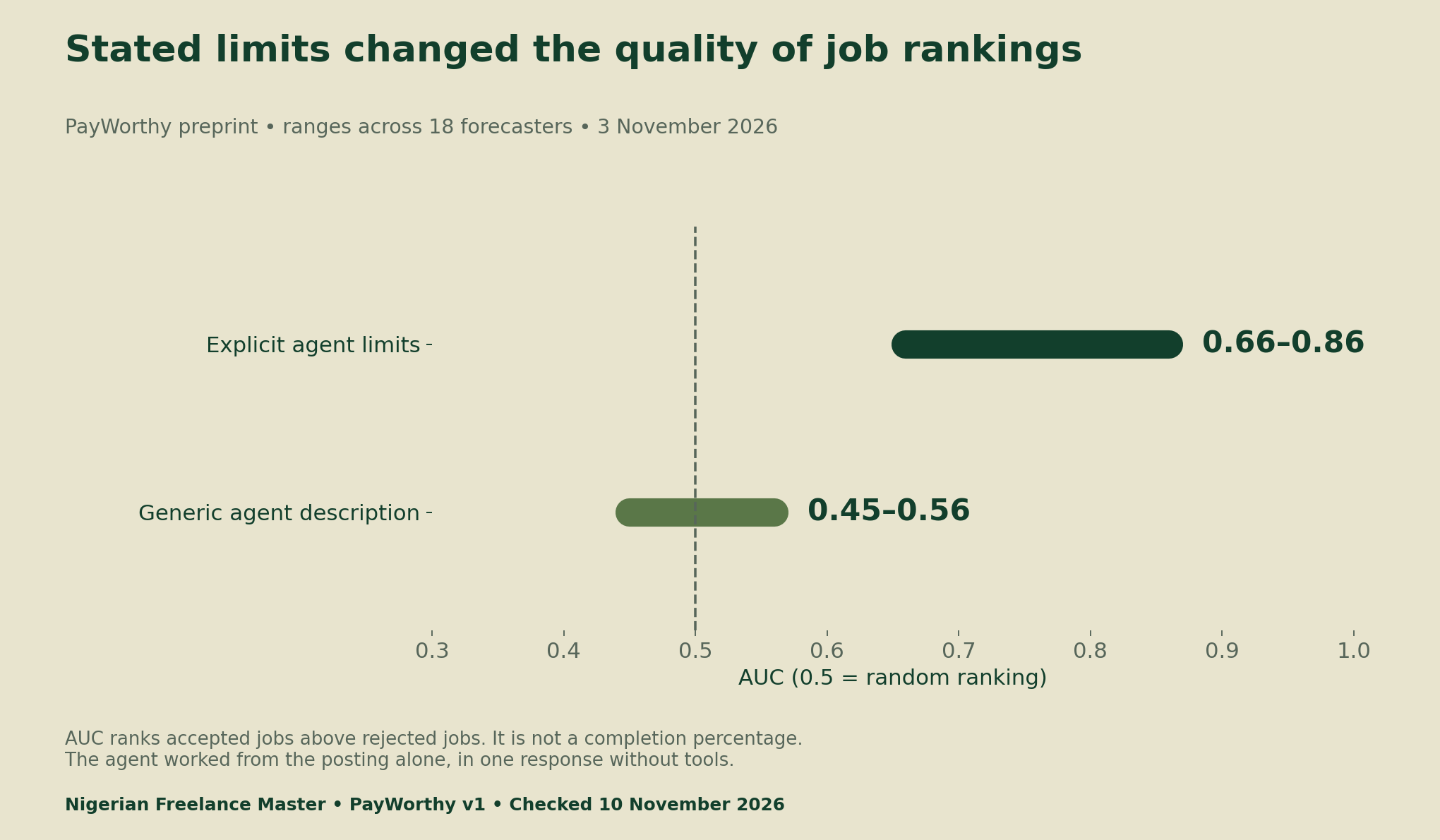
AUC asks whether an accepted job ranks above a rejected job; 0.5 is a random-ranking reference. It does not turn 0.86 into an 86% personal success chance. The category-capped, deliverable-oriented sample and simulated-client grading also limit generalisation. Treat the preprint as a reason to describe constraints accurately, rather than a guarantee about any tool or market.
Ask for inputs before writing the proposal
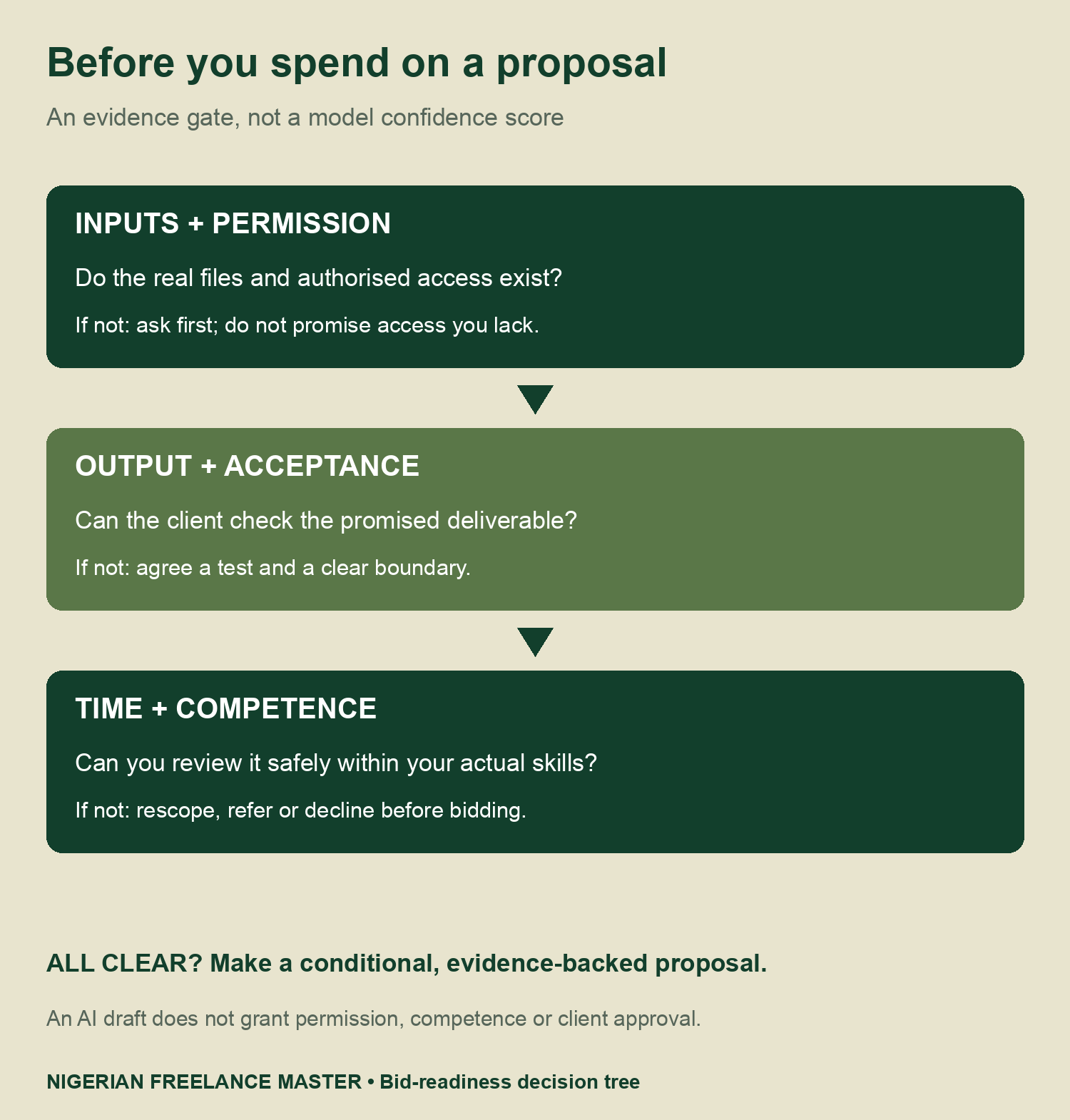
A job can sound simple while depending on a missing source file. “Clean our spreadsheet” tells you little about the workbook, sensitive fields, row count, formulas or required checks. A screenshot may be useful for discussion, yet it cannot replace the editable data needed to reproduce the work.
Ask for a safe sample, the expected output and permission to use the relevant material. Keep real client information out of public prompts and practice packs. Where confidential data is involved, agree the authorised environment before transferring it. An accessible file is not automatically a file you may upload to any service.
Record each unresolved dependency in the readiness ledger. Avoid hiding it inside a broad claim that you can “handle everything with AI.” A conditional proposal can name what you will deliver after the client supplies approved inputs, and what remains outside the price.
Separate an authorised route from a technical possibility
Knowing how to edit a website does not give you permission to change its production account. A model can draft code while the actual deployment route remains unavailable. Ask who owns approval, whether a staging environment exists and who will publish the final change.
Prefer the minimum access required for the agreed work. Do not ask a client to send a password into a chat when an approved collaborator role or offline copy is sufficient. If the route is unclear, pause that part of the scope and clarify it before promising delivery.
Define a result the client can verify
“Make it professional” is a preference, not a reproducible acceptance test. Replace it with a deliverable, a checking method and a named decision maker. For a short article, that might mean a fixed length, supplied tone examples, source links and an editor review. For a spreadsheet, it might mean matching control totals and explaining exceptions.
A useful acceptance rule can still require judgement. The purpose is to expose that judgement early, rather than pretend every task has a simple automated score. Agree how revisions will be handled and which changes would count as new work.
Reserve time for review and know your boundary
An AI draft can arrive quickly while factual checking, testing and revisions take much longer. Build those steps into the delivery window. Include realistic power, connection and collaboration constraints when planning your own availability; this report does not estimate an average Nigerian freelancer’s downtime or costs.
Some work also needs specialist competence, certification or regulated judgement. Drafting an explanation is different from signing an engineering certificate, approving a tax filing or providing a binding legal opinion. Offer a bounded support task when appropriate, with the qualified reviewer responsible for the specialist decision.
If you cannot safely check the result, do not price the job as if the draft is the finished product. State a review dependency or decline that scope. This protects the client and makes the proposal more credible.
Use the twenty-case practice pack without inventing results
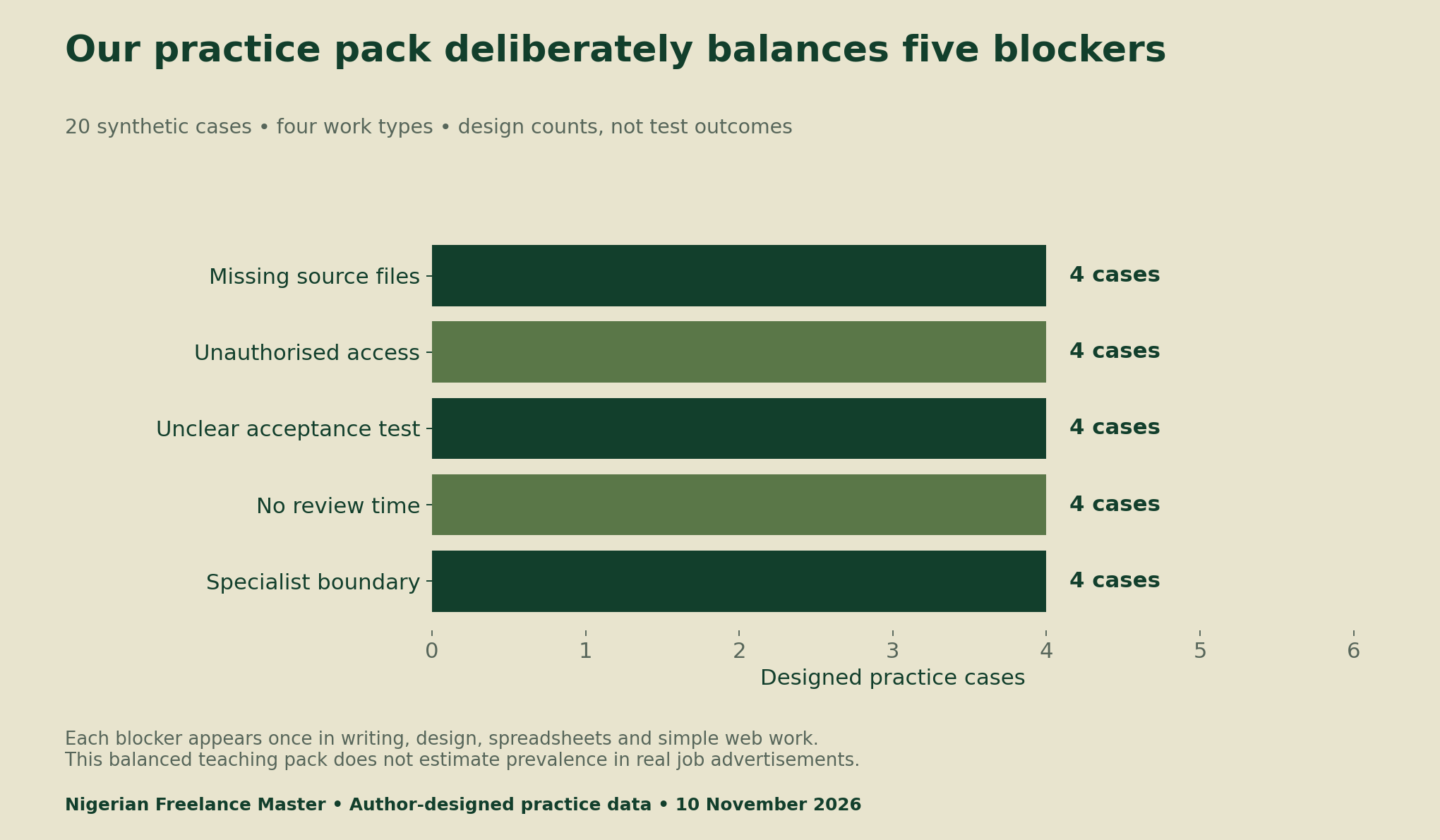
Our pack contains five cases in each of four work types: writing, design, spreadsheets and simple web work. Within each type, one case highlights each of five blockers. Every case has a minimal request, a designed blocker answer key and a clarification that changes the named issue. Other requirements still need checking.
For example, a minimal request says “repair the contact page” but supplies no source. Its clarified version supplies relevant HTML, CSS and a reproducible issue. That resolves the designed missing-file problem. It does not establish deployment permission, security, every browser result or client acceptance.
Read the answer key yourself before using the pack. You can practise identifying the dependency, drafting a clarification question and proposing a safe next step. Do not substitute these invented cases for an audit of actual client outcomes.
A reproducible model test needs a fixed protocol
If you run a comparison later, first save the exact model version, settings, prompt and date. Freeze the case wording and answer key before viewing outputs. Randomise which version is presented first, keep each run separate and retain the output needed to check each score.
Count a correctly identified known blocker separately from a missed blocker and a false alarm. A false alarm means the response claims a particular problem remains when the clarified case explicitly resolves it. Record the actual explanation, because a generic warning about every possible risk is not the same as detecting the relevant dependency.
Use raw counts before any percentages. Write down the denominator for each measure and retain disagreements for review. Time and tool cost need their own units. Do not compare a fast unchecked response with a slower reviewed result as if they provide the same service.
The downloadable register has empty result cells, not zeros. No blank cell should be interpreted as “no errors.” We make no before-and-after claim, model ranking or Nigerian bidding-success estimate from this unrun protocol.
Download the AI freelance job screening tools
- Paper metric and scope register (CSV)
- Twenty paired synthetic practice cases and answer key (CSV)
- Blank bid-readiness evidence ledger (CSV)
- Blank reproducible experiment register (CSV)
For related context, read our guide to interpreting advertised automation budgets. Our eligibility screening guide adds checks on location and engagement conditions. Budget, eligibility and technical feasibility answer different questions; a strong proposal needs all relevant evidence.
Method, limitations and citation
Research checked 10 November 2026. We retained the primary paper, transcribed its headline AUC ranges and documented their meaning. We then authored twenty synthetic paired cases and checked their balance: four work types × five blockers = twenty. The decision tree and worksheets are editorial tools, not validated predictions or legal advice.
There is no recruited participant sample, measured model experiment, client payment record or Nigerian earnings dataset in our practice pack. We do not claim an independent specialist reviewed it. Refresh the paper version and your actual tool limits before reusing the evidence.
Suggested citation: Nigerian Freelance Master, “AI Freelance Job Screening: Test Feasibility Before You Bid,” 10 November 2026. Credit PayWorthy for its published measures and this report for the practice pack and screening framework. Send source-backed corrections through our contact page.