



The 3MTT delivery partner decision for Nigerian freelance trainers starts with the service you already operate. Can you document a credible training offer, its costs and the evidence behind its outcomes? The new Delivery Network separates ordinary membership from funded delivery. Therefore, joining one route does not mean you have secured the other.
This guide provides a fictional evidence-readiness matrix and a blank own-cost worksheet. It is aimed at trainers who run a delivery business, not learners looking for a course or individuals expecting a guaranteed grant. No real learner records or application documents are collected here.
3MTT delivery partner: distinguish the launch from the opening date
The official partner portal lists the launch event on 17 November 2026 and guidance sessions on 13–20 November. However, the ministry announcement dated 11 November already opened applications. The event supplies this week’s news hook; it was not the first application day.
The ministry describes about ₦4 billion earmarked across Cohorts 5 and 6. That is programme context, not one trainer’s award or a per-cohort amount. Its Cohort 5 funding deadline is 30 November 2026 at 23:59 WAT. Membership stays open with quarterly reviews. Recheck the official dates before acting.
Decide whether you are exploring membership or funding
The two routes have different implications. Enabled membership gives an accepted partner a place in the delivery network. Funded delivery requires a further selection and an agreed delivery arrangement. Consequently, an acceptance message about membership should not be recorded as a funding award.
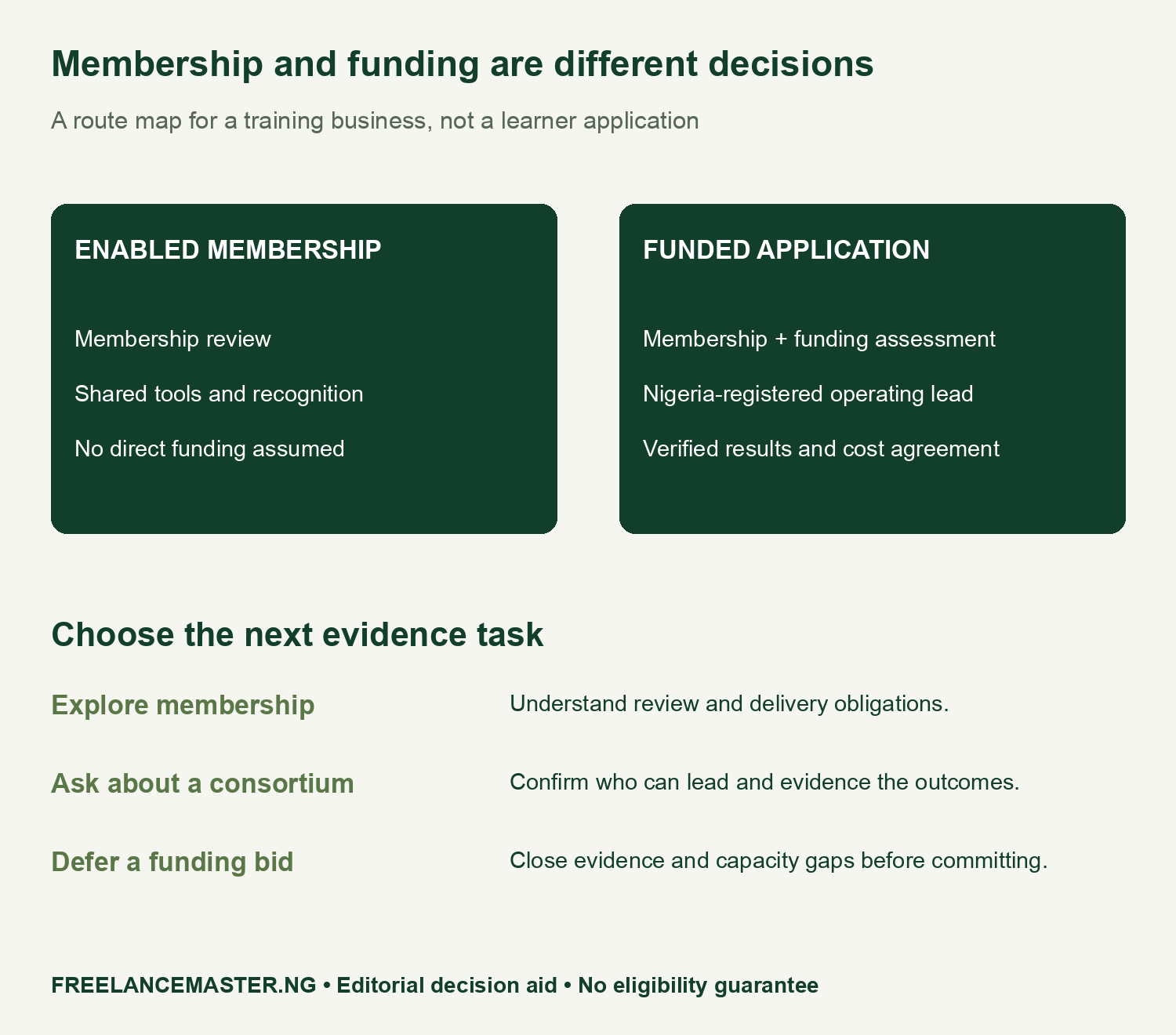
For a funded application, including a consortium, the lead must be an organisation registered and operating in Nigeria. An individual trainer can explore the network without assuming they can lead a funded bid personally. Before discussing a consortium, identify the proposed lead, its real delivery role and who would own each obligation.
Meanwhile, a partnership enquiry is not a signed commitment. Keep early discussions factual: your training scope, available teaching capacity and unresolved evidence questions. Do not promise placements on another organisation’s behalf or copy a prospective partner’s learner data into a public portfolio.
Teaching hours and verified outcomes are different evidence
The portal identifies four results: learning commenced, skills verified, an earning opportunity secured, and that opportunity sustained six months later. Its applicant guidance also distinguishes membership from results-based funding. None of this makes teaching attendance alone proof of all later outcomes.
Our example provider has a start record and a skills-assessment record in its fictional pack. It cannot yet substantiate opportunities or six-month continuation. The matrix therefore marks two rows available and two missing or not yet possible. This is an internal readiness description, not programme verification.
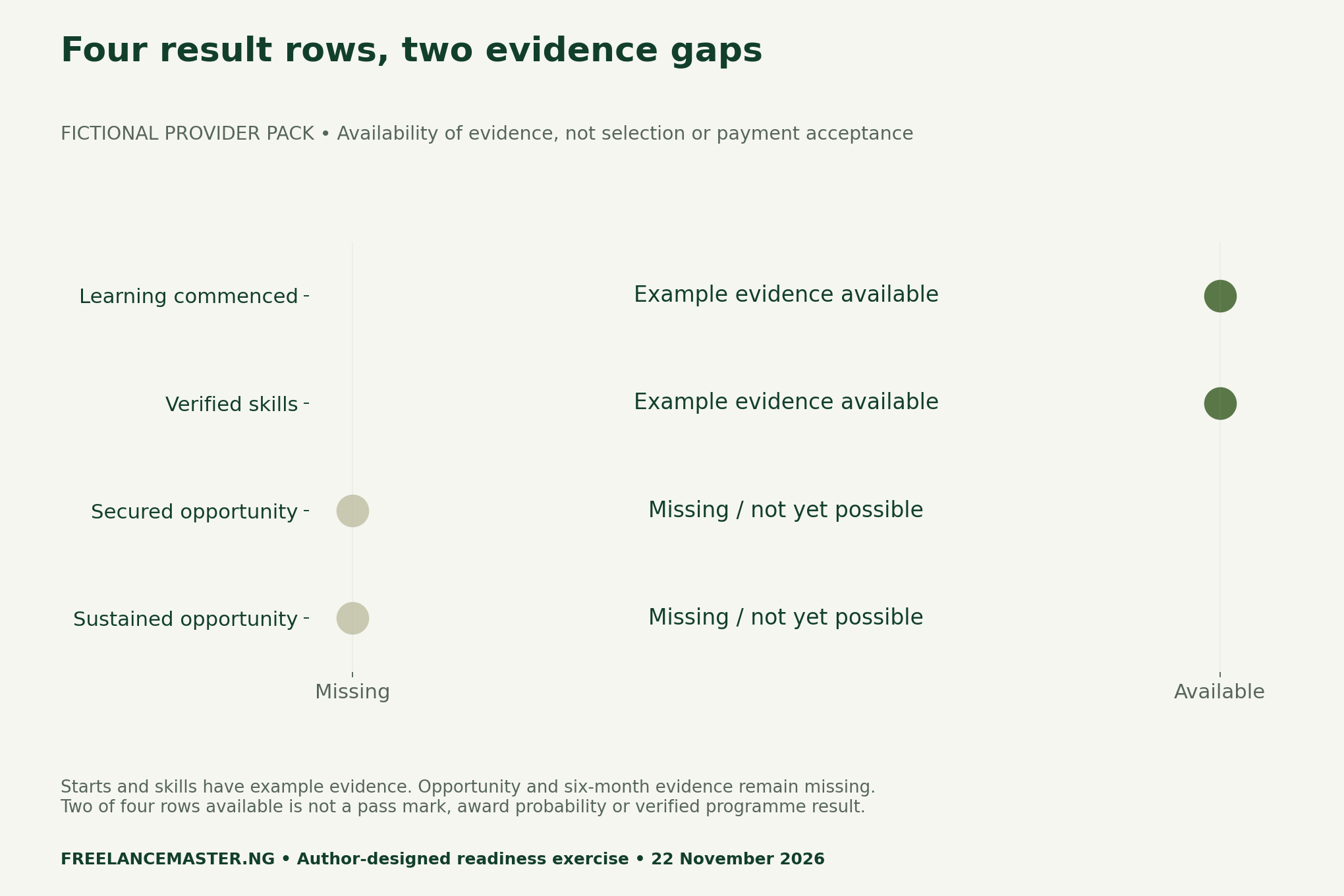
For each row, name a possible attestor, the authorised evidence needed, its collection cost and when verification can occur. Then leave acceptance status open until the responsible programme process actually accepts the evidence. A file existing in your folder is not the same as a verifier approving it.
Price your own capacity before assuming reimbursement
The blank cost sheet separates staff hours, your own hourly-cost assumption, other costs and payment timing. Include preparation, assessment, follow-up, recordkeeping and reporting. Also include any unpaid time required to clarify evidence. Leave unknown rates and reimbursement terms blank rather than estimating them from the programme headline.
For instance, a teaching schedule may fit your calendar while follow-up work does not. In that case, the capacity limit belongs in the decision record before you offer a cohort size. The worksheet deliberately contains no automatic award calculation and no implied payment for each task you list.
Do not divide the approximate programme funding by a learner target to create a rate. Nor should you assume another provider’s prospective terms apply to you. Use only a current official agreement when assessing actual rates, conditions, evidence acceptance and cash-flow timing.
Choose a next step that matches what you can evidence
Explore membership if you want to understand the network and can explain your existing training service. Consider a consortium enquiry if a credible registered lead and complementary partners can substantiate the full offer. Alternatively, defer a funding bid while you close evidence or capacity gaps. None of these choices guarantees selection.
Keep the evidence exercise non-sensitive. Use aliases in working examples and obtain proper authorisation before collecting actual participant information. The download is a planning template; it does not require you to submit identity records, learner lists or employer confirmations to this website.
For a related lesson on defining an inspectable service, read our two-scope portfolio guide. Here, the additional task is deciding whether your training business can support outcomes and reporting over time, rather than merely deliver a class.
Method, limits and reusable tools
We checked the first-party portal, ministry statement and applicant guidance on 22 November 2026. Dates and programme conditions are source observations. The provider pack, readiness statuses and capacity questions are editorial examples. No award, real placement, verified learner outcome, professional assessment or application submission is claimed.
- Fictional four-result evidence-readiness matrix (CSV)
- Blank result-evidence and acceptance register (CSV)
- Blank capacity and own-cost worksheet (CSV)
- Source dates and separate application gates (CSV)
Suggested citation: Nigerian Freelance Master, “3MTT Delivery Network: Is Your Training Business Funding-Ready?”, 22 November 2026. Keep the fictional labels when reusing the readiness figure.