



An AI video ads portfolio for freelancers should show what the buyer will receive. Editable scenes and a finished advert are different deliverables. This Nigerian freelancer guide supplies two fictional 15-second cuts, their editable source packet and a clear record of what stayed constant. It makes no advertising-performance claim.
Upwork’s October 2026 hiring report, published 19 November, reports a three-month growth streak for AI Ad Creation and two months for AI Video Ads. Its public methodology measures distinct hired contracts mentioning a skill across US marketplace clients. These are not Nigerian demand, rate or earnings estimates.
AI video ads portfolio for freelancers: read the signal carefully
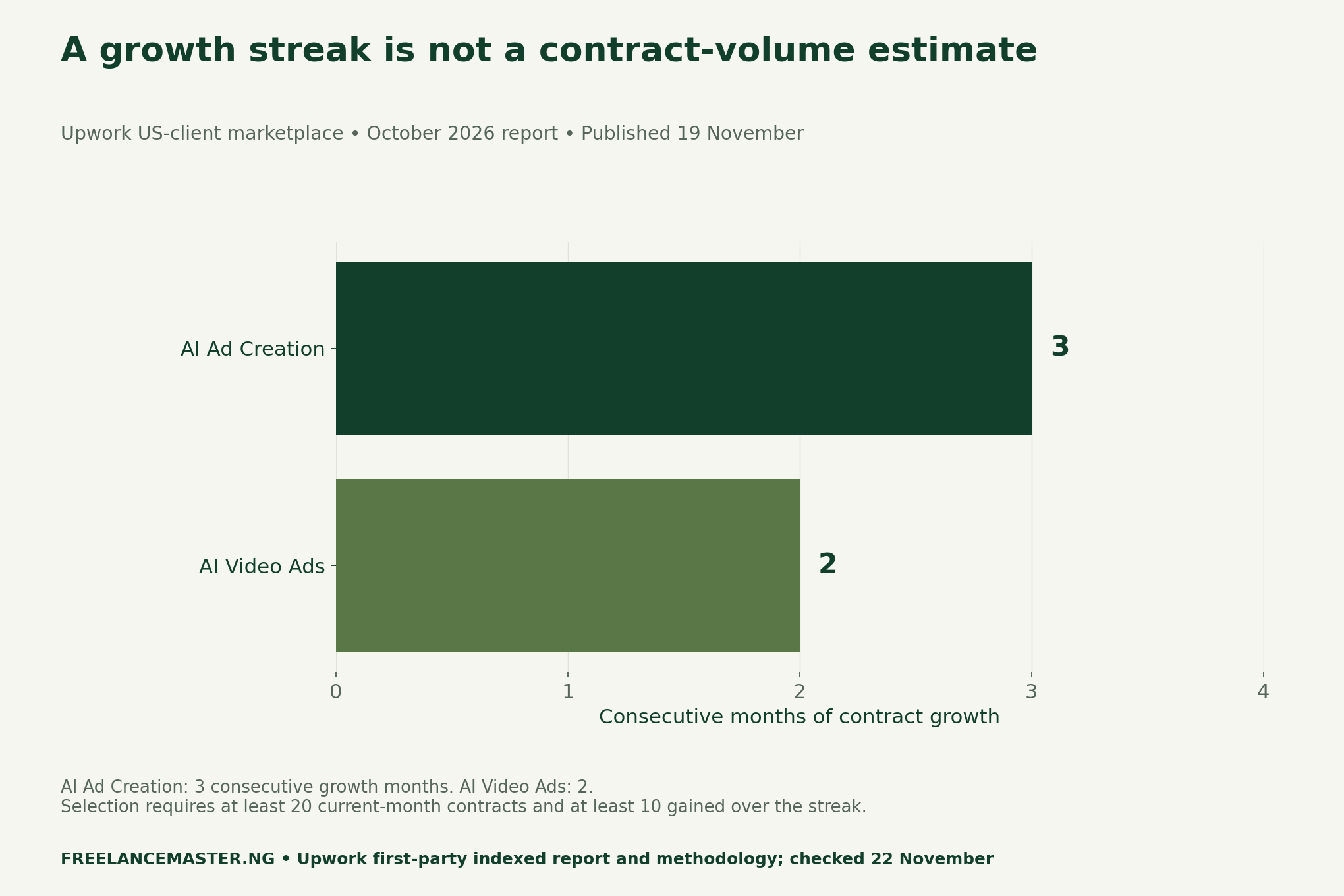
The report’s selection thresholds help explain which streaks appear. They do not tell you how many Nigerian freelancers won work, what a contract paid or how likely a new applicant is to be hired. Use the signal to frame a relevant sample, then let the sample’s actual scope and quality speak for themselves.
Full direct opens of the Upwork report and report index returned 403 during our research check. The dated first-party indexed report and methodology supplied the statements above. We have not inferred hidden chart values or treated search rankings as counts of hired contracts.
Separate scene supply from finishing the advert
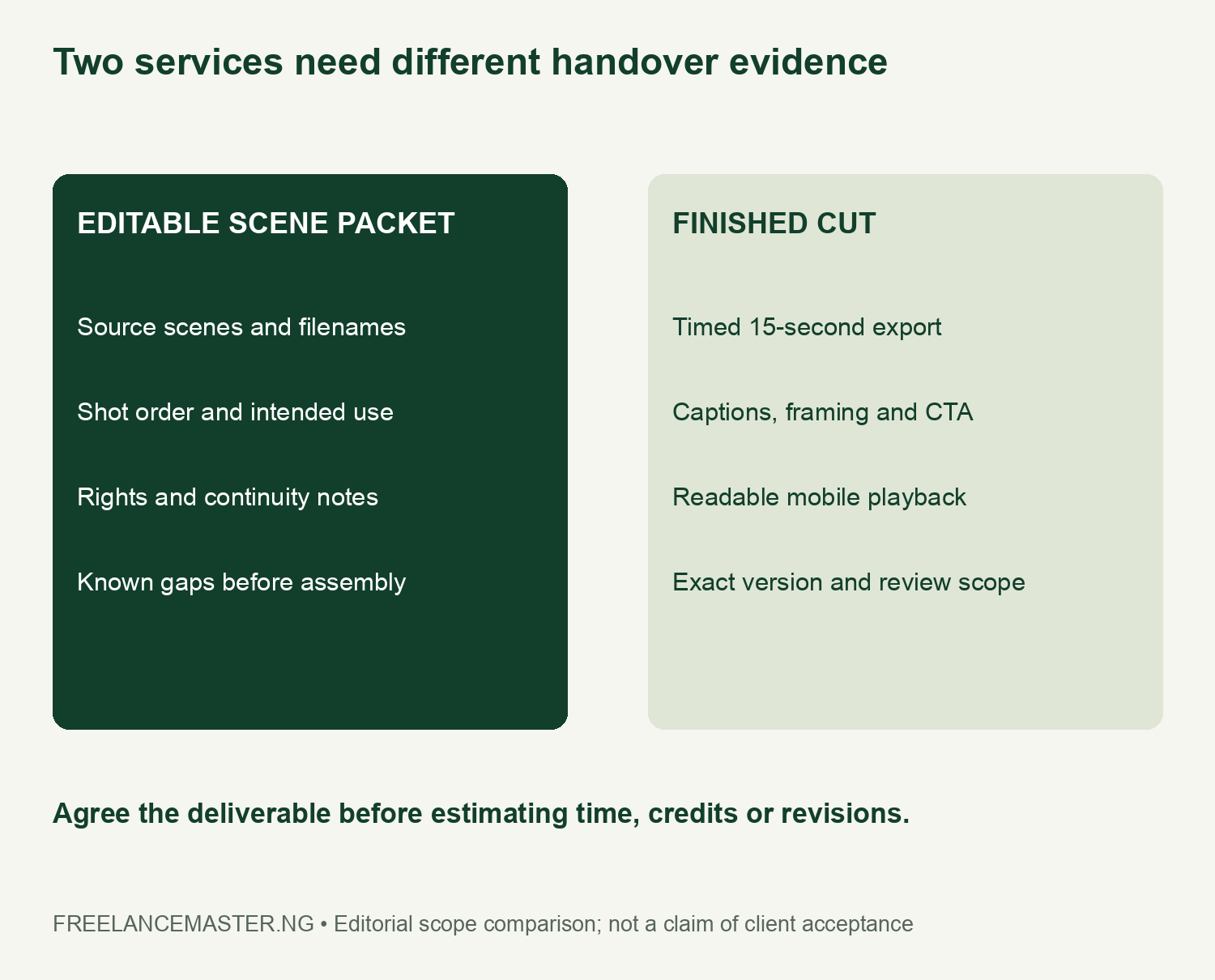
A 19 November client brief asks for final 4:5 and 9:16 outputs, caption checks and attention to the first three seconds. It is one indexed scope example, not representative market data, a confirmed hire or an invitation to accept its terms. Our scene-only scope is a proposed comparison, not a second measured job category.
For scene supply, explain whether the buyer receives editable source files, selected clips or a ready-to-edit packet. For finishing, state the timeline, captions, audio, exports and review versions. Otherwise, a buyer may expect an assembled advert while the freelancer has priced only source generation.
Inspect the two fictional cuts and their source packet
Our invented product is a generic desk organiser. The two 4:5 cuts are silent and use original vector-style drawings. Cut A opens on a closer framing; Cut B opens wider. From second 3 onward, both use the same frames, captions, CTA and motion. No real product benefit, merchant mark or performer appears.
These are inspectable production examples, not output from an AI video-generation service. They demonstrate how to package and control a creative variation. If selling generative footage, add your own properly authorised model output, rights notes and measured tool usage; do not imply these drawings demonstrate that capability.
Download the editable scene packet and renderer (ZIP), or download fictional Cut A (MP4) and fictional Cut B (MP4). The packet includes source code, scene checks, original frames and both exports. It contains no credentials or client material.
Keep the runtime calculation separate from performance
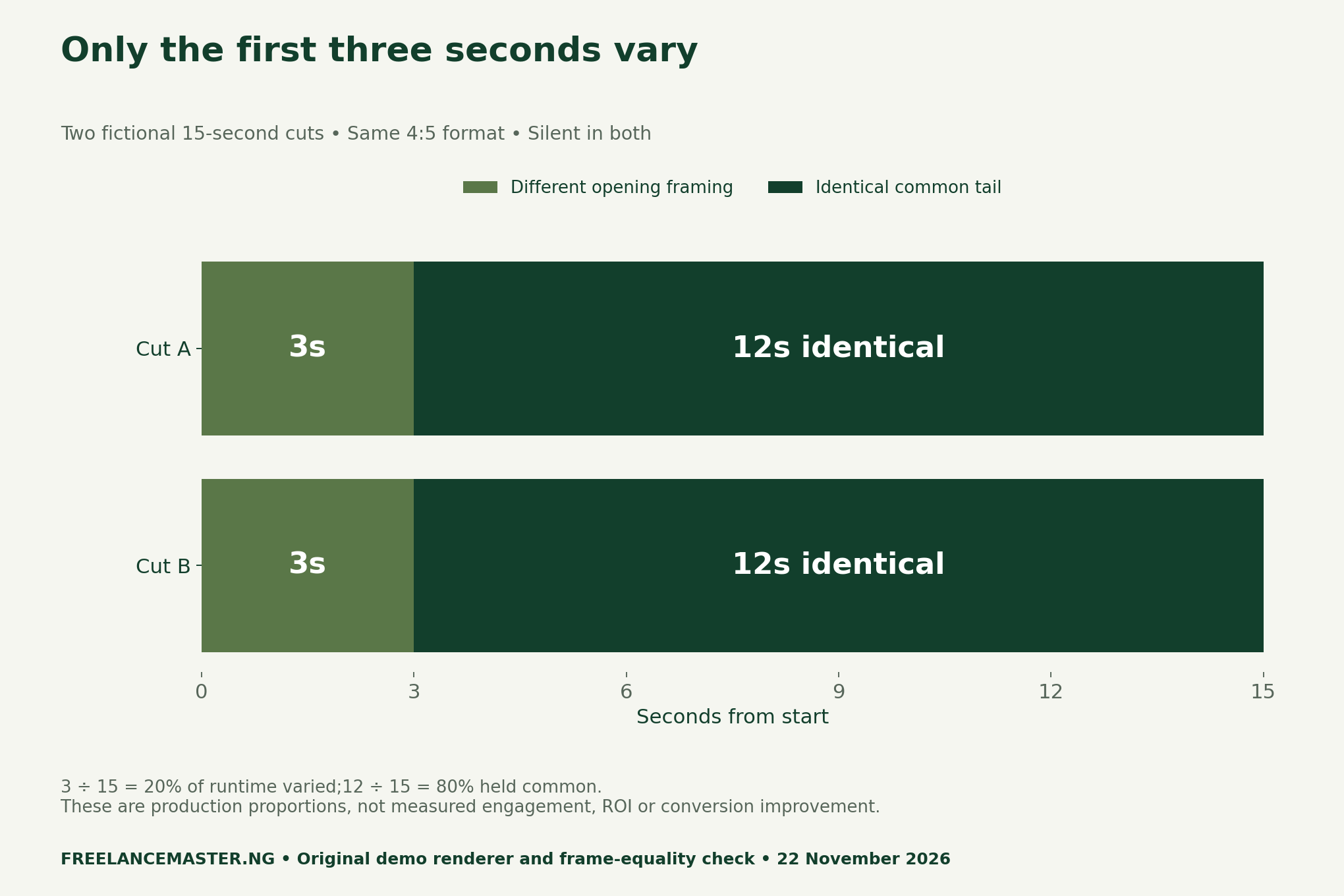
The arithmetic is 3 ÷ 15 = 20% varied and 12 ÷ 15 = 80% common. Our renderer checked all 180 tail frames at 15 frames per second for pixel equality before encoding. Both exported files have a verified 15-second duration and 544 × 680 dimensions. Compression can change encoded bytes without changing the controlled source sequence.
Google Ads’ video-experiment guidance supports controlling variables within eligible campaign settings. Our creative pair is not such a campaign. We bought no traffic, assigned no audience and measured no outcomes. A second aspect ratio would need its own framing check; 9:16 has not been rendered or tested here.
Use a rights and continuity check the client can inspect
The shot manifest names the source, time range, variant or common status and continuity check. The QA sheet separates product identity, likeness, music, source rights, captions and untested formats. Record an actual licence or permission where needed; a tool subscription is not a substitute for checking every asset’s permitted use.
Also keep a generation-credit log. Leave usage blank until measured, with tool, model, attempt, billing unit and accepted or rejected status. Our example cuts contain no generated video footage and make no credit-cost claim. A real production estimate should include failed attempts, editing and revisions as separate work.
When handing over, name the exact cut and its limitations. For example, a 4:5 demo can pass its own framing review while a 9:16 export remains pending. A completed render does not establish client acceptance or campaign success. This makes the portfolio useful without inventing results you have not earned.
Method, limits and four CSV tools
We checked primary material on 22 November 2026 and created the fictional assets locally. The scripts retain the composition calculation and frame-equality check. For broader skill context, see our AI freelance skills data guide. The contribution here is an inspectable deliverable packet, not a claim that a particular tool or course guarantees work.
- Shot, source and continuity manifest (CSV)
- Control-versus-variant production checks (CSV)
- Rights and quality review rubric (CSV)
- Blank generation-credit usage log (CSV)
Suggested citation: Nigerian Freelance Master, “AI Video Ads Portfolio: Show the Scenes and the Finished Cut”, 22 November 2026. Keep the fictional and unmeasured labels with reused assets.