




Searching for remote freelance jobs in Nigeria involves two separate questions: can you work from Nigeria, and is the role actually freelance? A remote label does not settle either question. Before spending an evening on an application, check the original employer’s conditions.
JobRise’s Nigeria report provides a useful example of why the denominator matters. Its 31 October snapshot contains 519 observed listings. Of those, 315 have remote-status coverage and 192 are explicitly marked remote. That produces two different percentages, with different meanings.
This report reconciles the counts, explains their limits and supplies a blank 30-listing screening worksheet. We have not audited 30 employer vacancies or measured an application success rate. The worksheet is a proposed method you can use on current listings.
Snapshot: 31 October 2026, 01:05 UTC. This is a compilation of observed open listings, not a Nigerian vacancy census. No freelance-only vacancy total is established.
What the remote-jobs report actually counts
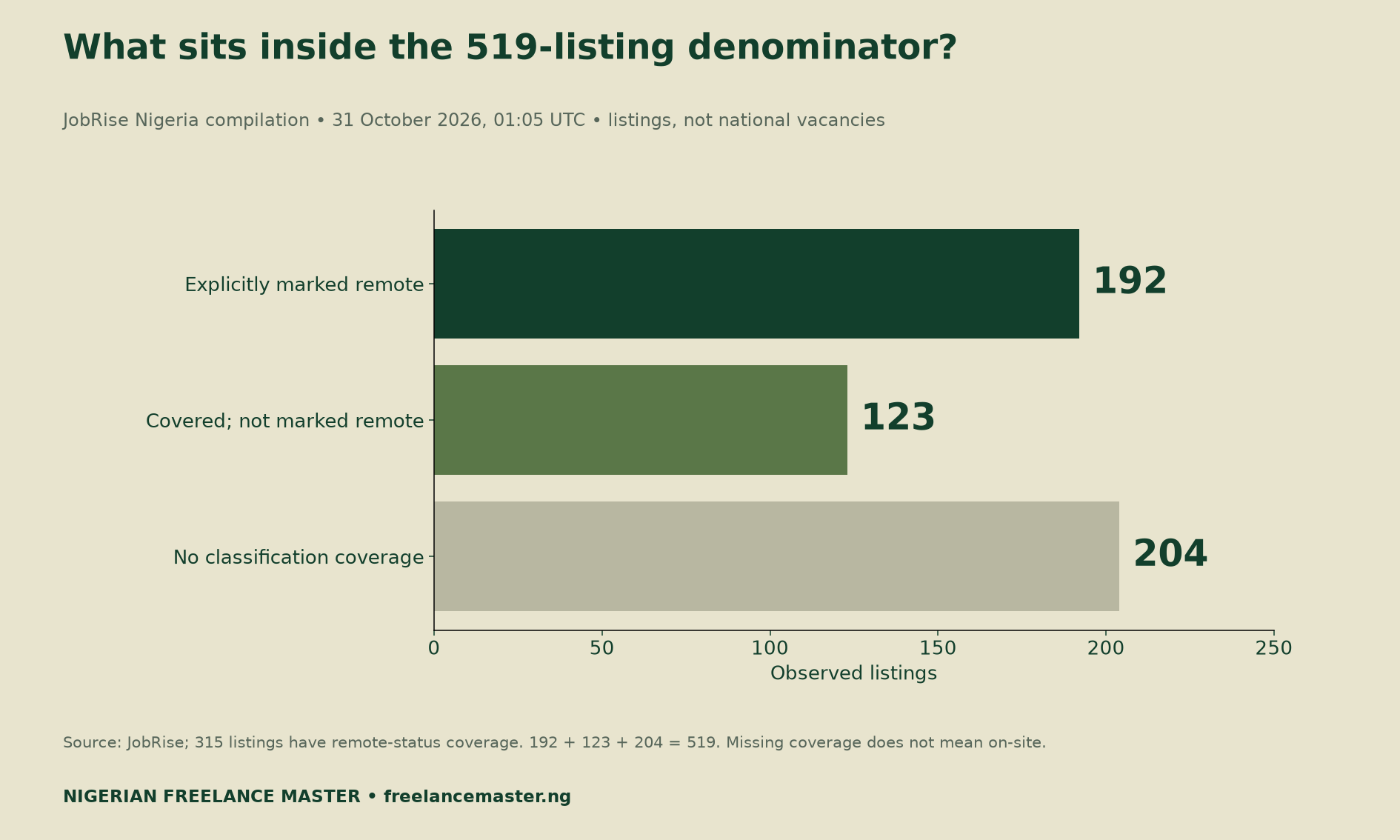
The original JobRise Nigeria report combines listings from several recruitment sources. At the frozen timestamp, 192 were explicitly remote, 123 had classification coverage but were not marked remote, and 204 lacked that coverage. These groups sum to the 519-listing inventory.
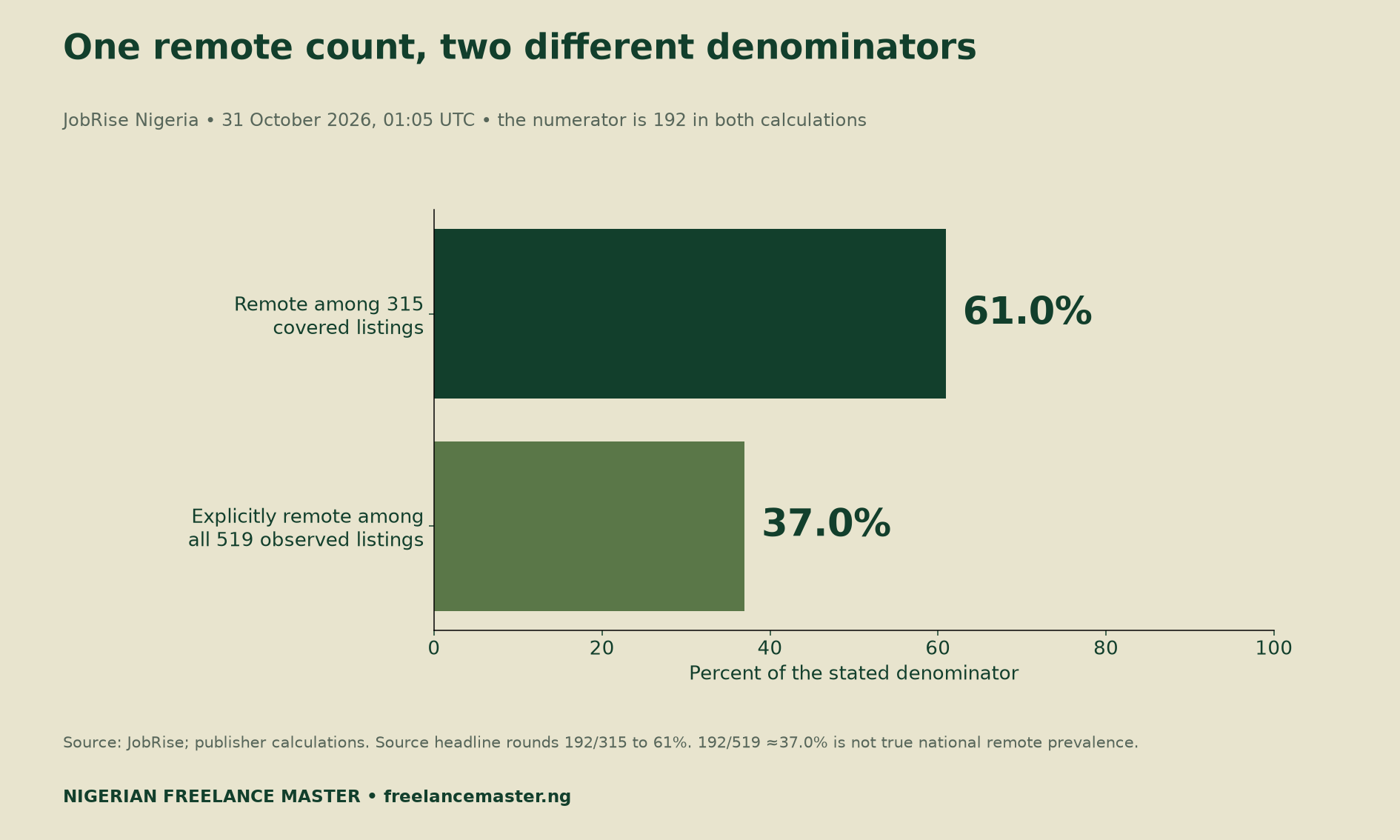
The report’s 61% remote headline uses the 315 covered listings as its denominator. Our calculation is 192 ÷ 315 × 100 = 61.0%, rounded to one decimal place. It does not mean 61% of all Nigerian jobs are remote.
Using all 519 observed listings instead gives 192 ÷ 519 × 100 = 37.0%. That is the explicitly remote fraction of this inventory. Because remote status is unknown for 204 listings, it is not an estimate of the inventory’s true remote-work prevalence.
Why classification coverage changes the interpretation
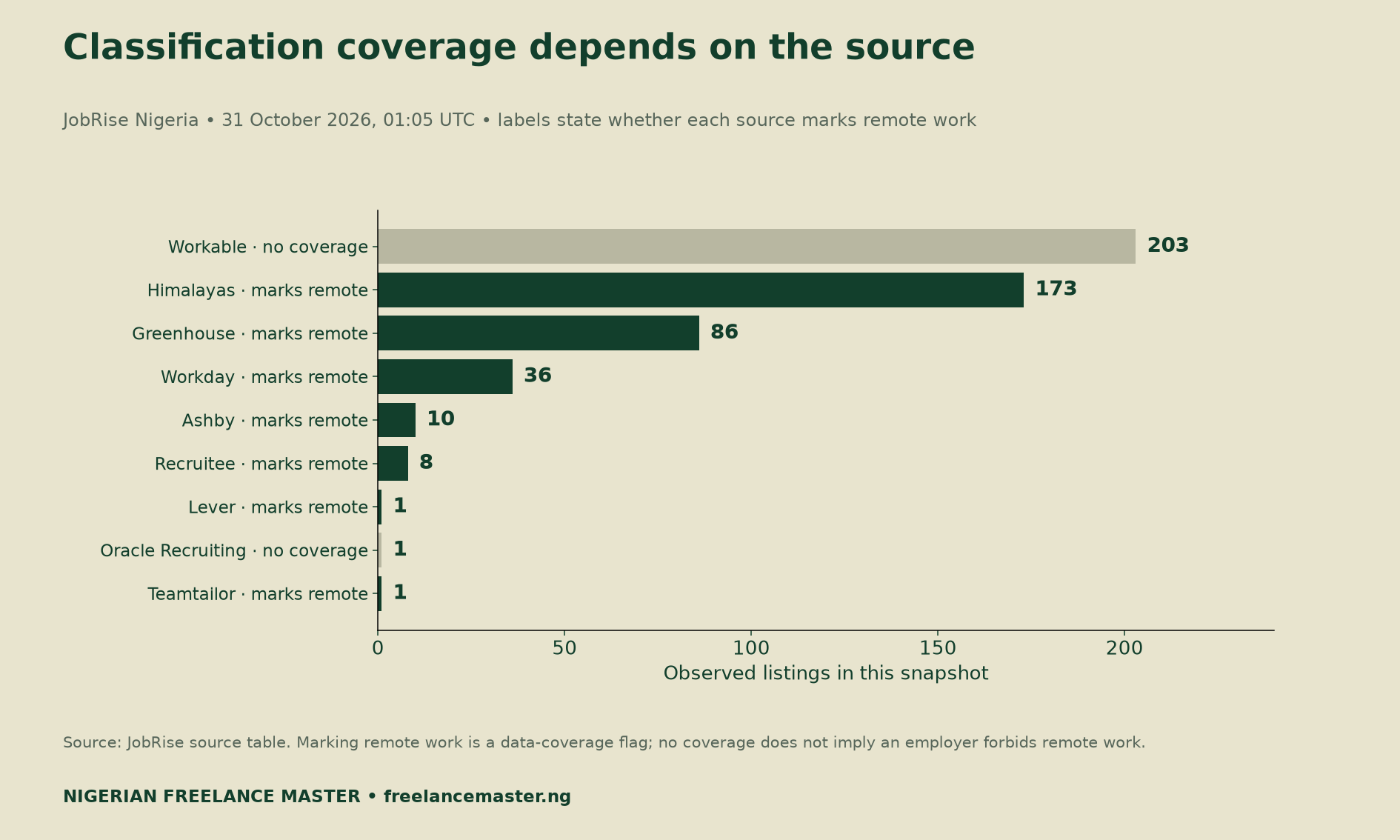
In this snapshot, Workable contributes 203 listings without remote-status coverage. Oracle Recruiting contributes one more without coverage. Together, those 204 listings account for the entire unknown group. This is a source-data limitation, not evidence that those employers reject remote work.
Himalayas contributes 173 listings with classification coverage, followed by Greenhouse with 86 and Workday with 36. Ashby, Recruitee, Lever and Teamtailor contribute the remaining 20 covered listings. The source totals reconcile to both the full inventory and the covered denominator.
JobRise deduplicates by company and title. It assigns multi-location roles to their first listed country, while roles without a single country belong in its global report. These rules affect what appears in a country inventory, so the compilation cannot stand in for the whole Nigerian labour market.
Dates also need care. A listing date may be the employer’s posting date or the date first seen. Older daily counts reflect jobs that remain open and can undercount earlier activity. Do not use this one snapshot to claim that remote hiring is rising or falling.
Screen remote freelance jobs in Nigeria with five checks
Open the original employer page before preparing a detailed application. Record its URL and the time you checked it. Then confirm that applications remain open. A cached aggregator card can outlast the actual vacancy.
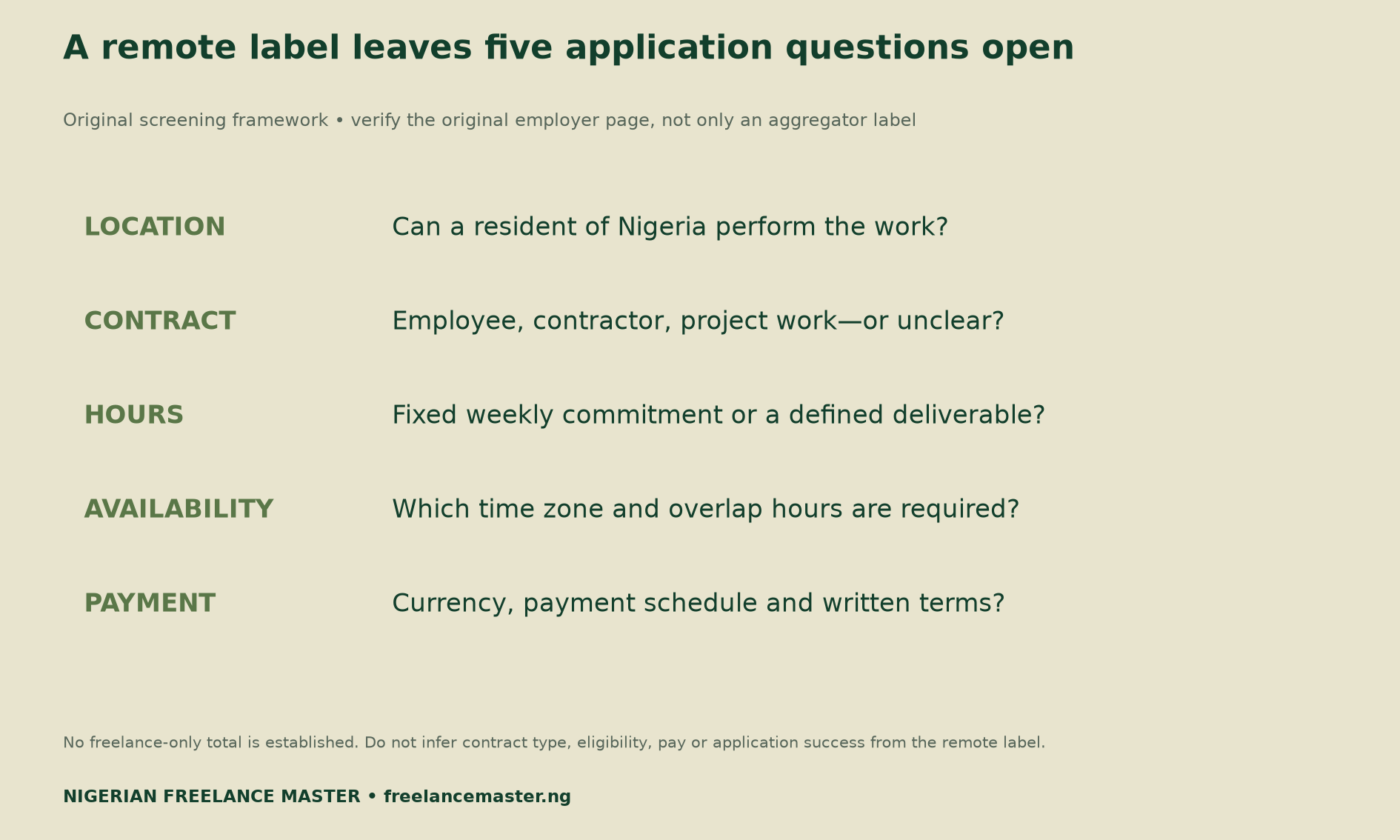
Location: look for a clear statement that a person resident in Nigeria can perform the role. “Remote” may still have geographic limits. Do not assume that nationality, residence and work-location requirements mean the same thing. If the wording is unclear, ask the employer before investing substantial time.
Contract: establish whether the arrangement is employment, independent contracting, a fixed project or something else. A full-time remote employee vacancy is not automatically a freelance opportunity. Record the employer’s actual wording rather than converting every remote result into a contractor lead.
Hours: check the weekly commitment, deliverables and availability expectation. A project with defined outputs differs from an ongoing role requiring fixed working hours. Compare those requirements with your existing commitments before deciding whether an application is practical.
Time zone: identify required overlap hours and the location used to state them. Ask for clarification if the advertisement simply says “business hours.” Record the arrangement you could actually maintain, rather than promising unrestricted availability.
Payment: look for the currency, payment schedule and proposed written terms. Missing information is a question to resolve, not permission to invent a likely rate. This report does not recommend a particular payment provider or estimate take-home income.

Use a repeatable screen instead of an imagined funnel
Our blank worksheet offers 30 numbered rows. Before filling them, choose a reproducible selection rule: for example, the first 30 relevant results under a named sort order at a recorded time. Define the role types you will include. Keep duplicates and exclusions visible in your notes.
For each row, retain the original employer link and evidence for the five checks. Also, mark details as unclear when the page does not answer them. Do not turn a missing contract label into a freelance classification just to increase the apparent opportunity count.
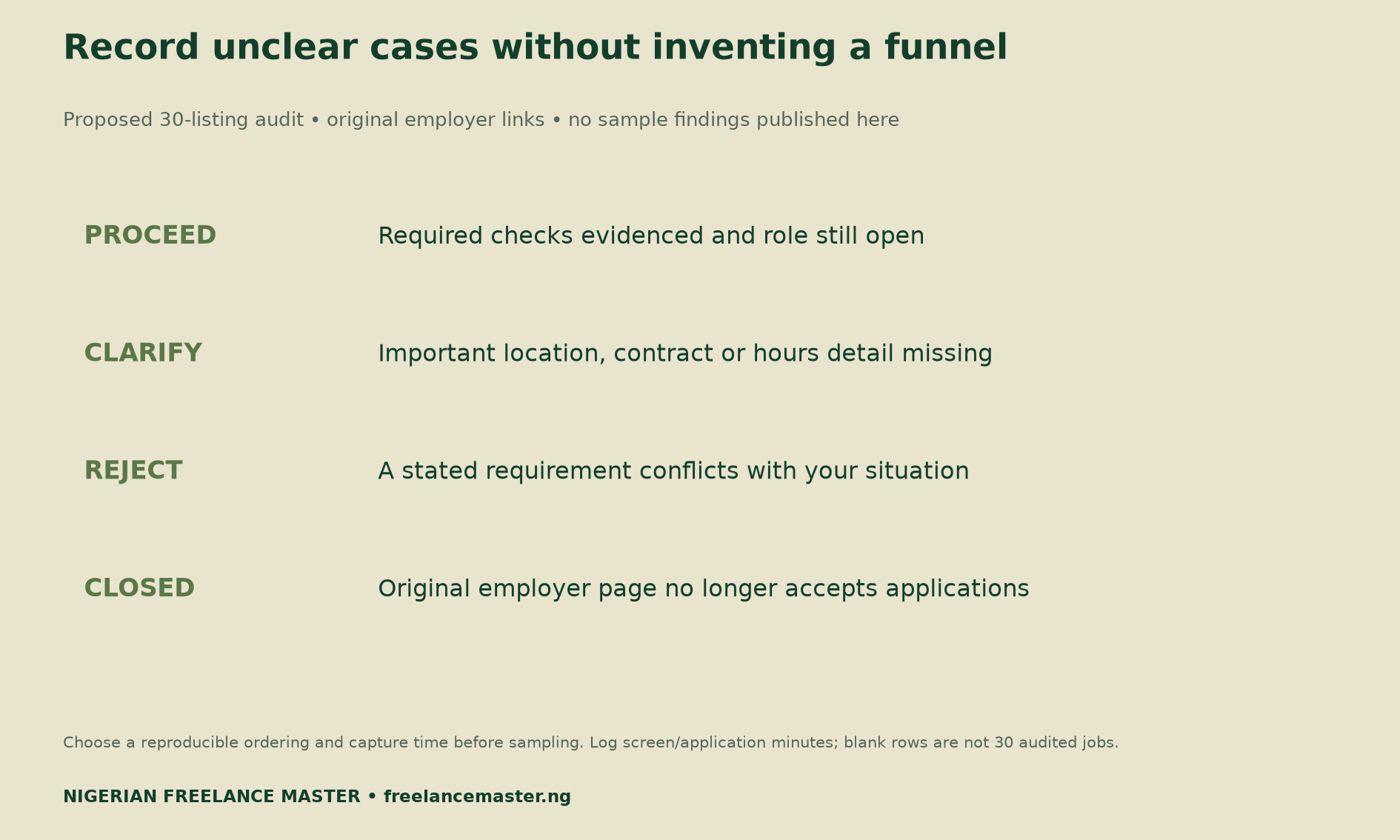
Use “proceed” when the relevant requirements are evidenced and fit your circumstances. Choose “clarify” when an important detail is missing. An explicit requirement that conflicts with your situation warrants “reject”; record “closed” when the original page no longer accepts applications.
Next, record screening minutes separately from application minutes. This makes the effort visible without pretending every rejection was wasted time. A short check that identifies a clear mismatch can still support a sensible decision. No universal time-saving percentage is claimed here.
Make the application specific to the work
Once a listing passes your screen, connect your evidence to the actual deliverable. Explain one relevant project, your contribution and how the result was assessed. Avoid a generic pitch that treats every remote role as interchangeable.
Our guide to turning industry knowledge into freelance opportunities can help with positioning. The related Fiverr income-risk audit helps you record actual channel receipts and effort. Neither promises that a screened application will succeed.
Keep the distinction between eligibility and selection clear. Meeting stated requirements permits a more informed application; it does not establish your probability of being hired. We have no applicant counts, employer selection data or Nigerian conversion benchmark for these listings.
Download the snapshot and screening tools
JobRise snapshot and denominator calculations (CSV) preserves the seven measures, denominators, timestamp and scope notes used in this report.
Source classification-coverage table (CSV) retains the nine source totals and their coverage flags. It can be used to reproduce the reconciliation.
Blank 30-listing eligibility screen (CSV) provides fields for employer evidence, contract details, decisions and time spent. Fill it with current listings; no employer sample results are preloaded.
Methodology and limits
We checked the original report in Chrome on 31 October 2026 and retained its rendered text. The live page had updated since the research brief, so every figure uses the same 01:05 UTC version: 519 total, 315 covered and 192 explicitly remote. We do not mix counts from different snapshots.
Our original analysis reconciles the source totals and calculates the two denominator-specific shares. The five-check framework and blank screening register are editorial tools. No 30-listing audit, employer verification sample, pay survey or application experiment was performed for this article.
Suggested citation: Nigerian Freelance Master, “Remote Freelance Jobs in Nigeria: Check Eligibility First,” 31 October 2026. Attribute the observed inventory to JobRise and identify the denominator calculations and screening framework as this publication’s analysis.


