




Paystack payment delays create two different questions: what happened to a payment channel, and what happened to your client’s individual payment? An incident notice can help with the first. It cannot, on its own, answer the second or justify asking someone to pay again.
This guide checks three selected Nigerian incident records from 30 October–6 November 2026. It separates their timestamps and severity phases, then provides a private payment-state register and continuity checklist. All three notices were marked resolved when checked on 6 November.
We have not inspected merchant accounts, processed payments, contacted clients or estimated anyone’s losses. The original tools support careful reconciliation. They do not guarantee settlement times or compare payment providers’ reliability.
What the three selected notices show
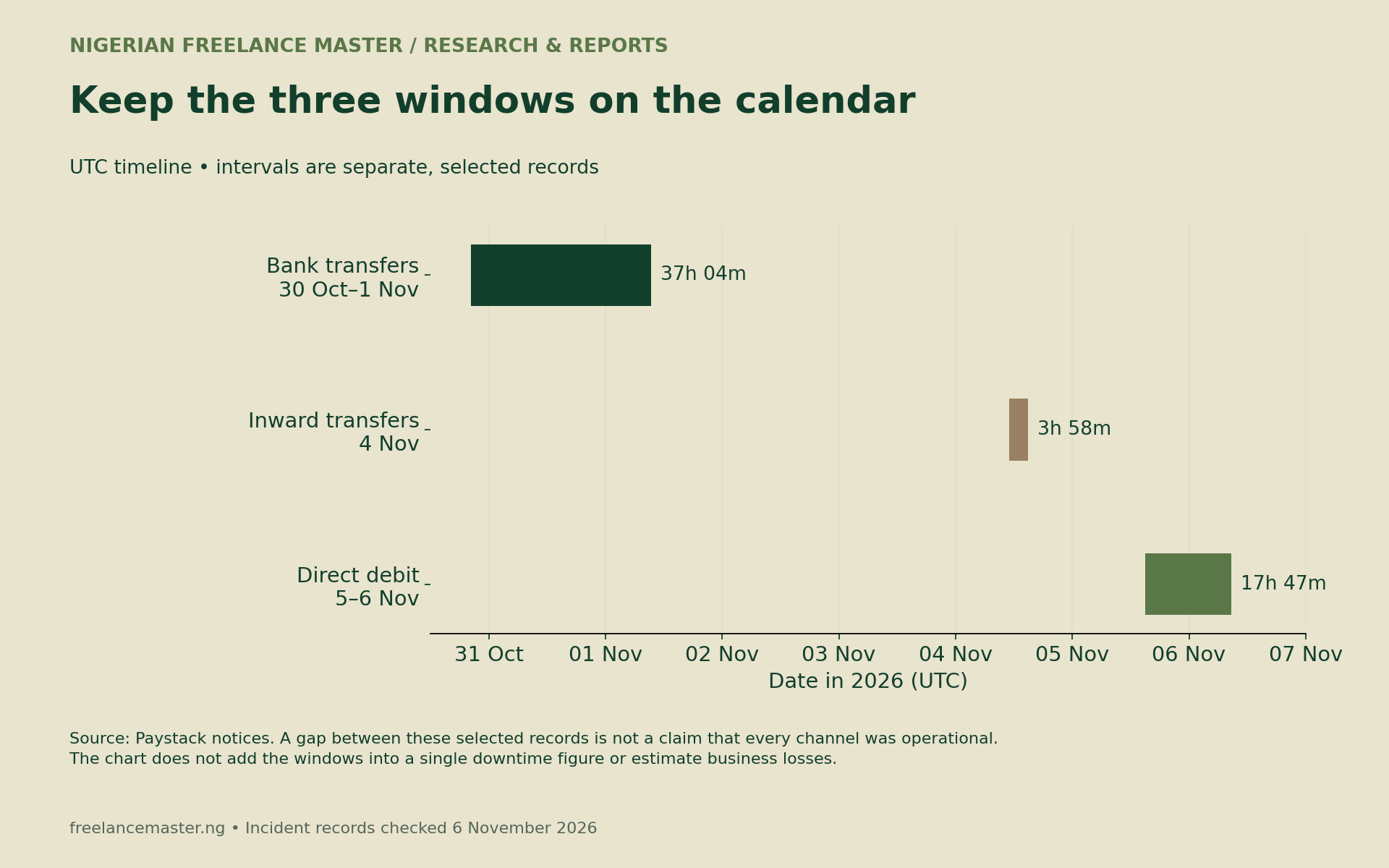
The 30 October–1 November bank-transfer incident runs from 30 October at 20:16 UTC to 1 November at 09:20 UTC: 37 hours 4 minutes. The notice describes inward and outward transfer difficulties and later recovery updates.
The 4 November inward-transfer incident runs from 10:57 to 14:55 UTC, or 3 hours 58 minutes. Its text concerns Pay with Transfer and Dedicated Virtual Accounts. A monitoring update appears at 12:03 UTC.
The 5–6 November direct-debit incident runs from 5 November at 14:56 UTC to 6 November at 08:43 UTC: 17 hours 47 minutes. It describes possible failures charging linked accounts or linking new ones. Keep that channel distinct from an ordinary bank-transfer attempt.
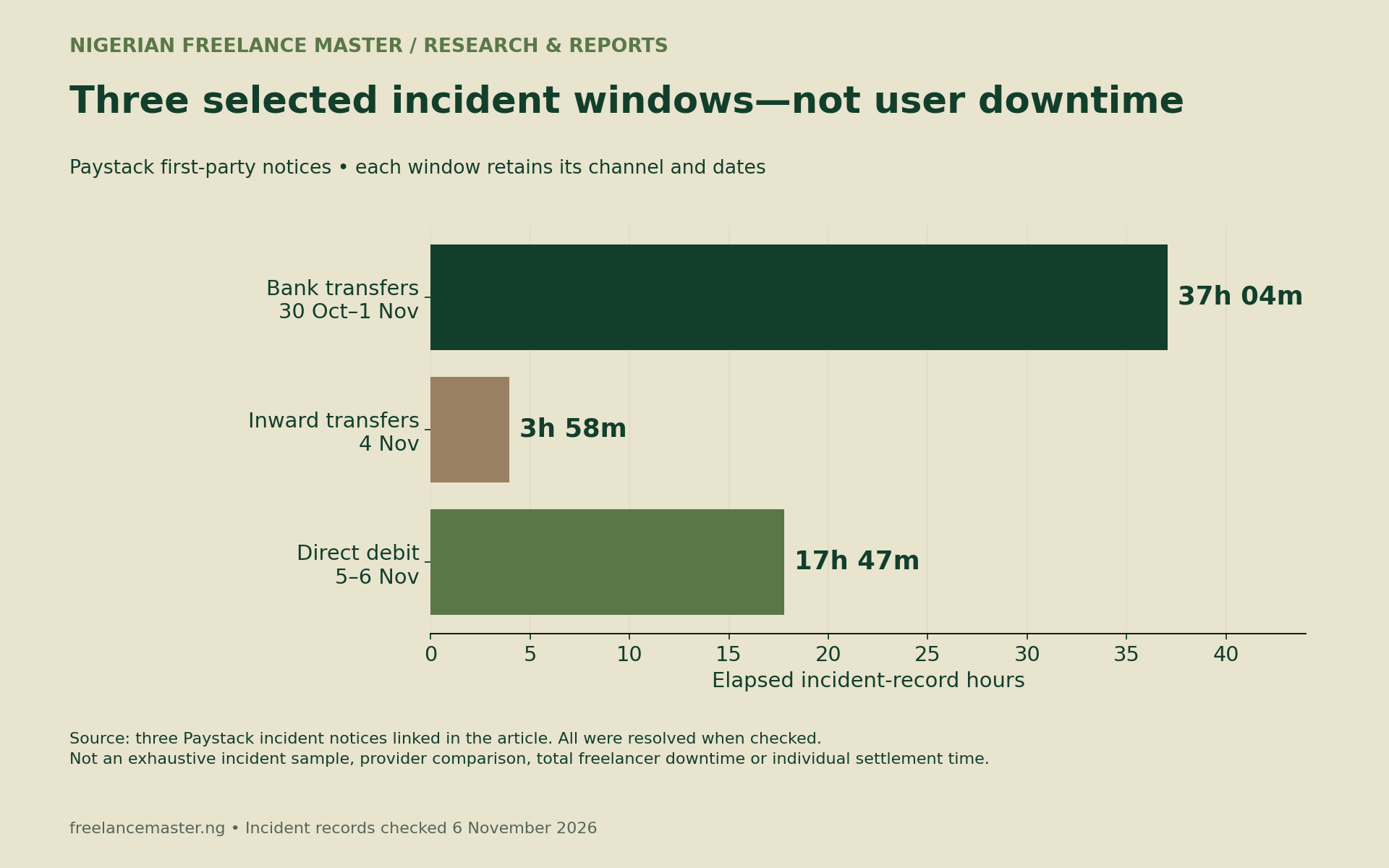
The records are selected examples relevant to payment continuity. They are not every Paystack incident in the period. We do not use them to calculate uptime, an average recovery time or an affected-customer share.
The 37-hour window was not one continuous severity level
The detailed transfer notice marks a major-outage component-status phase from 30 October at 20:16 UTC to 31 October at 09:43 UTC. It then records degraded performance until 1 November at 09:20 UTC.
From the displayed minute timestamps, those phases last 13 hours 27 minutes and 23 hours 37 minutes, respectively. Together they produce the 37-hour 4-minute record span. This arithmetic preserves the severity change instead of labelling the entire period a complete outage.
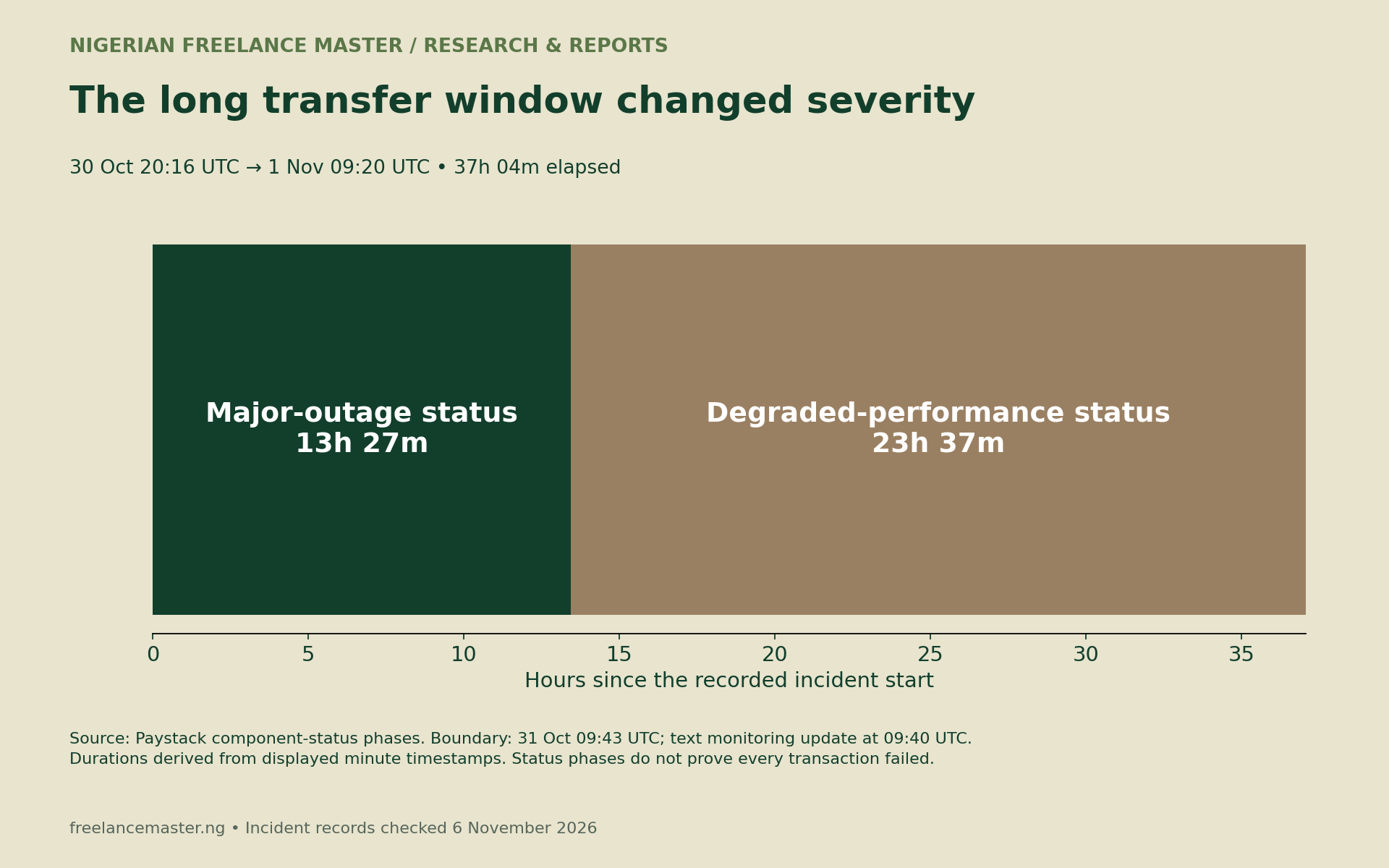
That three-minute distinction matters for reproducibility. The notice contains a monitoring message at 09:40 UTC and an update at 09:43 UTC. Our phase calculation uses the component-status boundary, rather than substituting the earlier message time.
A provider-level severity label also remains different from an individual result. Some transactions may succeed during a degraded period, and a particular pending attempt may require its own reconciliation after the wider incident is resolved. The notice does not supply a ledger of every customer outcome.
Preserve UTC and translate WAT explicitly
West Africa Time is UTC plus one hour. Adding one hour changes the displayed clock time, not the elapsed incident duration. Keep the original UTC timestamp beside any local conversion so another reader can reproduce the timeline.
| Selected record | Start in WAT | Resolution in WAT | Elapsed record span |
|---|---|---|---|
| Bank transfers, 30 October–1 November | 30 October, 21:16 | 1 November, 10:20 | 37h 04m |
| Inward transfers, 4 November | 4 November, 11:57 | 4 November, 15:55 | 3h 58m |
| Direct debit, 5–6 November | 5 November, 15:56 | 6 November, 09:43 | 17h 47m |
These are 2026 timestamps from the selected notices. In other situations, a conversion can move an event to the next calendar date. Record the date as well as the time; a bare “09:20” is insufficient for a multi-day reconciliation.
Paystack payment delays: separate three records
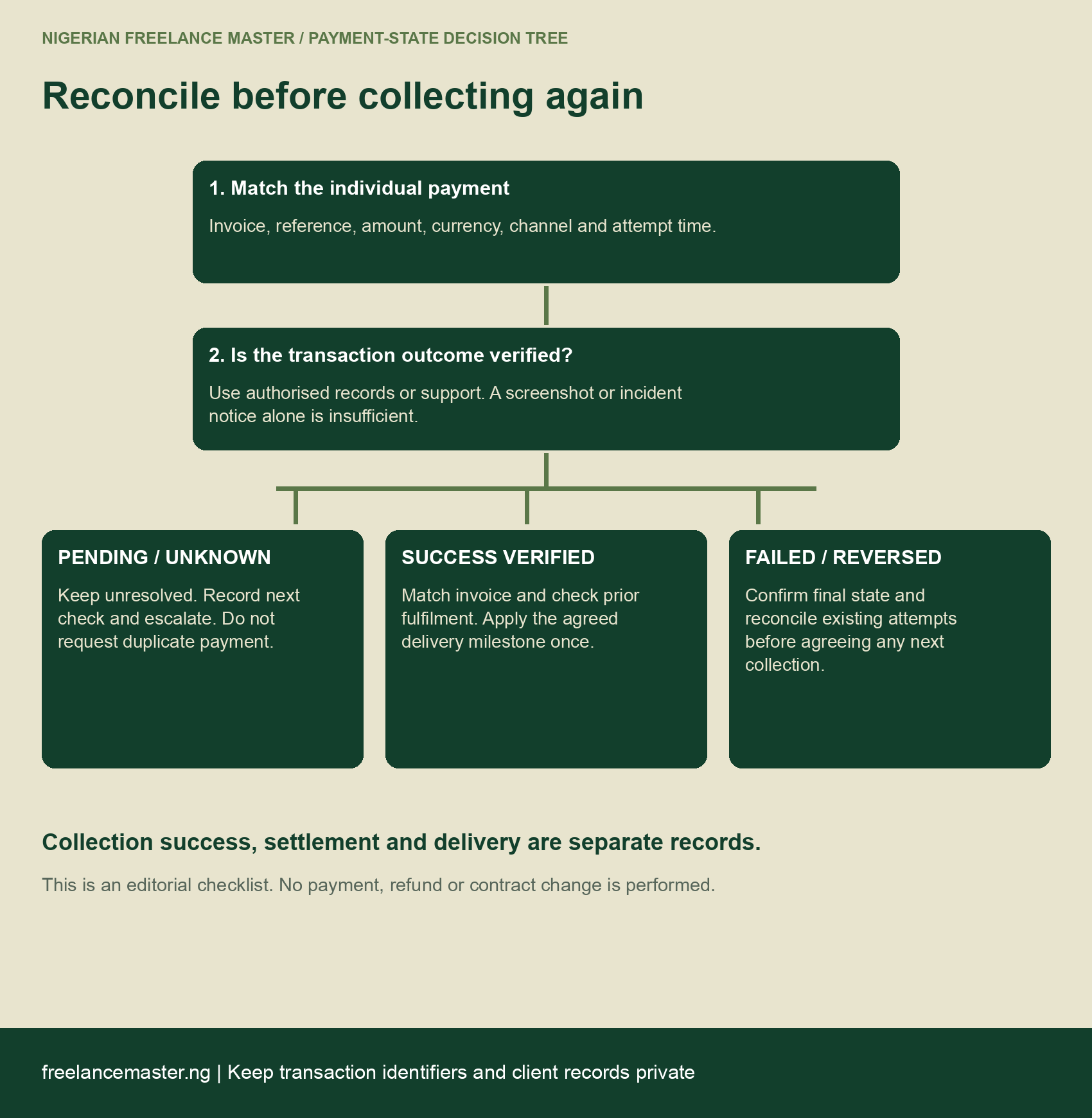
Start with the client’s attempt. Record when the client says they paid, the channel, the amount and the matching reference. A screenshot can be supporting context, but it should not replace verification through the authorised payment record.
Next, record the verified payment state. Paystack’s verification documentation distinguishes an unresolved pending transaction from a successfully processed one. Direct-debit processing is also an in-progress state. Use the exact state from the relevant transaction record rather than replacing uncertainty with “failed.”
Finally, record the agreed delivery milestone. Your service agreement may connect delivery to a deposit, full payment or another defined condition. A processor incident does not automatically rewrite that agreement. If timing needs to change, communicate and agree the adjustment.
These three records can disagree temporarily without making a client dishonest. A payment attempt, collection success, settlement to a bank and delivery are different events. Preserve the difference while the evidence is incomplete.
Verify the individual outcome before another collection
Use your authorised merchant records or seek Paystack support for the relevant transaction. Match the reference, amount, currency and invoice. If you use an integration, the developer must verify the actual transaction result; a successful API call or a visited callback page is not by itself proof of payment.
Paystack’s accept-payments guidance also requires checking the amount against the service value. The point for a freelancer is simple: confirm the correct payment, rather than accepting a generic success message detached from its invoice.
Keep credentials and secret keys out of spreadsheets, public posts and client messages. This guide does not ask you to share them or run a payment API request. It provides a record structure for information you are authorised to view.
Before considering another collection attempt, reconcile all attempts associated with the invoice. A pending result may later change. Creating a second demand while the first remains unresolved can cause duplicate collection and a more difficult reconciliation.
Distinguish collection from settlement
A successfully processed customer payment and the later movement of funds into your bank are separate records. Do not use a settlement concern to tell a client that a verified successful collection never happened. Likewise, do not label a pending collection as settled.
Keep the settlement field separate in your private register. If funds have not arrived as expected, check the relevant payout or settlement record and its current support guidance. The three incident spans above do not provide a universal settlement deadline.
Paystack’s dashboard-records guide describes separate transaction and payout records. It also explains filtering and exporting records. Use only information you are permitted to access and keep any exported client data private.
The same discipline applies to fulfilment. Check whether the invoice or transaction has already received the agreed value before issuing it again. Paystack’s verification guide specifically warns about duplicate fulfilment in digital-value workflows.
Communicate verified facts and a next update
A useful client update states what you know, what remains unresolved and when you will check again. It avoids assigning blame or promising a settlement time you cannot substantiate. Keep the message specific to the invoice and payment channel.
For example, a proposed template is: “I have recorded your payment attempt for our invoice. Its final outcome is still being checked against the payment record. Please avoid making a second payment while we reconcile it. I will update you at our agreed check-in time.”
That wording is a drafting aid, not a message we sent. Adapt it to the verified state and your agreement. If the payment has already succeeded, say so; do not keep describing it as unresolved merely because a wider incident once existed.
Our Upwork availability guide uses clear boundaries for time commitments. Payment continuity benefits from the same approach: give a realistic update commitment and preserve room for evidence to change.
Keep a private payment-state register
The blank register provides ten rows for your own records. Ten is a worksheet size, not an incident sample. It contains no client names, transaction references or completed financial history.
Record a private invoice identifier, transaction reference, attempt time with time zone, amount and channel. Add the verified state, verification source and time, separate settlement state, agreed milestone and prior-fulfilment check. Finish with the next check and a private support-case reference when needed.
Do not publish a filled version without carefully removing private data. A transaction reference can connect records that were not intended to be public. Never add full card details, credentials, authentication codes or secret keys to this worksheet.
Our business-client evidence guide explains how unknowns should remain visible in research. In payment records, that principle is especially useful: an unknown final state should not be silently changed into zero receipts or a confirmed failure.
Download the evidence and continuity tools
- Selected incident windows with UTC and WAT timestamps (CSV) preserves the three notices and elapsed-minute calculations.
- Transfer severity-phase calculations (CSV) distinguishes the component-status boundary from the earlier monitoring message.
- Blank private payment-state register (CSV) supplies ten empty rows for authorised invoice reconciliation.
- Payment continuity checklist (CSV) separates verification, duplicate checks, settlement, delivery and communication.
Treat the tools as a way to organise evidence. They cannot resolve an individual transaction without its authorised records. They also cannot authorise a refund, a further charge or a change to an existing service agreement.
Sources, calculations and limitations
We checked the three linked Paystack incident notices and its payment-verification guidance on 6 November 2026. Durations use the displayed minute timestamps. UTC remains the source basis; local timestamps add one hour for WAT. The component-status phase split uses 31 October at 09:43 UTC.
This is a selected operational case, not an exhaustive outage study. We did not observe individual customer losses, affected-user counts, settlement delays or all successful and failed payments. Adding the incident windows would not establish a freelancer’s total downtime or a provider reliability ranking.
The featured image is AI-assisted conceptual artwork of a freelancer checking invoice and payment evidence. It depicts no real transaction, client, account or Paystack interface. Cite Paystack for its notices and documentation, and Nigerian Freelance Master for the calculations, infographic and blank tools. Our original materials may be reused with attribution and a link to this article; source material retains its own terms.