




AI freelance skills data should help you ask better questions, not push you into learning everything. A market can become more varied while an individual assignment remains a bounded piece of work. For Nigerian freelancers choosing a specialism, those are different decisions.
A new OpenAI–Upwork report illustrates the distinction. We separate its market-wide diversity index from its per-post task counts, then offer blank tools for reading current briefs and choosing a defensible next step. We have not run a Nigerian vacancy audit or tested a training programme.
AI freelance skills data: read the unit of analysis first
OpenAI published its freelance-work research announcement on 10 November 2026. The accompanying OpenAI–Upwork report, Exhibit 3.1, contains two measures that can look similar in a headline but answer different questions.
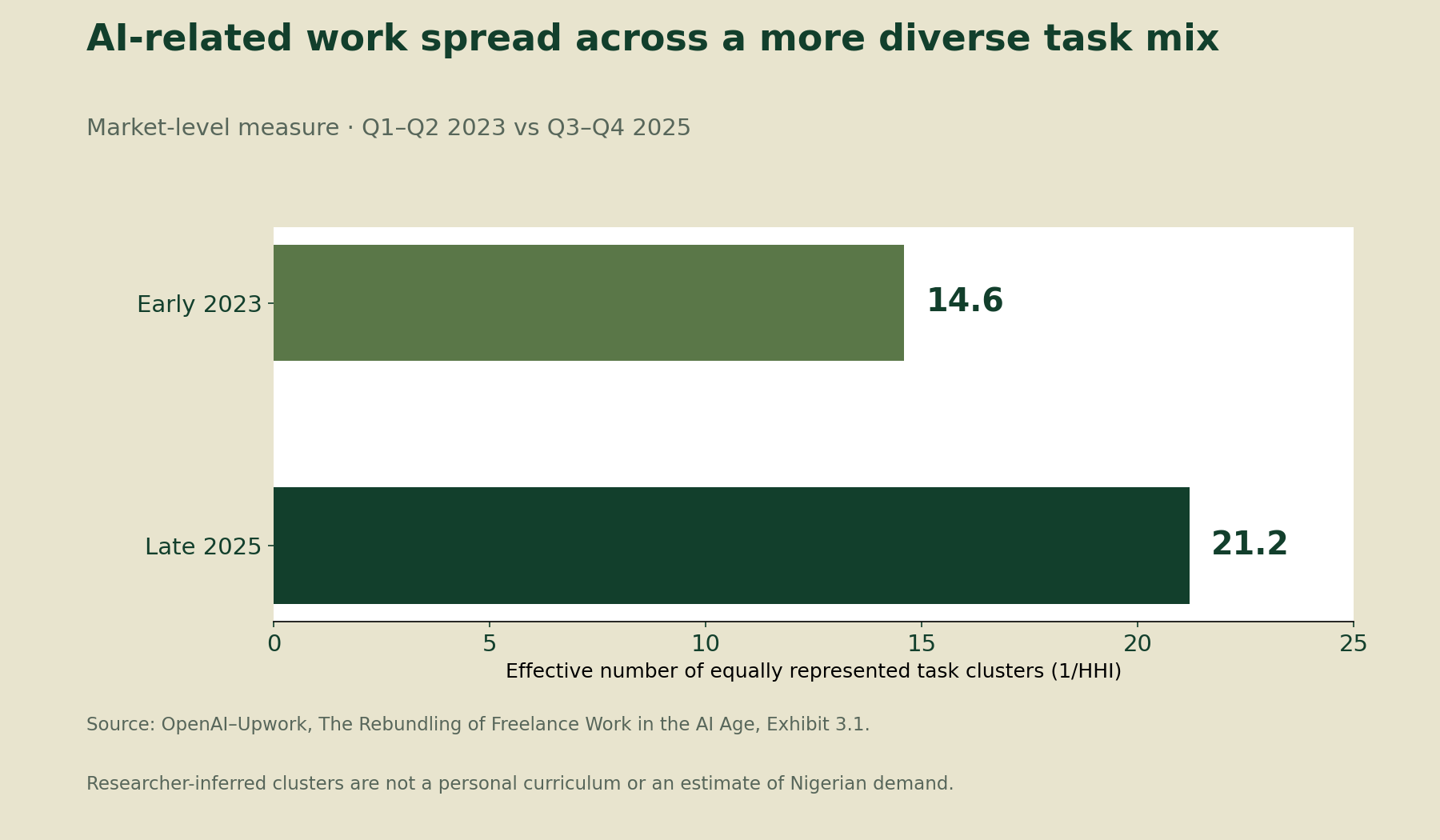
The market-wide effective number of task clusters rose from 14.6 in early 2023 to 21.2 in late 2025. It is an inverse-concentration measure, 1/HHI: the number of equally represented clusters that would produce the observed concentration. Early and late refer to the first half of 2023 and second half of 2025.
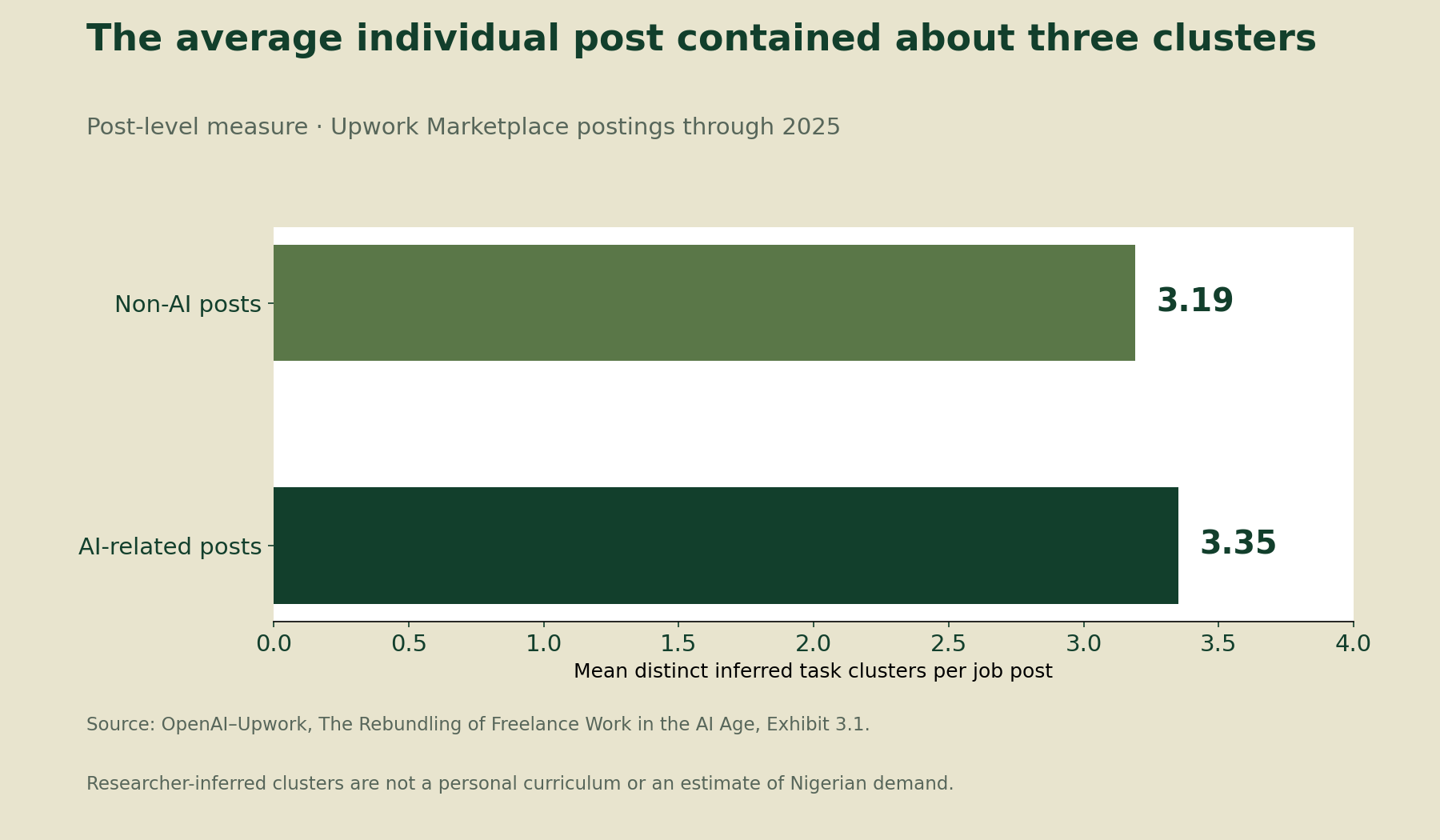
Within individual posts, the mean was 3.35 distinct inferred clusters for AI-related jobs and 3.19 for non-AI jobs. The difference is 0.16 clusters per post, roughly 5%. These are researcher-inferred clusters, not a literal checklist of advertised skills. The proprietary platform analysis is observational and does not estimate Nigerian demand.
A broader market does not prescribe your curriculum
A diversity index describes the distribution of work across a market. It does not say that one freelancer must perform every activity in that distribution. Turning 21.2 into a requirement to learn 21 skills confuses a market pattern with an individual development plan.
Similarly, a mean task-cluster count cannot replace the actual assignment. One brief may involve a familiar core task and a narrow integration. Another may combine work that requires separate specialists. Read the deliverable, dependencies and responsibilities before deciding what you can offer.
For a Nigerian freelancer, the relevant demand is the work you can lawfully and practically serve. Location eligibility, client access, working hours and your own evidence matter. A global platform statistic cannot answer all of those questions.
Keep market, post and person separate
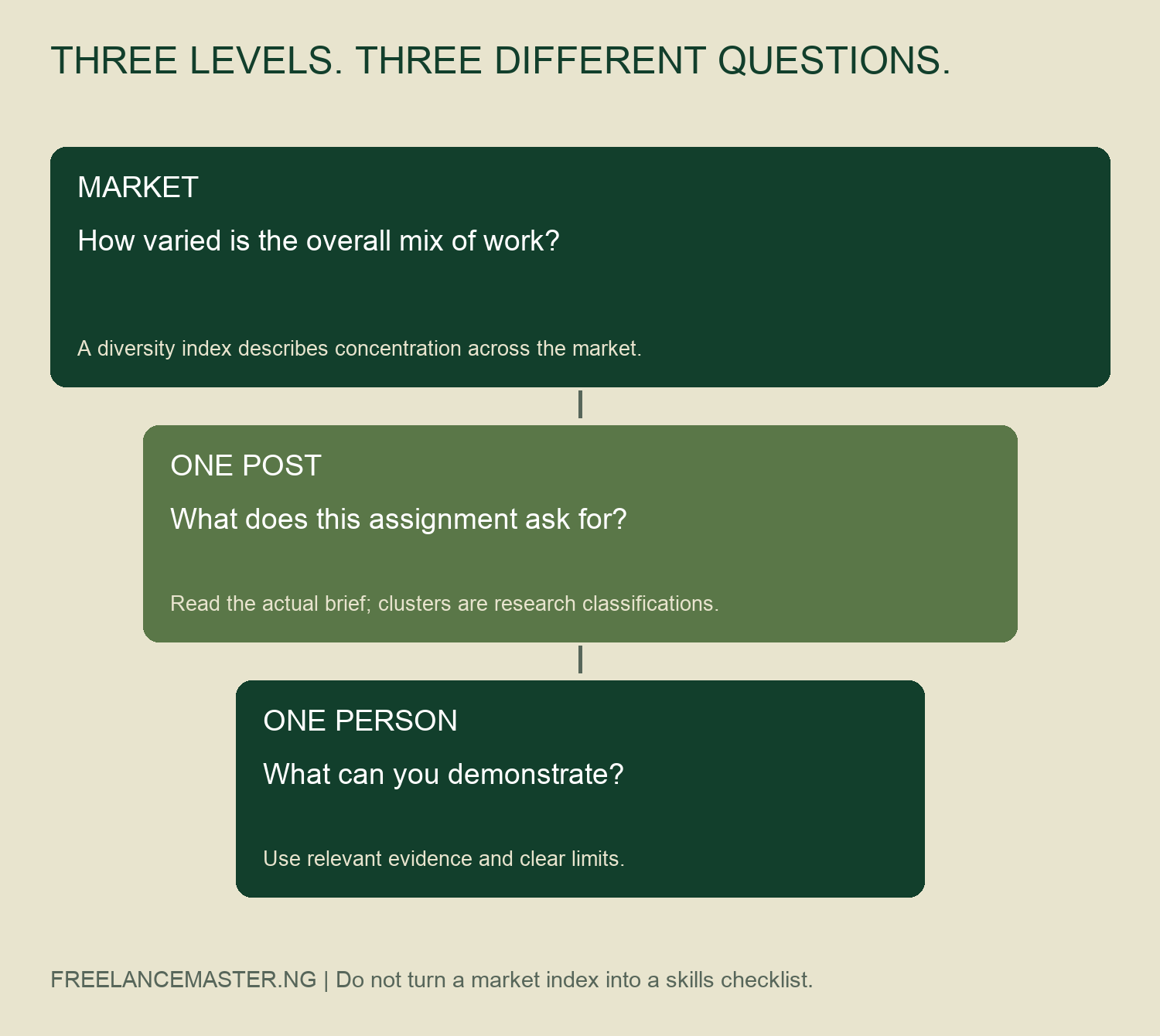
The hierarchy above is an interpretation aid, not a conversion formula. Market variety suggests where to investigate. A particular post identifies requirements to clarify. Your work samples show what you can demonstrate under a stated scope.
Keep a separate evidence row for each level. This prevents a broad trend from becoming an unsupported claim in your profile. For example, “the market is changing” does not establish that you can deliver a client’s integration safely.
Run a small, transparent brief-reading exercise
Choose a target service before collecting examples
Start with a concrete service you might provide, rather than a broad label such as “AI work”. Define the output and the type of client problem. Then select current, relevant briefs through legitimate public access and record their URLs and checked dates.
Choose a manageable number that you can read carefully. Do not describe a convenience sample as representative of the entire market. Also retain your inclusion rule, so another reader can understand why these examples were selected.
Code the wording rather than your assumptions
Copy a short, necessary requirement into your private worksheet and link it to the source. Mark whether it is essential, optional or unclear. Separate domain knowledge from a named software tool and from responsibility for a finished result.
If the wording is ambiguous, record the question. Do not add a requirement because it appeared in a neighbouring post. Likewise, avoid treating every mentioned product as a skill you must buy a course to acquire.
Match requirements to demonstrable evidence
For each genuine requirement, identify what evidence you already have. A relevant work sample may be useful, but describe its scope and limitations. A tutorial completion badge and an independently delivered client result are different forms of evidence.
Our course-selection scorecard addresses training choices separately. First establish the gap you need to close. A new course should answer that specific gap rather than merely echo a market headline.
Choose among demonstrating, verifying, learning and partnering
Demonstrate now when your existing evidence matches a clear requirement. Explain what the sample shows and avoid expanding the claim beyond what you actually did. An honest narrow capability is easier to assess than a long unsupported skill list.
Verify the requirement when the brief is unclear. Record the question and seek clarification through an authorised conversation. Do not make a paid commitment on the assumption that an optional capability is mandatory.
Learn narrowly when a defined, relevant gap can be addressed within your available time and resources. State the output you will use to check the learning. Keep training time and tool costs visible instead of assuming they will pay for themselves.
Partner when the work needs a separate specialist. Agree who owns each deliverable, review and handover. Do not imply professional authority or access you do not have, and obtain client approval before involving another person or sharing their information.
Use the decision matrix without inventing demand
The matrix below is blank because your selected briefs and capabilities have not been examined here. Fill each row with a requirement, evidence, uncertainty and one bounded next action. Retain “not enough information” as a valid result.
After reading several relevant briefs, review patterns cautiously. Repeated wording in your examples may justify further investigation, but it does not establish a national shortage or a hiring probability. Keep the dates and sample boundaries beside any summary you create.
Our AI freelance job-screening guide covers the later decision to bid on a particular task. This article helps you interpret the evidence before choosing a learning or collaboration direction.
Download the source values and blank tools
- Task-diversity source values (CSV)
- Blank job-description coding sheet (CSV)
- Blank specialism decision matrix (CSV)
- Market, post and person measure dictionary (CSV)
The source file contains four published values with their units and exhibit reference. The coding sheet and decision matrix are unfilled templates; the dictionary separates the three levels. None contains observed Nigerian client requirements or a completed personal skills assessment.
Method and limitations
We checked the announcement and report on 15 November 2026. We transcribed the values from Exhibit 3.1 and kept the market and posting measures on separate charts. The differences were calculated directly from the displayed values, without reconstructing the underlying proprietary records.
The editorial framework does not establish causal effects, course returns or an individual’s prospects. Suggested citation: Nigerian Freelance Master, AI Freelance Skills Data: A Diverse Market Is Not a 21-Skill Curriculum, 15 November 2026, using OpenAI–Upwork’s November 2026 report. Keep its observation periods and units when citing the figures.