




Nigerian SME record gaps can be a useful starting point for a careful freelance diagnostic. Start with a specific problem that an owner can describe and verify. A survey headline alone cannot establish that a business needs your service or should buy new software.
This guide uses new Nigerian survey findings to frame a bounded, read-only exercise. It includes two charts, a fictional record trail and practical CSV tools. The example contains no real client information, and we have not conducted a business audit.
What the Nigerian SME record gaps survey actually says
Visa’s company-issued release, hosted in Premium Times’ promoted section on 11 November 2026, describes its Pay and Get Paid study. Face-to-face interviews took place in March–April 2026 across eleven markets; the Nigerian sample comprised 251 SMEs.
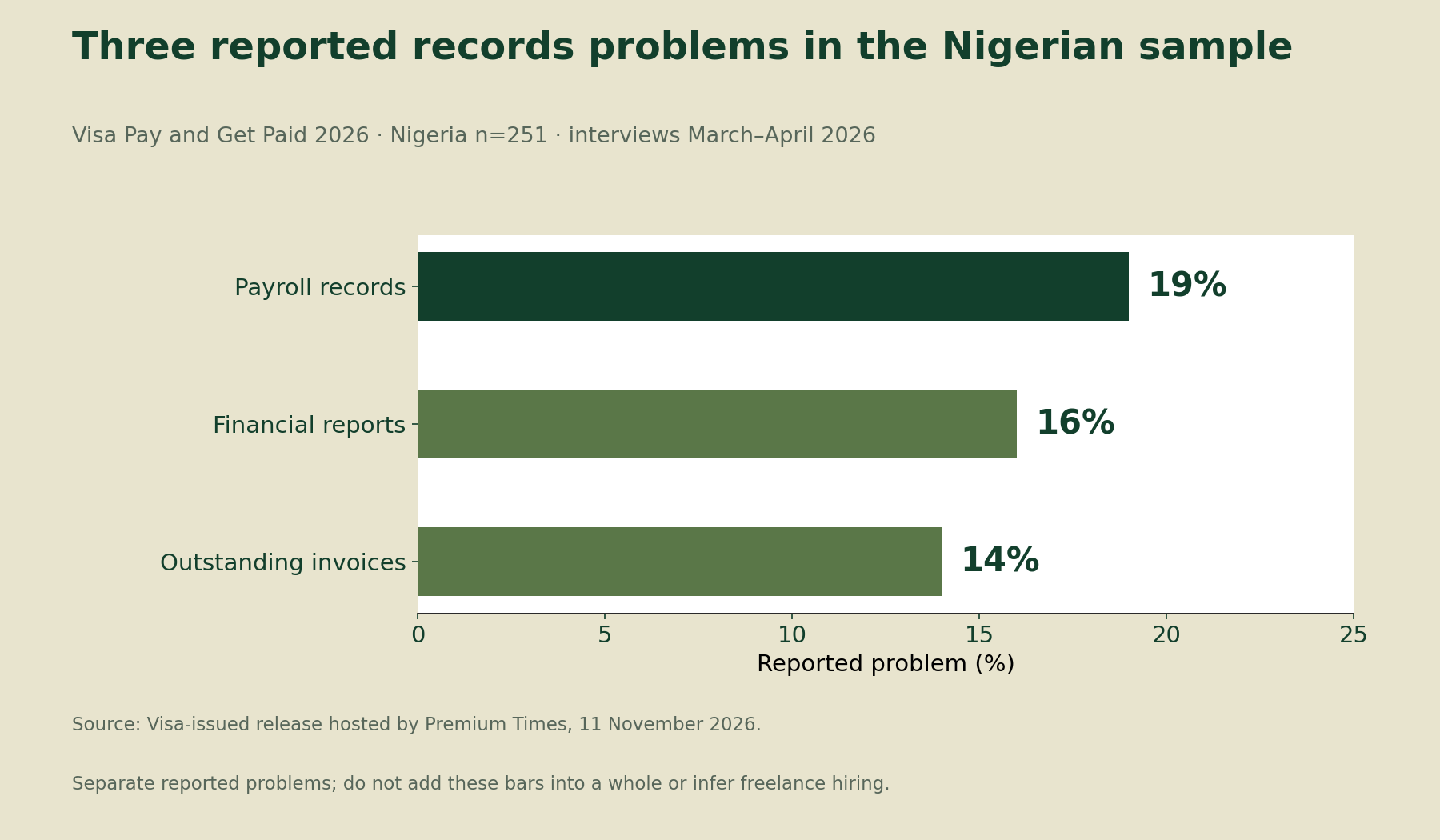
Reported Nigerian problems included organising payroll records (19%), preparing financial reports (16%) and tracking outstanding invoices (14%). These are separate findings, not parts of an additive whole. The release does not establish how many businesses would hire a freelancer.
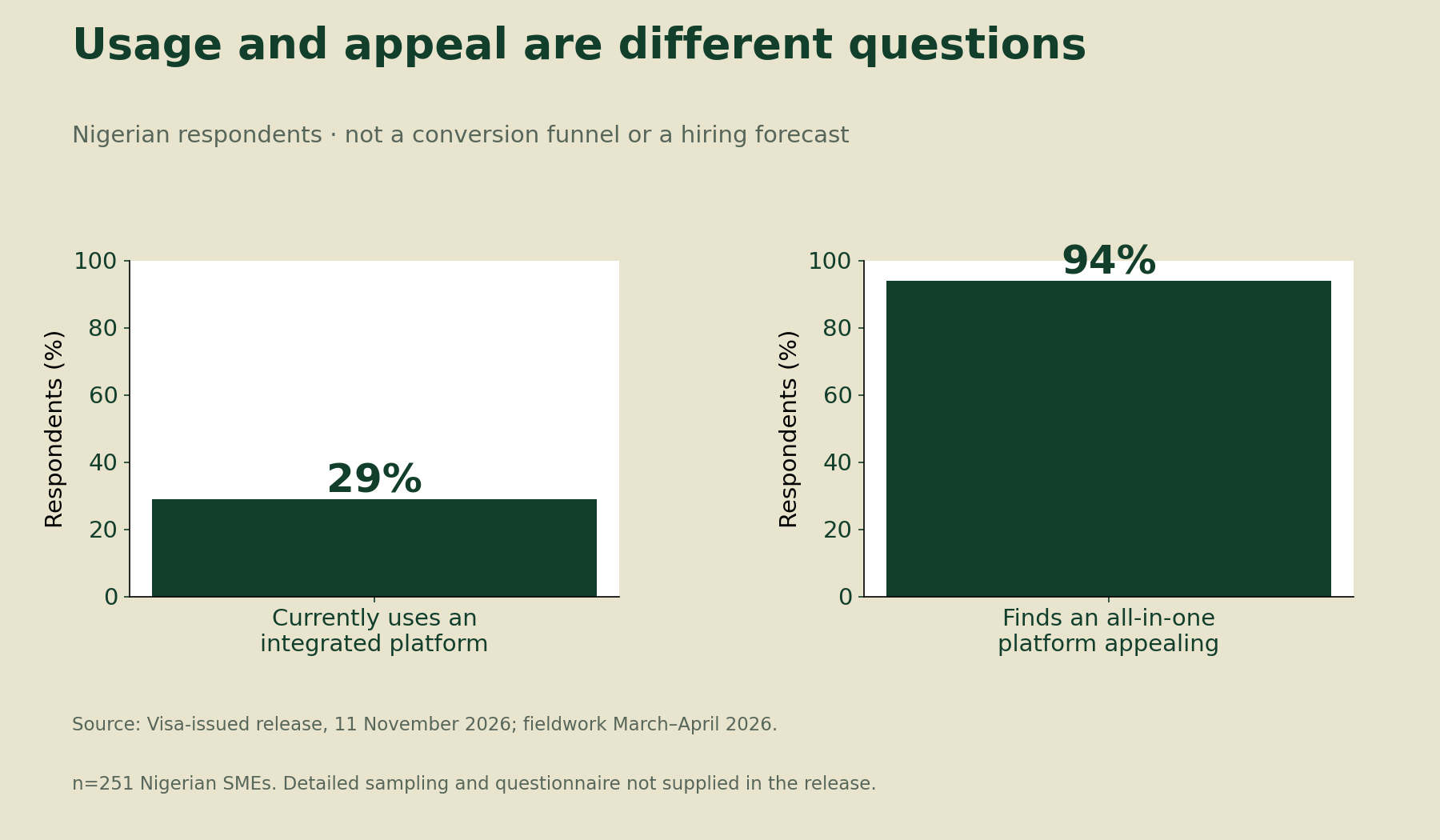
On different questions, 29% reported using an integrated payments/business platform and 94% found an all-in-one solution appealing. Appeal is not a purchase, implementation budget or hiring commitment. The two figures should not become a conversion funnel.
Choose one record problem before choosing a tool
Ask the owner which decision is difficult today. Perhaps an invoice appears unpaid even though a receipt exists. Alternatively, a summary may use a different reference from the original sale. Either question is more specific than a promise to digitise the whole business.
Next, define what a diagnostic will produce. A useful deliverable could be a short discrepancy register with source locations, unanswered questions and a named person to confirm each finding. It should also state what you did not inspect.
Agree the boundary in writing before accessing information. Specify the record period, permitted copies, fields, storage arrangements and who receives the findings. Client permission does not remove your responsibility to minimise unnecessary personal or business information.
Follow a fictional sale through four records
Our synthetic example begins with sale DEMO-001 for NGN 12,000. The invoice repeats that reference and amount. A receipt records NGN 12,000 received but has no sale reference, while the summary still marks DEMO-001 as outstanding.
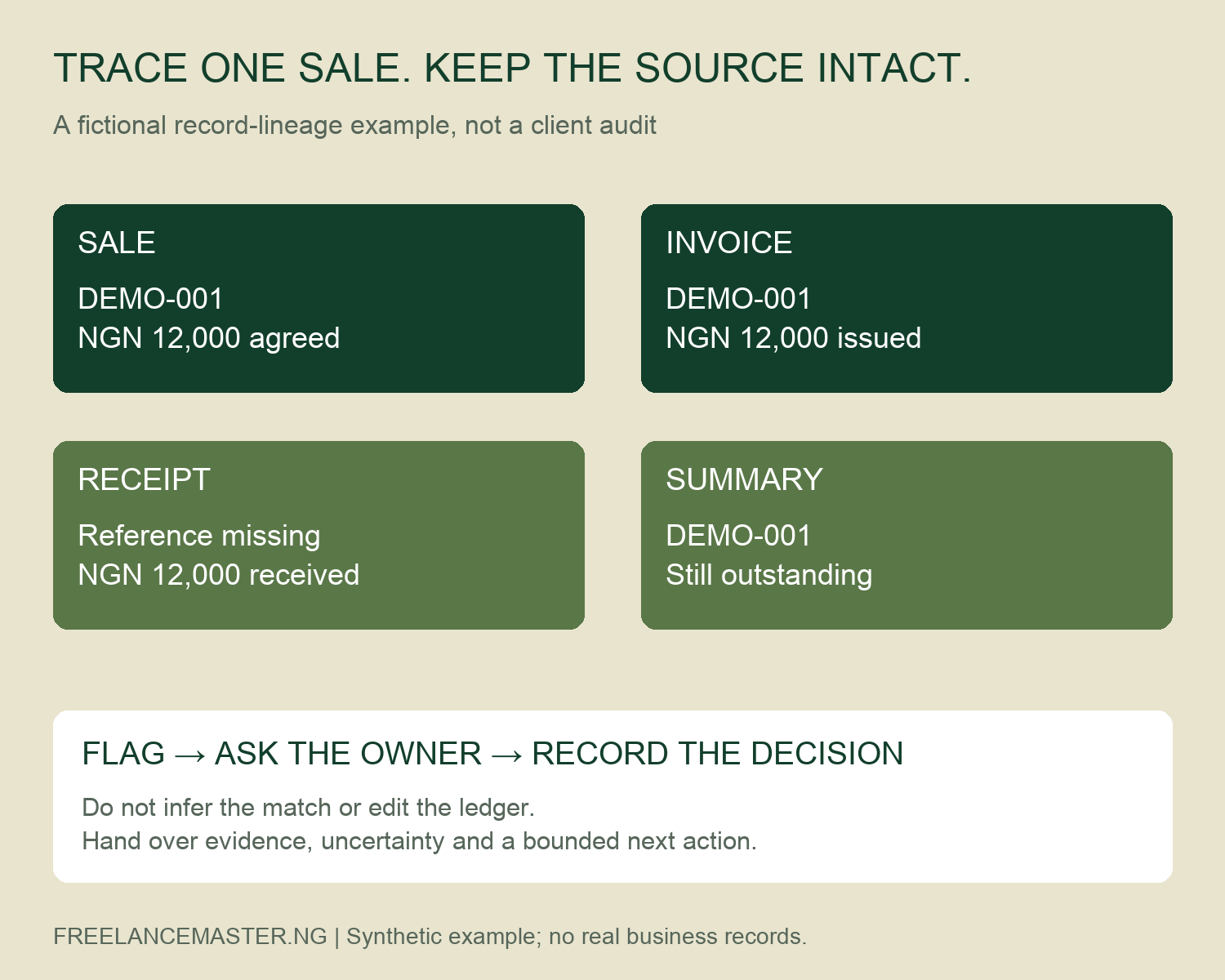
The amount alone is insufficient evidence of a match. Another sale might have the same value. Record the missing reference and ask the authorised owner to confirm the relationship through an appropriate source.
Keep the original records intact. A diagnostic can identify the inconsistency without changing an invoice, allocating a payment or rewriting the summary. Preserve a clear distinction between what you observed and what someone later confirmed.
Build a discrepancy register that another person can follow
Describe the observation precisely
Use neutral wording such as “receipt reference is blank” rather than “the customer failed to pay”. The first statement describes visible evidence. The second introduces a conclusion that the records may not support.
Record a usable source location and checked date. Avoid copying entire customer files into a findings document when a minimised reference is enough. Mark uncertainty explicitly, including where an authorised source is unavailable.
Assign a question and a decision owner
Give each issue a concrete question: which invoice does this receipt relate to? Name the authorised role that can answer it. A freelancer should not become the decision owner simply because they assembled the spreadsheet.
Then record the next action and status. “Awaiting owner confirmation” is a legitimate result. Do not change it to resolved merely to make the handover look complete.
Separate diagnosis, implementation and professional work
A read-only diagnostic documents approved records and inconsistencies. Implementation changes a system or process and requires a separate scope, access decision and acceptance check. Treat these as distinct deliverables, even when the same person has suitable skills for both.
Matters involving accounting judgement, tax certification, payroll processing or legal obligations may require appropriately qualified professionals. This worksheet confers no professional authority. Keep custody of funds and live bank credentials outside the example scope.
If a discrepancy suggests possible misconduct, avoid accusations from incomplete records. Preserve relevant evidence through the client’s agreed process and refer the matter to the appropriate decision-maker. The public fictional demonstration must never include real customer identifiers or access details.
Hand over findings before proposing software
A good handover separates confirmed observations, unresolved questions and possible next steps. Explain whether the issue concerns missing identifiers, unclear ownership, inconsistent status or another bounded problem. A new platform may not correct poor source information automatically.
Ask the client to confirm the findings before preparing a later implementation proposal. Any suggestion should address the documented need, available skills and maintenance responsibilities. We have not tested or ranked software in this article.
Our portfolio guidance can help you explain a synthetic demonstration honestly. For a later agreement, use the site’s freelance agreement guide as a discussion starting point, with suitable advice for the actual assignment.
Download the evidence and diagnostic tools
- Visa Nigerian SME source values (CSV)
- Fictional record-lineage example (CSV)
- Blank record-discrepancy register (CSV)
- Diagnostic scope and exclusions (CSV)
The register is blank for your authorised exercise. The lineage file is fictional, and the scope file describes this editorial example. None is a completed client audit, an integration service or evidence of commercial results.
Source transparency and limitations
We checked the release on 15 November 2026 and transcribed five reported percentages without estimating respondent counts. The retrieved material did not supply the full questionnaire, raw data or detailed sampling information. Treat it as promotional first-party evidence, not independent research validation or a national market-size estimate.
The diagnostic is an original editorial framework, separate from Visa’s findings. Suggested citation: Nigerian Freelance Master, Nigerian SME Record Gaps: A Bounded Freelance Diagnostic, 15 November 2026. Retain the Nigerian sample and March–April observation period when citing the survey.