



To reconcile freelance client bank transfers in Nigeria, check two things separately: whether your own official account record shows a credit, and which agreed milestone it funds. A client’s receipt may help you investigate. However, it does not by itself establish the credit received or settle an ambiguous allocation.
Our fictional ledger keeps those questions apart. Two milestones total ₦200,000. A verified ₦70,000 allocated to A leaves ₦130,000 across the invoices. Meanwhile, a further verified ₦40,000 stays unallocated. It does not reduce either milestone simply because the same client sent it.
Reconcile freelance client bank transfers in Nigeria: start with the evidence
The fresh news hook is the 19 November 2026 SIIPS report launch. AfricaNenda’s 2026 executive summary retains Nigeria’s NIP at the mature inclusivity level. Its consumer research covers 1,403 digital-payment users in 15 African markets. Among respondents who experienced a problem, 33% did not report it; the summary does not give that subgroup’s exact count.
Those are infrastructure and survey findings, not a Nigeria-specific transfer-failure or complaint rate. They cannot confirm whether your client’s payment arrived. The report’s publication date also differs from its evidence periods: consumer research took place in March–April, while system information was collected in January–July 2026.
Therefore, use the research to frame a careful recordkeeping question. Do not treat the mature classification as a receipt guarantee, or multiply 33% by 1,403 to invent the affected subgroup. The practical analysis below is an original fictional allocation example, separate from the report’s findings.
Keep the due amounts and the received credits in separate records
Begin with the agreed amount due for each milestone. In our example, A has ₦120,000 due and B has ₦80,000 due. The combined due amount is ₦200,000. Neither invoice contains real customer details, bank references or a claim about a specific bank’s service.
Next, record each claimed payment as a separate evidence item. Use nonsecret aliases in a portfolio copy. Check received credit through your own bank’s official app, statement or an appropriate official channel. If the available record is unclear, label it unresolved rather than declaring the transfer successful, failed or fraudulent.
Apply the ₦70,000 match to milestone A only
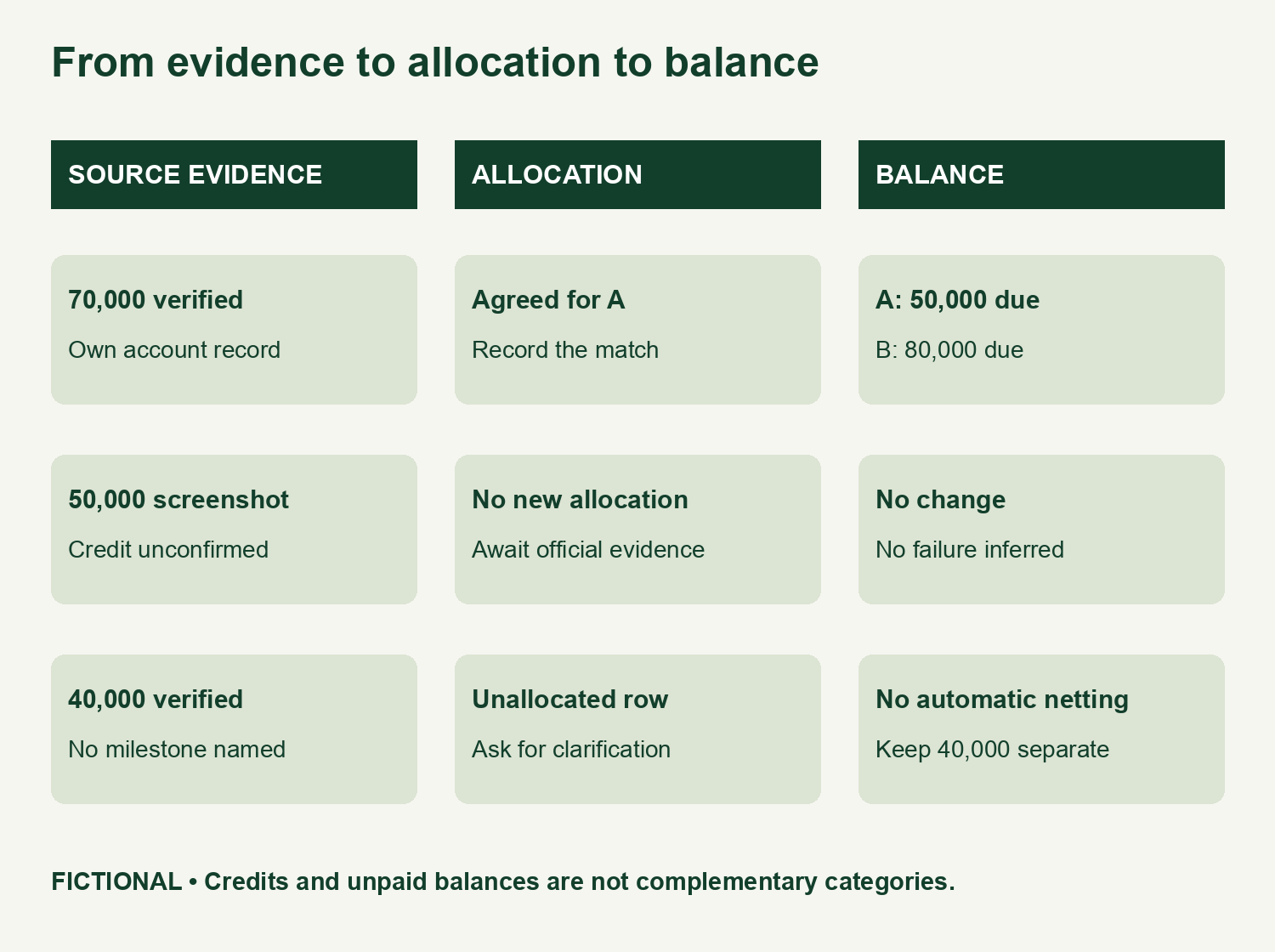
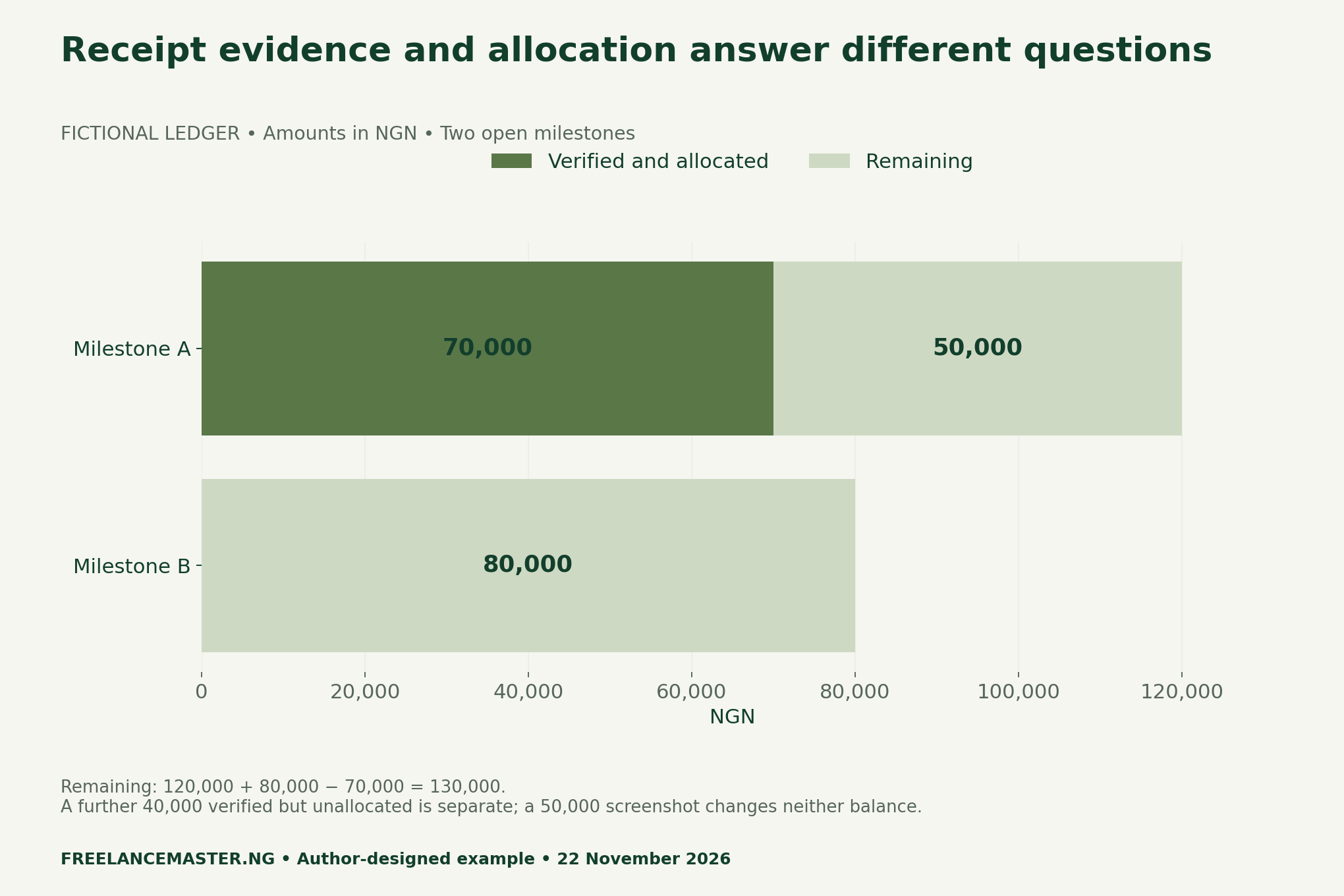
In the worked example, C1 is a verified ₦70,000 credit with an agreed allocation to A. Thus, A’s remaining amount is ₦120,000 − ₦70,000 = ₦50,000. B receives no allocation and remains at ₦80,000. Together, the two open amounts are ₦50,000 + ₦80,000 = ₦130,000.
| Milestone | Amount due | Verified allocation | Remaining |
|---|---|---|---|
| A | ₦120,000 | ₦70,000 | ₦50,000 |
| B | ₦80,000 | ₦0 | ₦80,000 |
| Total | ₦200,000 | ₦70,000 | ₦130,000 |
Do not count the screenshot as another received payment
C2 is a screenshot purporting to show ₦50,000. The example does not yet contain official evidence that this credit reached the receiving account. Consequently, A stays at ₦50,000 remaining. The screenshot belongs in the evidence register with an unresolved status, rather than in the allocated-credit total.
That status does not establish wrongdoing or tell the client to pay again. First, reconcile the recipient account, relevant date and appropriate nonsecret reference through agreed secure channels. Keep sensitive account details out of public worksheets. Where clarification is needed, use the bank’s official support route rather than an unverified contact.
Leave the ₦40,000 in an unallocated row
C3 is different: the example confirms a ₦40,000 received credit but contains no agreed milestone match. Record it as verified but unallocated. Do not silently assign it to A, B or a future job. Ask the client for written allocation clarification, using the milestone aliases and the minimum necessary details.
Until that clarification is recorded, the invoice ledger still shows ₦130,000 remaining and the separate credit register shows ₦40,000 unmatched. These are different accounting views, not complementary slices of one total. Nor does their arithmetic alone establish a legal amount payable or authorise a refund.
Agree the next step before changing the work schedule
A useful message states the record plainly: “Our record shows the verified C1 allocation to A. C2 remains unconfirmed in our receiving record. C3 is received but needs an agreed milestone reference. Please confirm its intended allocation.” Adapt that wording to the facts and your agreed communication process.
Finally, apply the existing milestone terms when deciding whether work can begin or continue. This worksheet does not override a contract, settle a dispute or promise a transfer time. For broader client coordination, see our guide to maintaining client relationships. This article’s narrower task is making multiple credits and multiple invoices reconcile without guessing.
Method, limitations and reusable downloads
We checked the first-party SIIPS report page and executive summary on 22 November 2026. The news context and its denominators are kept separate from all invented ledger amounts. No real bank account, client, dispute, observed transfer outcome, financial advice or refund promise is included.
- Fictional milestone allocation and balances (CSV)
- Fictional credit evidence and suspense rows (CSV)
- Blank milestone reconciliation worksheet (CSV)
- Source measures and calculation dictionary (CSV)
Suggested citation: Nigerian Freelance Master, “Client Says They Paid: Match the Credit to the Right Milestone”, 22 November 2026. Preserve the fictional-example labels when reusing the figures.