





UNHCR digital services tender Nigeria searches can surface an opportunity that looks close to your portfolio. The first decision is whether the actual lot and procurement rules fit your team. A country appearing on a beneficiary list does not answer that question. Neither does a strong API demo or a polished agency website.
Our five-row screen separates public scope, permitted proof, support capacity and mandatory checks. It helps a Nigerian developer or small agency decide what to investigate before spending time on a full bid. A deadline chart, lot-to-proof infographic and four CSV tools make the screen reusable without presenting it as an eligibility ruling.
What the UNHCR digital services tender Nigeria listing establishes
The official UNGM notice UNHCR_RFP_3565 opened on 9 November 2026. Its revision log says a questions-and-answers document was shared on 24 November. The listing describes five lots covering Drupal delivery and support, Drupal hosting, conversion experimentation, cloud and API integration, and a UTM campaign tool.
Nigeria appears among beneficiary countries. That field is not a determination that a particular Nigerian individual or entity may bid. The public notice directs readers to the supplier portal for the complete package. We could not independently read the linked Q&A attachment, so this report does not interpret its answers.
Use the UNHCR supplier guidance linked by the notice to locate the official portal. Read the latest package and amendments before relying on any summary. This article does not submit a bid, register an entity or accept procurement terms on your behalf.
Keep the questions cutoff separate from the offer deadline
The public questions cutoff is 26 November 2026 at 14:00 CET, equivalent to 14:00 WAT. The offer deadline is 17 December at 14:00 GMT+1, also 14:00 WAT. The questions cutoff may already have passed when you read this. Confirm the current deadlines and submission instructions in the portal.
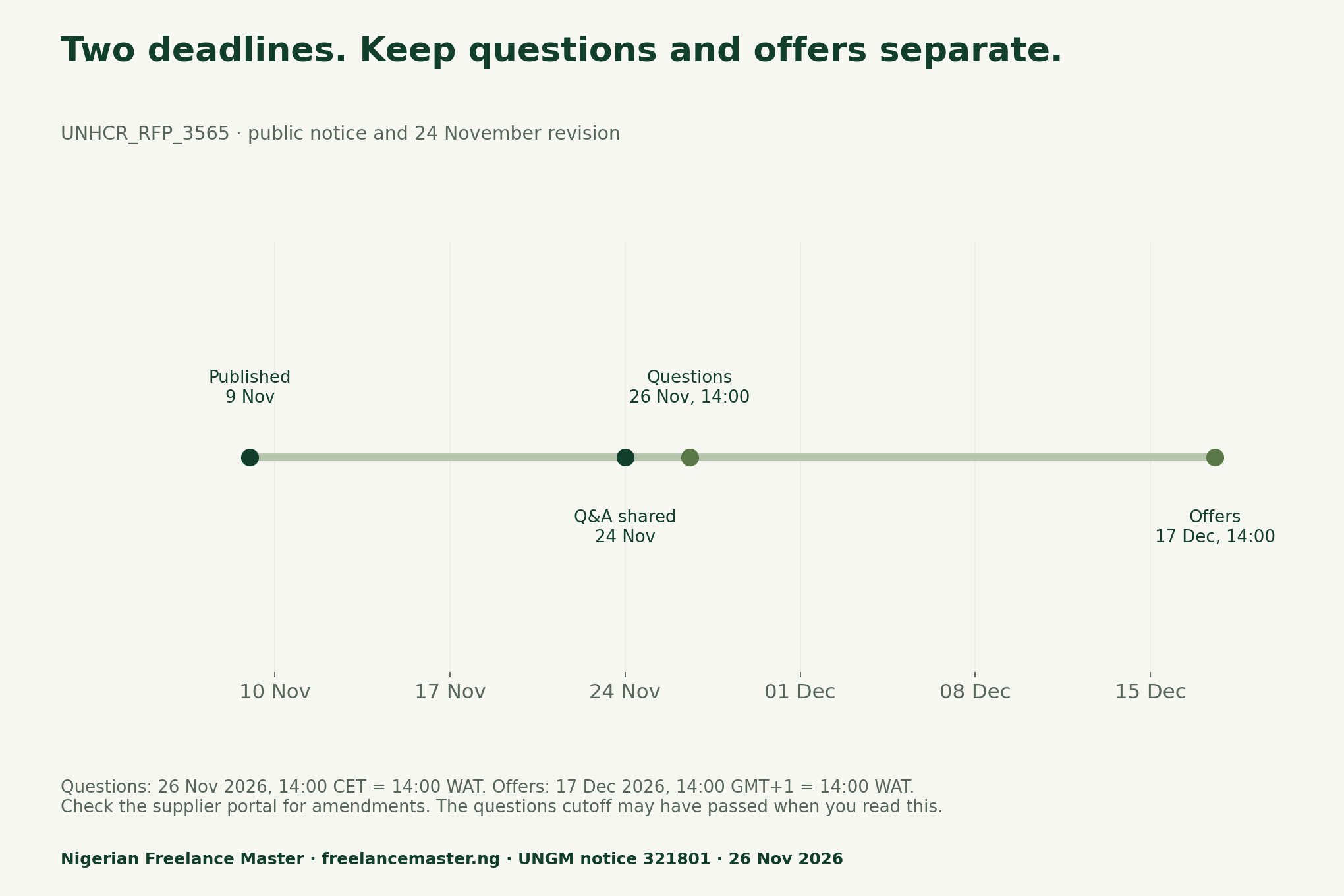
In your own working register, record the source, date checked and document version beside each deadline. Assign an owner to verify the submission channel. A calendar reminder is useful, but it should not be the only record. If two documents disagree, leave the conflict visible and seek clarification through the authorised route.
Screen the lot before you screen the whole opportunity
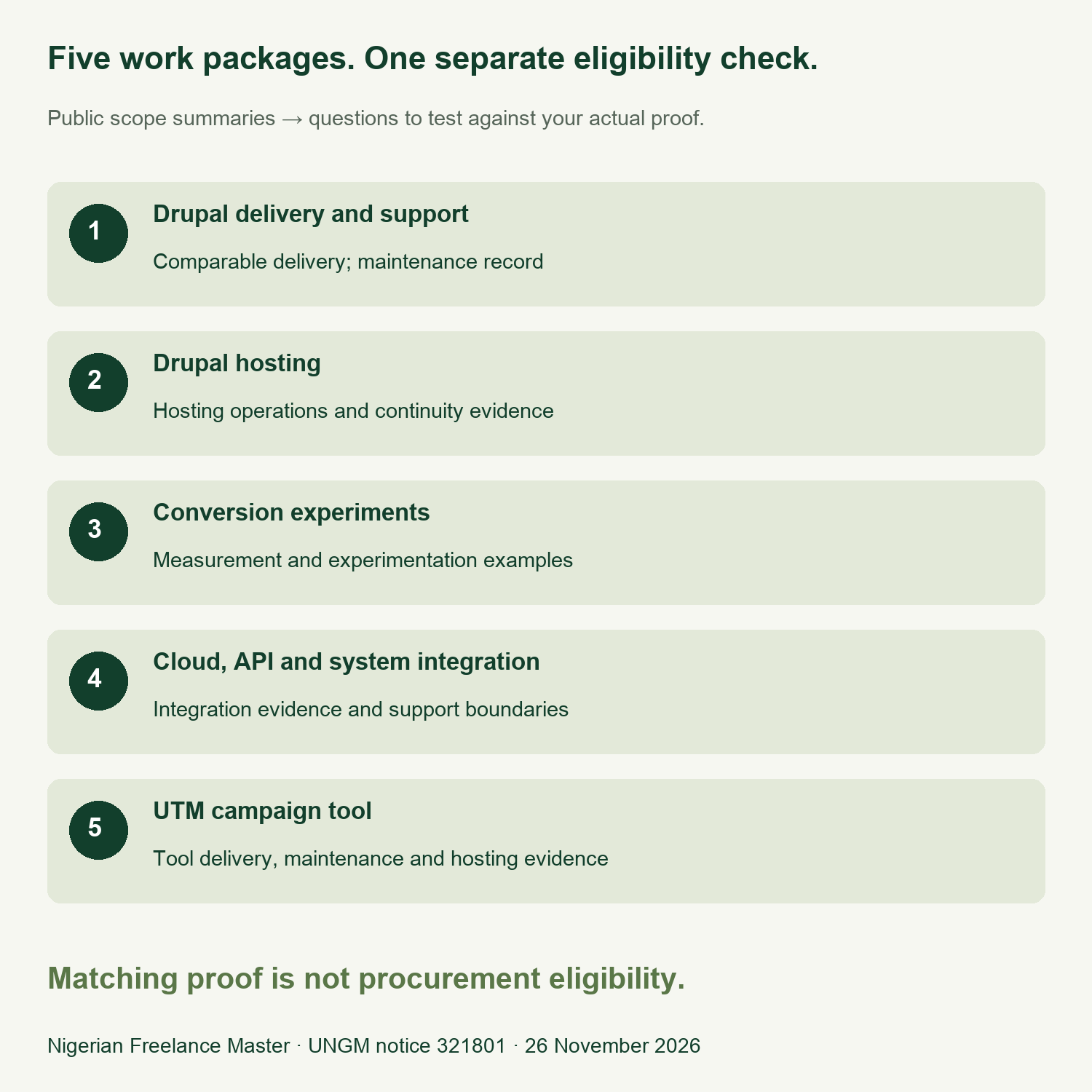
Start with one row per lot. Summarise the public work in plain language, then identify a project that genuinely supports your capability. Name your contribution, not just the client or technology. Keep confidential files out of the screen and use a permitted reference that you can explain if asked.
| Lot | Public work summary | Our suggested proof question |
|---|---|---|
| 1 | Drupal delivery and support | Comparable delivery; maintenance record |
| 2 | Drupal hosting | Hosting operations and continuity evidence |
| 3 | Conversion experiments | Measurement and experimentation examples |
| 4 | Cloud, API and system integration | Integration evidence and support boundaries |
| 5 | UTM campaign tool | Tool delivery, maintenance and hosting evidence |
A fictional team with a permitted API integration example might prioritise checking Lot 4. That example does not prove it can operate a Drupal hosting service. The team should record the mismatch rather than stretching one portfolio item across every lot. A useful screen can end in hold or no-go; it does not need to produce a bid.
Treat support capacity as a separate question
A successful build and an ongoing service are different commitments. For each relevant lot, ask what would happen after the initial delivery: who handles incidents, maintenance, documentation and handover? Do not invent a service level from the public title. Read the full requirement and compare it with capacity you can actually sustain.
Record a gap as an unresolved issue, not a hidden assumption. For example, one person may have strong integration experience but no confirmed backup for continuing support. The worksheet does not prescribe a consortium or subcontracting structure. Whether a structure is allowed, and what evidence it needs, belongs in the mandatory portal checks.
This also helps a team avoid double-counting people. If the same person supports several proposed lots, make that dependency visible. A capacity plan should explain the work you can cover under the actual requirements. It should not treat an impressive list of tools as a substitute for available people and a credible operating plan.
Verify mandatory requirements before deciding to bid
Use the mandatory-checks file to capture the exact permitted bidder type, eligibility requirements, lot conditions and submission format. Add the relevant document reference and a named internal owner. Leave the status unverified until there is a source-based answer. A general supplier registration step is not proof that a particular bid qualifies.
Keep financial assumptions separate as well. We infer no contract value, delivery location, award probability or guaranteed revenue. If the full package requires a financial or legal condition, ask an appropriate adviser about your own position. Do not quote from a guessed budget merely because the opportunity is international.
Before final submission, check that the team is using the same document version. Confirm the required files, channel and cutoff, then allow time to verify the receipt. Do not use this article as a replacement submission route. Only the buyer’s current instructions establish how a valid response must be delivered.
Download the five-lot screen and source audit
The public lot map and deadline file retain their source references. The blank bid screen has a row for each lot and defaults to hold while mandatory rules remain unverified. A separate requirements ledger captures evidence and ownership. These are editorial tools, not official tender documents or a completed assessment of your team.
- Public five-lot map and editorial proof prompts (CSV)
- Public deadline and revision audit (CSV)
- Blank five-lot bid or no-bid screen (CSV)
- Blank mandatory-requirements verification ledger (CSV)
Method and limits: public notice and revision metadata were checked on 26 November 2026. Attachment access did not yield readable Q&A content. One deadline chart is appropriate; the lot map is a separate explanatory infographic. No contract values, supplier outcomes or demand statistics are invented. The five rows reflect the listed work packages, not five jobs or five awards.
For a related distinction between a listing and real eligibility, read our remote freelance eligibility screen. More source-led tools appear in Research & Reports. Suggested citation: Nigerian Freelance Master, “UNHCR Digital Services Tender Nigeria: Screen the Right Lot”, 26 November 2026.