





A freelance internet outage in Nigeria raises a delivery question: how late can you switch connections and still confirm that the client received the full file? Waiting for a restoration notice is not a delivery plan. A useful cutoff comes from your own tested route and the time left before the agreed deadline.
This guide uses three local NCC incident records as context, then builds a clearly fictional 15:00 WAT delivery example. Two charts, a decision infographic and four CSV tools separate reported network events from your own upload test. The aim is a practical switch decision, with early communication and verified receipt.
Match the freelance internet outage context locally
The NCC website links to its public outage portal. The portal PDF checked on 26 November covers 19–26 November WAT. It includes an Airtel fibre-cut record in listed Anambra LGAs on 22 November and two MTN power records in listed areas of Kebbi, Sokoto and Zamfara on 23 November.
The selected durations are 2 hours 53 minutes 22 seconds, 3 hours 13 minutes and 1 hour 44 minutes. The first record lists USSD, SMS, voice and data; the two MTN records list SMS, voice and data. Keep the operator, service, locality and incident window together. A state label does not mean every connection in that state failed.
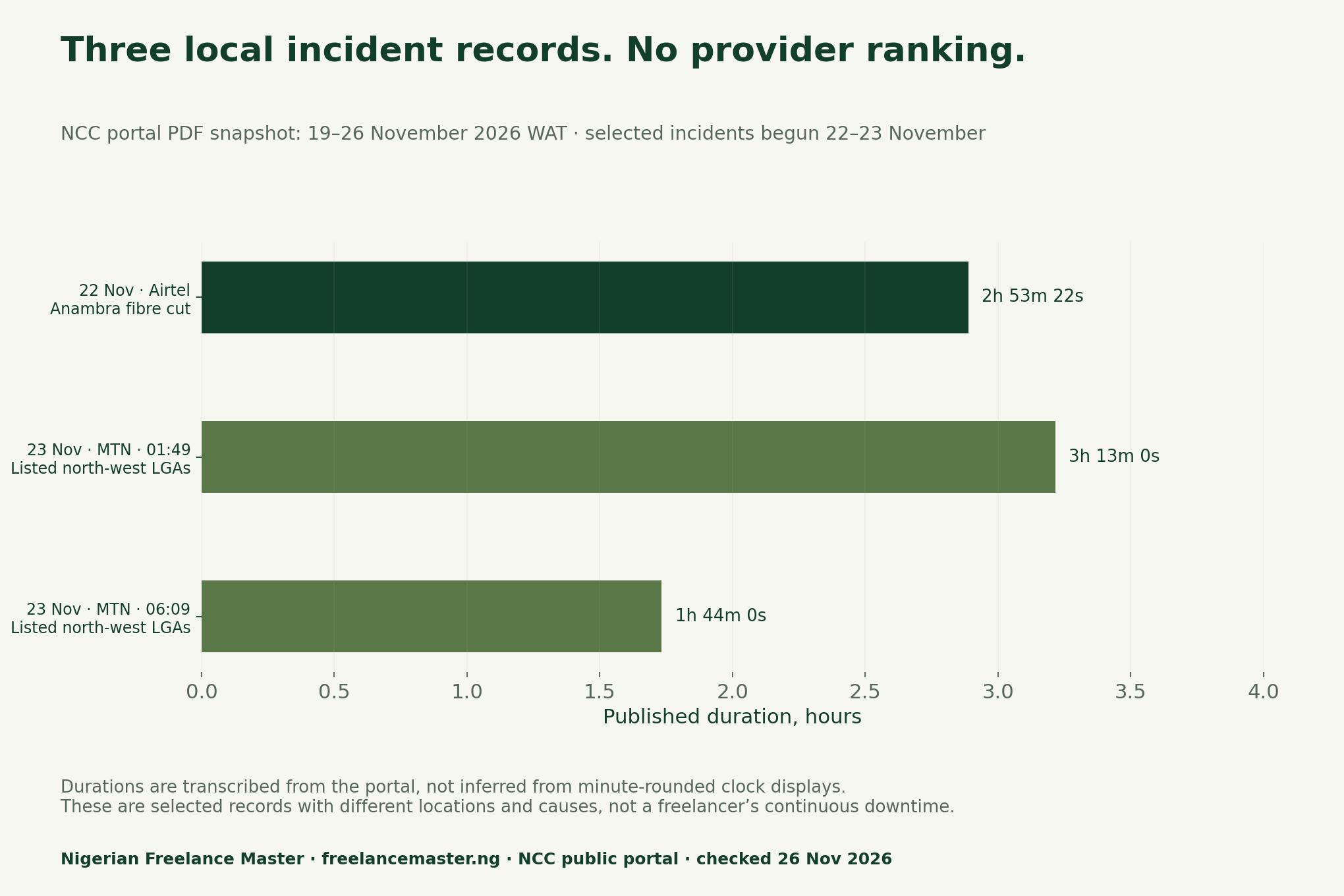
The current PDF’s window differs from the brief’s earlier 17–24 November snapshot. We retain the selected 22–23 November incidents and identify the actual source window used here. The downloadable source file also retains listed LGAs. We do not sum the rows into a national outage total or use them to rank providers.
Test an alternative before you need to rely on it
Run a non-client file through the delivery route you intend to use. Record its size, the power setup, the time needed to switch, upload duration and the receipt check. Use an approved destination and a harmless dummy file. Keep real client documents, account details and private delivery links out of a public demonstration.
A successful test is evidence about that test. It does not prove future performance or that two services have independent last-mile routes. A different provider name alone does not establish infrastructure independence. Record that uncertainty and ask a provider or client administrator where a technical answer is needed.
Repeat the drill when the file size, location or delivery method materially changes. If your observed times vary, keep the range visible and allow extra slack. Do not treat the fastest upload as the only possible outcome. The blank log leaves a field for limitations so you can preserve what the drill did not establish.
Calculate the switch cutoff from the receipt deadline
In our fictional example, the client needs the full file by 15:00 WAT. Switching takes 20 minutes, uploading takes 25 and verification needs 15. Subtracting all three gives a latest switch time of 14:00 WAT. These are invented inputs, not measured Nigerian upload performance or recommended universal allowances.
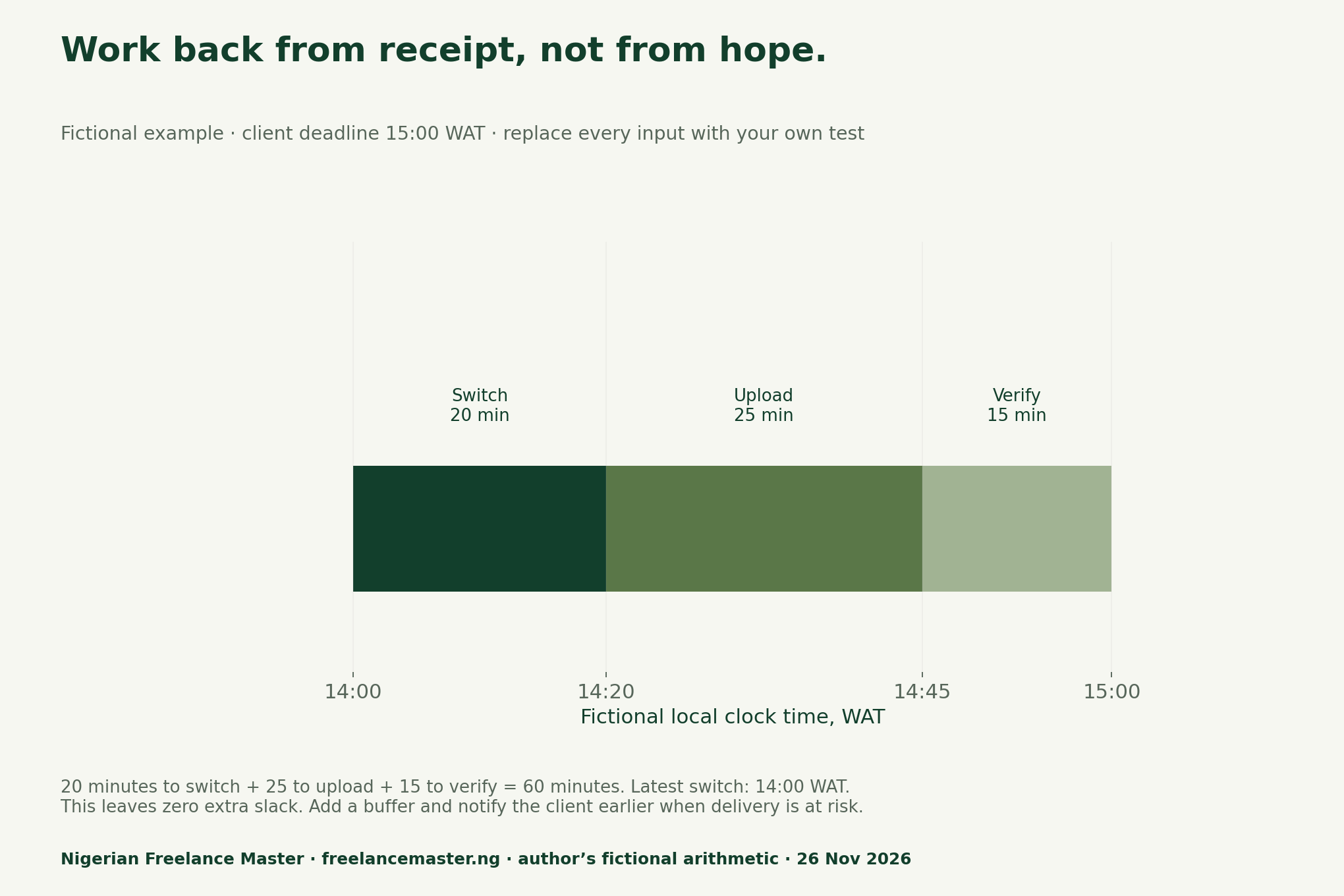
| Fictional activity | Duration | Planned window |
|---|---|---|
| Switch | 20 minutes | 14:00–14:20 WAT |
| Upload | 25 minutes | 14:20–14:45 WAT |
| Verify receipt | 15 minutes | 14:45–15:00 WAT |
If you reserve another ten minutes as a buffer, the latest planned start becomes 13:50 WAT. That is a sensitivity example, not a new measured input. The practical lesson is to include all remaining tasks. An upload that finishes at the deadline leaves no time to discover that the wrong version or an inaccessible link was sent.
Notify the client before the plan becomes impossible
Agree on the full-file channel and any fallback before an incident. A preview may help a client review progress, but it is not a substitute for the complete deliverable unless they accept it. Do not publish a confidential file or move it to an unapproved account simply because the normal route is slow.
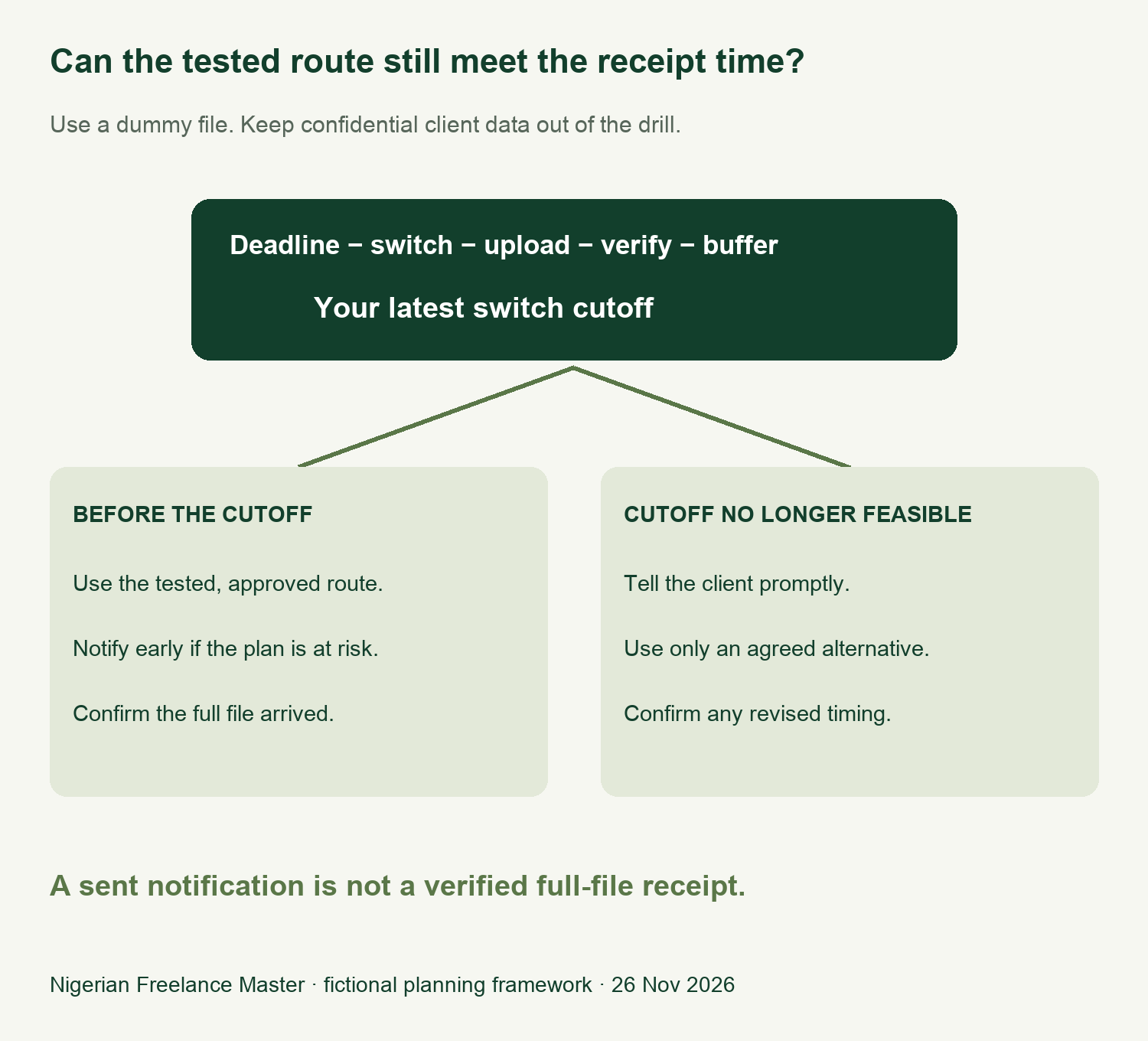
A useful risk message states the affected delivery, what you have checked and the next action you propose. Keep it factual. Do not promise restoration based on an unrelated incident record. If timing changes, obtain a clear acknowledgement and record the revised expectation. The client should not have to infer the status from a broken link.
Verify the complete file, version and access
Use the receipt-check period for the actual acceptance question. Confirm that the intended recipient can access the correct full file and that the version is the one you meant to deliver. A progress bar, sent email or upload notification may be useful evidence, but none alone answers all three questions.
Record the confirmation time and a private reference to the receipt. If access fails, explain the remaining issue and seek an approved remedy. Keep your public drill log free of client names and private URLs. The delivery checklist is designed to support a conversation, not to manufacture evidence that a client accepted work.
Download the incident audit and deadline tools
- Selected NCC local incident records and scope (CSV)
- Fictional deadline and switch calculation (CSV)
- Blank non-client upload and fallback drill log (CSV)
- Blank client delivery and receipt checklist (CSV)
Method and limits: sources checked on 26 November 2026. Incident durations are transcribed as published; minute-rounded clock endpoints do not reproduce every reported second. The fictional schedule uses 15:00 minus 60 minutes. Two charts answer distinct questions: source scope and delivery arithmetic. No live provider test, independent route verification or nationwide reliability measure is claimed.
For another source-led decision screen, see our digital-services tender lot guide. Browse Research & Reports for more reusable tools. Suggested citation: Nigerian Freelance Master, “Freelance Internet Outage: Set a Client Deadline Cutoff”, 26 November 2026.